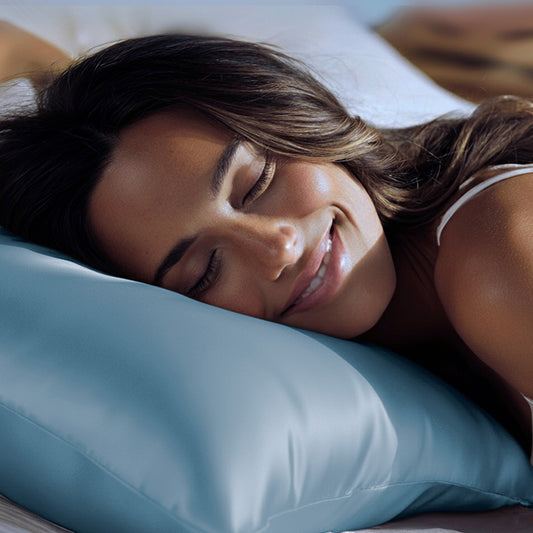
Your pillowcase is the most-used product in your beauty routine and the least examined. Still, everyone seems to forget that it touches your face and your hair for roughly a third of your entire life. Moreover, it absorbs whatever you put on your skin before bed, and it drags across your hair every time you roll over.
Now, silk has been the standing recommendation for years. You'll find that the claims range from reasonable to wildly oversold, and almost nobody separates the two.
So, let's do exactly that for you; then, let's talk about why BEDGEAR went a different direction with Hyper-Silk.
What a Silk Pillowcase Actually Does
Strip away the marketing and silk is doing one main thing: reducing friction. Silk filaments are long, smooth, and rounded. Cotton fibers, on the other hand, are short, staple-length, and microscopically ragged. When you look under a microscope, cotton looks less like a bedsheet and more like very fine sandpaper.
That difference matters because of what happens while you sleep. Most people shift position somewhere between ten and forty times a night (if you have a partner we almost guarantee you've noticed this). Every one of those movements drags your hair cuticle and your facial skin across the fabric underneath.
The bad news? On a rough surface, that drag creates mechanical stress; on a smooth one, things glide.
The second thing silk does is absorb a lot less. Cotton is a champion at wicking moisture, which is great for a towel and less great for a pillowcase.
Your leave-in conditioner, your night cream, your hair's natural oils; cotton pulls a share of all of it into the fabric instead of leaving it where you put it.
What the Science Says About Silk Pillowcase Benefits for Hair
Here's where most articles about silk pillowcase benefits stop being useful, and it's important to clarify this early on. The evidence is real, but it is not uniform, and pretending otherwise does nobody any favors.
Split it into three tiers and temper your expectations if you're looking for silk pillowcases as a cure-all for thinning, damage, or growth.
Well Supported: Friction Reduction
This one is measurable and has been measured. Textile researchers, including published work from TRI Princeton, have confirmed that the friction force between hair and silk is lower than between hair and cotton.
Independent lab testing commissioned by silk brands has landed in the same territory, with reported friction reductions in the 30 to 45 percent range against cotton.
Treat those specific percentages as brand-commissioned rather than peer-reviewed. The direction, though, is not in dispute. Lower friction against hair is the mechanism behind essentially every other benefit on this list, so it's worth noting.
Plausible, But Thinly Studied: Moisture and Product Retention
The claim goes like this: cotton wicks moisture, so it pulls your hair's natural oils and whatever you applied before bed into the fabric. A less absorbent surface leaves more of it on the strand. Dermatologists repeat this one often, and the material science behind absorbency is not controversial.
What's missing is controlled testing on hair specifically. Nobody has run a good trial measuring how much product ends up in a cotton pillowcase versus a smooth one overnight. The mechanism is sound and the effect is probably real; the size of it is a guess.
Weak: Hair Growth and Thickness
No pillowcase makes hair grow. Growth happens at the follicle, and a fabric lying against the shaft has no influence on that whatsoever. Any brand implying otherwise has left the evidence behind entirely.
There's a real version of this claim buried underneath, though. Reducing breakage helps you keep length you already grew, which is usually the actual bottleneck for anyone growing hair out.
That is retention, not growth, and the distinction matters.
5 Silk Pillowcase Benefits for Hair

Hair is where the evidence is strongest for silk sleep products, and where most people notice a difference the fastest!
Here's what a low-friction surface actually changes overnight. Stick around and enjoy the various benefits below.
Less Breakage on Fragile and Treated Hair
Every strand of hair has a cuticle layer, and mechanical friction lifts and chips away at it. Once that outer layer is compromised, the strand is far more likely to snap.
Hair that is fine, color-treated, bleached, relaxed, or heat-styled is already working with a weakened cuticle, so it has the least margin for extra abuse.
Testers who have put silk pillowcases through side-by-side trials consistently report fewer tangles and less visible damage, though breakage itself is notoriously hard to isolate and measure. Reducing overnight friction does not repair damage that has already happened.
What it does, though, is stop your bedding from contributing new damage every single night. And this is the part you actually control.
Fewer Tangles and a Shorter Morning Routine
Tangles form when strands catch on a rough surface and wrap around each other while you move. A smooth pillowcase gives them less to catch on, so hair tends to stay in the general arrangement you left it in.
The practical payoff is less aggressive brushing in the morning, which can save you time if you're rushing to make your commute goals. What's more, that matters more than it sounds; detangling wet or knotted hair is one of the most common sources of everyday breakage.
Frizz Stays Down Because the Cuticle Stays Flat
At the end of the night, frizz is largely a cuticle problem. When those overlapping scales are lifted and roughed up, light scatters instead of reflecting, and strands stop lying against each other neatly. Friction is one of the fastest ways to lift them.
Sleeping on a smoother surface keeps the cuticle flatter through the night, so keep that in mind. People with curly, coily, or wavy hair often notice this one within a few days, so it's worth giving it a shot if you've struggled to control your curls.
Who knows, maybe you'll finally get a good brush in the morning.
Your Products Stay in Your Hair
If you apply a leave-in, an oil, or an overnight mask and wake up to hair that feels drier than it did at midnight, some of that product is in your pillowcase. Cotton is absorbent by design; it does not distinguish between sweat and your expensive bond builder.
A less absorbent surface leaves more of what you applied where you applied it. You get the treatment you paid for instead of treating your bedding.
Styles and Curl Patterns Hold Longer
Blowouts, silk presses, braids, twist-outs, and defined curl patterns all lose shape through friction and mechanical disruption; a real hassle. Reduce the drag and the style survives more nights before it needs redoing. Now we're talking.
For anyone maintaining protective styles or stretching time between wash days, this is often the benefit that justifies the switch on its own. Fewer restyles also means fewer heat applications.
Those five benefits all trace back to the same variable, which is why the fabric you choose matters more than the number of products you layer on top of it.
Here's how the common options compare on the things that actually drive results.
| Fabric | Drag on Hair | Product Absorption | Care |
|---|---|---|---|
| Cotton | Highest; textured fibers catch the cuticle | High; pulls oils and leave-ins off the strand | Easy; machine wash and dry |
| Satin (polyester) | Low at first; climbs as the finish dulls | Low, but tends to hold heat against the scalp | Easy; low cost |
| Mulberry silk | Very low; the benchmark | Low | Delicate; gentle wash, air dry, snags easily |
| BEDGEAR Hyper-Silk® Vegan performance knit | Very low; friction-free and cool to the touch | Low; knit construction also moves air through | Machine washable; built for regular use |
Where Traditional Silk Falls Short
Silk earns its reputation on feel, and we understand that. It loses points everywhere else, and those tradeoffs are why plenty of people buy a silk pillowcase once and never replace it.
- Care is fussy: Gentle cycle, mesh bag, pH-neutral detergent, no fabric softener, air dry. Skip a step and the hand degrades.
- It snags: A rough fingernail, a zipper, an earring; woven silk pulls easily and pulls are permanent.
- It gets expensive: Quality mulberry silk runs high, and dermatologists recommend washing pillowcases often, which means you really want more than one.
- It slides: The same slickness that helps your hair also means the case wanders off the pillow overnight.
- Airflow is limited: Silk feels cool on contact, but a dense woven structure is not built to move air.
- It is an animal product: For anyone shopping vegan or cruelty-free, that ends the conversation.
None of that means silk is a bad product, and we want to be very clear on that.
Instead, it means the benefits people want are tied to a surface property, not to the silkworm; and if you can engineer that surface, you can fix everything on the list above.
How BEDGEAR Hyper-Silk Is Engineered Differently
That is exactly the bet behind our Hyper-Silk line. We're talking about a vegan, cruelty-free performance fabric engineered to outperform traditional silk on the things that actually determine whether you keep using it.
We start with the construction. Hyper-Silk is a knit rather than a woven, which means air circulates through the fabric instead of sitting on top of it. That keeps heat and moisture from building up against your head, and it is why the surface stays cool to the touch through the night.
Then, there's how it moves. The fabric is high-stretch, so it flexes with you as you shift positions instead of bunching or pulling away. Your hair stays in contact with a smooth surface all night, not just when you happen to be lying still.
And one of the best parts? It also stays put. A zip closure keeps the case locked onto the pillow rather than migrating toward the floor at 3am. And its machine washable, which matters more than any single spec on this page; the pillowcase you can wash twice a week is the one that actually helps your hair.

Hyper-Silk Performance® Pillowcase
Vegan Hyper-Silk® fabric with a friction-free, cool-to-the-touch surface that helps reduce frizz, hair breakage, and sleep lines caused by cotton and polyester. Breathable knit construction, high-stretch flex, secure zip closure, and machine washable. Available in Standard, Queen, and King.
Shop Hyper-Silk PillowcaseGetting the Most Out of Your Silk Pillowcase
Buying the pillowcase is the easy part. A few habits determine whether it earns its keep.
- Wash it often: Every two to three days is the target; once a week is the floor. Oils, sweat, and product build up fast on a surface your hair lives on.
- Skip fabric softener: It coats fibers and dulls the smooth surface you bought the thing for.
- Own more than one: A second case means the wash cadence above is realistic instead of aspirational.
- Never go to bed with wet hair: Wet strands are at their most fragile, and no fabric compensates for that.
- Loosen the tie: A tight elastic at the same spot every night creates a stress point the pillowcase cannot undo.
- Replace the pillow too: A flat, unsupportive pillow undercuts everything above it.
None of these are dramatic changes, though, so keep that in mind. Stacked together over a few months, though, and they're the difference between a nice pillowcase and a routine that actually shows up in the mirror.
Not Sure Where to Start?
The Beauty collection is built around one idea: the hours you are asleep should be working for your hair, not against it. Start with the pillowcase and build from there.
The Real Silk Pillowcase Benefits for Hair: Minus the Hype
The honest summary of silk pillowcase benefits for hair is narrower than the marketing but more useful to you as a consumer. A smoother surface reduces friction against the cuticle, and that reduction is well documented. And less friction means less breakage, fewer tangles, less frizz, and less of your leave-in ending up in your laundry.
What it does not do, though, is grow hair, thicken it, or undo damage already done. Any brand telling you otherwise is outrunning the evidence, and it's a bad look. Real silk pillowcase benefits for hair are meaningful and modest at the same time, which is a harder story to sell and a more accurate one.
At the end of the night, that is the reasoning behind Hyper-Silk. If the benefit comes from the surface rather than the fiber, then the right move is engineering a surface that is just as smooth while adding airflow, stretch, a closure that stays put, and a wash cycle you can actually keep up with. Vegan, cruelty-free, and built to survive the routine that makes it work.
FAQs
Still weighing whether a silk pillowcase is worth it for your hair? Here are the questions we get most.