Most people think of a blanket as, well, a blanket. You throw it on the bed, you sleep under it. But if you're a hot sleeper, the wrong blanket is one of the most disruptive things in your sleep setup. Unfortunately, most people never connect the dots between their bedding and how they're feeling in the morning.
A cooling blanket is a different category of product entirely. It's engineered to manage heat and moisture rather than just layer on top of them. Here's what that actually means, how the technology works, and whether you need one.
What Is a Cooling Blanket?
A cooling blanket is a blanket made with breathable, moisture-wicking fabrics and heat-dissipating construction to help regulate body temperature during sleep. It doesn't generate cold air or require any power source. What it does is manage what a standard blanket ignores: the heat and moisture that build up between your body and your bedding through the night.
Standard blankets are designed to retain heat. Sure, that's useful in cold weather, but it's a problem when your body is trying to cool down to reach deep, restorative sleep. The good news? This is where a cooling blanket really flips that equation. So, instead of trapping heat, it moves it. Instead of holding moisture against your skin, it wicks it away. The result is a sleep surface that stays closer to comfortable through the night. Plus, all this happens without any adjustment from you. Pretty cool, right?
That said, we know how all of this sounds coming from a bed company, so don't let us be the only ones to sit here and tell you this. In fact, research published in Sleep Foundation confirms that the bedroom environment (including temperature) is one of the most controllable variables in sleep quality. Your blanket is the layer closest to your body. It has the most direct influence on how hot or cool you sleep. If it's trapping heat, you're not sleeping in a neutral environment; you're fighting it. A cooling blanket is the fix for that specific problem.
How Do Cooling Blankets Work?
Two mechanisms do most of the work: thermoregulating fabrics and heat-conducting technologies. They're different approaches to the same goal, and in a well-built cooling blanket, they work together.
Thermoregulating Fabrics
Thermoregulating fabrics manage temperature by moving moisture away from the body. When you sleep, your body perspires; even when you're not sweating through your sheets, moisture builds at the surface of your skin. A standard blanket holds that moisture in place, whereas a thermoregulating fabric pulls it away; this keeps your skin drier and prevents the feedback loop where trapped moisture generates more heat.
Common thermoregulating materials include performance polyester blends, nylon weaves, and fabrics engineered specifically for moisture transport. The key quality to look for is breathability; the fabric needs to allow airflow, not just wick surface moisture. Luckily for hot sleepers, BEDGEAR's performance fabrics are built around this principle, using constructions that move moisture and promote airflow simultaneously rather than sacrificing one for the other.
Heat-Conducting Technologies
Where thermoregulating fabrics handle moisture, heat-conducting technologies handle the thermal side. A few different approaches exist; here's how each one works.
Phase Change Materials (PCMs)
Microcapsules embedded in the fabric that absorb body heat as they transition between states, releasing it away from the skin rather than letting it accumulate.
Gel-Infused Construction
Gel integrated into fabric or fill material absorbs heat on contact and disperses it. Commonly found in blankets designed for immediate cool-to-the-touch feel.
Airflow Channels
Structural construction that allows air to move through the blanket rather than stagnate. Prevents heat pockets from building at the sleep surface overnight.
Breathable Weave Structures
Open, lightweight weave patterns that allow body heat to escape through the blanket instead of reflecting back toward the sleeper. Common in performance blanket construction.
The most effective cooling blankets combine more than one of these approaches. A breathable weave that also uses a performance moisture-wicking face fabric, for example, handles both the thermal and moisture sides of the problem at once.
Do Cooling Blankets Actually Work?
Yes, don't worry, you can find a cooling blanket that really gets the job done. That said, the cooling blanket needs to be built around the right materials. Let us explain why.
First and foremost, your core body temperature needs to drop approximately 1 to 2°F to initiate and maintain deep, restorative sleep. That temperature drop is part of your body's natural circadian rhythm; it happens automatically, but it can be disrupted. A blanket that traps heat actively prevents that drop, so your body keeps trying to shed heat; the blanket keeps holding it in. Overall, the result is lighter sleep, more frequent waking, and less time in the deep stages where physical recovery actually happens.
Thankfully, a well-built cooling blanket supports that temperature drop rather than fighting it. It doesn't force your body to cool down; it removes the obstacle that was in the way. So, for hot sleepers especially, that removal alone produces a measurable difference in sleep quality.
A study published in the Journal of Physiological Anthropology found that ambient temperature is one of the most significant environmental factors affecting sleep quality and the progression through sleep stages. The difference between sleeping cool and sleeping hot isn't just about comfort; it's about recovery. Deep sleep is where the body repairs tissue, consolidates memory, and regulates hormones. A cooling blanket is one of the simplest ways to protect that window.
Who Needs a Cooling Blanket?
So, who actually needs one of these cooling blankets? Well, not everyone does. However, for certain sleepers, the right cooling blanket is one of the highest-impact changes they can make to their sleep setup. So, here is who genuinely benefits.
Hot Sleepers
If you regularly kick off your blanket at night or wake up overheated, you're fighting a thermal problem. A cooling blanket resolves it at the source.
Night Sweat Sufferers
Night sweats compound quickly; once you're damp and hot, sleep quality falls off fast. Moisture-wicking construction prevents the buildup before it starts.
Athletes and Active Recoverers
Body temperature runs elevated after training. A cooling blanket supports the temperature drop the body needs for the deep sleep where physical recovery happens.
Warm Climate Sleepers
If your bedroom doesn't cool down much at night, your bedding is doing all the thermal regulation. A cooling blanket makes that regulation active rather than passive.
Couples with Different Temperature Needs
One partner runs hot, one runs cold. A cooling blanket on one side solves the compromise problem without affecting the other side's setup.
Anyone Who Sleeps with a Standard Blanket Year-Round
Standard blankets are designed to retain heat. If you're using one in warmer months, you're sleeping under the wrong product for the conditions.
Hot Sleepers
Are you a got sleeper? Or just someone who wakes up in a puddle of sweat at night? Well. if you wake up at night with the blanket already kicked to the floor, that's not a quirk — it's your body making a decision your bedding forced on it. Hot sleepers run warmer than average throughout the night, which means a standard blanket actively works against them. The heat builds at the sleep surface, the body responds by waking or shifting, and the sleep cycle gets disrupted before deep rest can happen.
A cooling blanket addresses this by keeping the surface temperature manageable in the first place. Breathable construction and moisture-wicking fabrics prevent the heat buildup that triggers those disruptions. For a hot sleeper, it's the single most impactful bedding change available — ahead of sheets, ahead of pillows, ahead of adjusting the thermostat.
Night Sweat Sufferers
Are you someone who struggles with sweating deep into the night? Well, night sweats are different from simply sleeping warm. They're a physiological response that produces enough moisture to saturate bedding, and once that happens, the combination of dampness and heat creates a sleep environment that's genuinely difficult to recover from mid-night. Waking up soaked at 2am isn't a comfort issue; it's a recovery issue.
Moisture-wicking fabrics in a cooling blanket pull that moisture away from the skin before it saturates. The blanket stays drier, the sleep surface stays cooler, and the chain reaction that turns a mild sweat into a full wakeup gets interrupted before it starts. For chronic night sweat sufferers, this is one of the most practical interventions available without changing medication or room temperature.
Athletes and Active Recoverers
Exercise elevates core body temperature, and that elevation doesn't reset the moment your head hits the pillow. So, for athletes who train in the evening or whose training volume keeps their resting body temperature higher than average, falling into deep sleep takes longer — and happens less completely — than it should. The sleep stages where physical repair actually occurs require a sustained temperature drop that an overheated sleep environment prevents.
A cooling blanket supports that drop by removing one of the obstacles in the way. Paired with a breathable mattress and performance sheets, it's part of a system that gives athletes the recovery environment their training demands. BEDGEAR has worked with professional athletes across multiple sports on exactly this; the cooling blanket is a foundational piece of that sleep system.
Warm Climate Sleepers
In cooler climates, the bedroom naturally drops to a temperature that supports sleep. In warm climates, especially during summer months or in homes without strong air conditioning, that environmental assist disappears, and it actually makes things a lot worse. The bedroom stays warm, and whatever bedding you're sleeping under either compounds the problem or helps manage it.
For warm-climate sleepers, though, the blanket is carrying more thermal regulation load than it would in a climate-controlled environment. A standard blanket isn't built for that job. A cooling blanket is. The breathable construction and heat-dissipating materials do the work the ambient temperature isn't doing, keeping the sleep surface comfortable even when the room itself is running warm.
Couples with Different Temperature Needs
The thermostat compromise is one of the most common sleep friction points for couples, and hey, we get it. One partner sleeps cold, one sleeps hot, and whatever temperature they settle on leaves at least one of them uncomfortable through the night. The standard fix — one person sleeping with more blanket, one with less — doesn't actually solve the problem, though. Instead, it just distributes the discomfort.
A cooling blanket on the warmer partner's side changes the equation. They stay comfortable at a room temperature that doesn't freeze out the other person. No negotiation required, no separate bedroom solution, no 3am thermostat adjustments. The cooling blanket handles the thermal difference at the individual level rather than trying to solve it at the room level.
Anyone Using a Standard Blanket Year-Round
A standard blanket is designed for one job: retain heat. That's the right tool for cold nights and cold climates. It's the wrong tool for spring, summer, and any bedroom that doesn't fully cool down overnight. Most people keep the same blanket year-round out of habit rather than intention, without considering that the blanket engineered to keep them warm in January is actively working against them in July.
Switching to a cooling blanket for the warmer months — or year-round, if you're a consistent hot sleeper — is a straightforward upgrade. The sleep environment that felt fine in winter feels noticeably different once the heat has a layer of breathable, moisture-managing construction between it and your skin instead of a heat-retaining one.
How to Wash a Cooling Blanket
Cooling blankets are built around performance fabrics; how you care for them affects how long those fabrics perform. The good news is that most cooling blankets, including BEDGEAR's, are machine washable. A few care guidelines apply across the category.
Use a gentle cycle with cold water. Hot water can degrade performance fibers over time, reducing their moisture-wicking effectiveness. Tumble dry on low or air dry; high heat has the same degrading effect as hot water on technical fabrics. Skip fabric softener; softener coats performance fibers with a residue that blocks moisture transport. It makes the blanket feel softer in the short term but quietly kills the function that makes it worth owning.
BEDGEAR's Cooling Blanket is machine washable; always check the care label for specific instructions before the first wash. Keeping the care routine simple and avoiding the heat and softener pitfalls is all it takes to keep it performing.
BEDGEAR Cooling Blankets
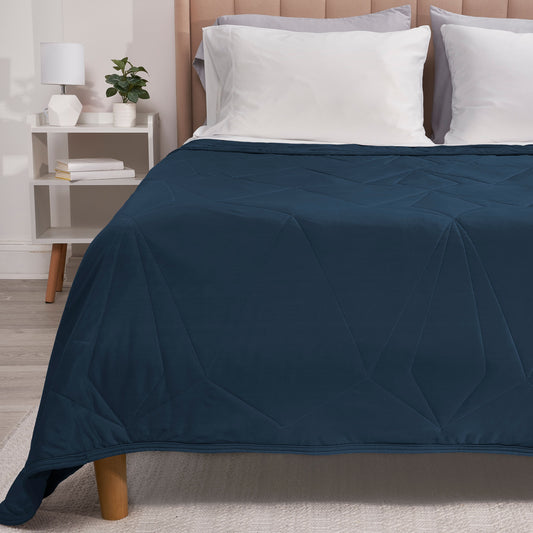
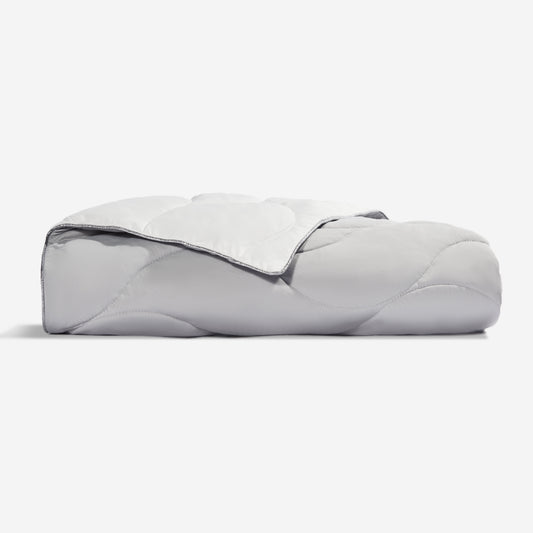
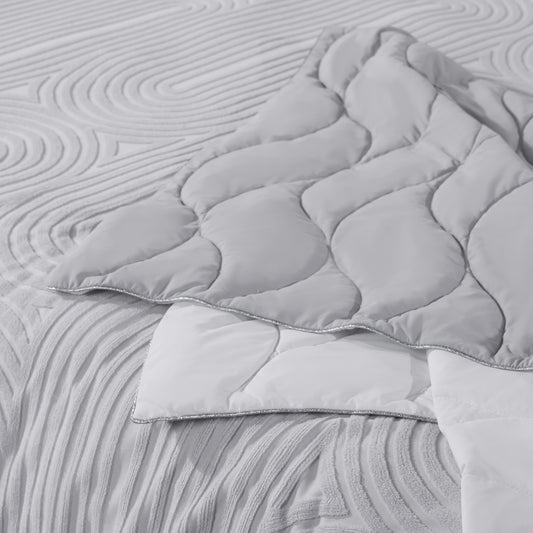
BEDGEAR builds its blankets around the same performance philosophy that runs through every product in the lineup: engineered for sleep, not just comfort. The BEDGEAR Cooling Blanket uses breathable, moisture-wicking construction to manage heat and humidity at the sleep surface. It's available in Queen and King and comes in Navy and Grey.
It's HSA/FSA eligible — worth noting if you've been treating sleep issues as a wellness priority rather than just a comfort one. Pairs well with BEDGEAR's Performance® Sheets for a fully breathable sleep surface from mattress to blanket. If you want to explore the full range of BEDGEAR blankets and comforters, the Performance® Blankets collection covers every sleep temperature need.
Build a Sleep System That Actually Runs Cool
From breathable sheets to performance blankets, BEDGEAR engineers every layer of the sleep system around the same goal: keep the sleep surface cool so your body can do its job overnight.
Don't Stop with a Cooling a Blanket: The Whole Sleep System Matters
A cooling blanket solves a specific problem: heat and moisture buildup at the sleep surface. It won't fix a mattress that traps heat, sheets that don't breathe, or a pillow that runs hot. But it is the layer most people overlook when they're trying to figure out why they sleep warm.
Start with the blanket. If that's where the heat is building, changing it produces an immediate difference. If you're still running hot after that, the answer is probably in the sheets or the mattress. The good news is that BEDGEAR builds every layer of the sleep system around breathability and performance; the cooling blanket is a strong starting point for anyone who's been fighting that problem without a clear fix.
Frequently Asked Questions
Have more questions about cooling blankets? Here are the answers to the most common ones.