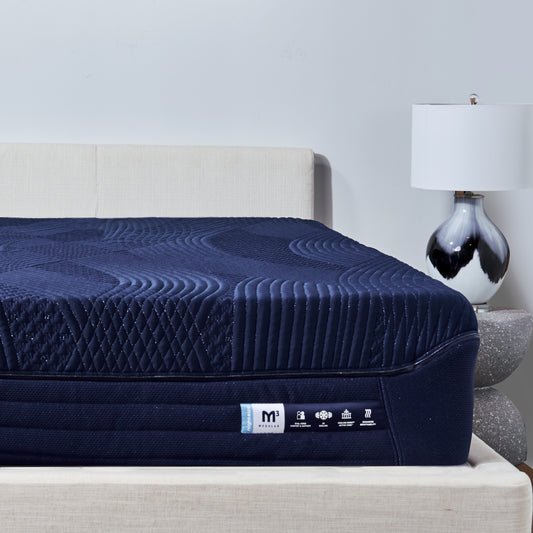
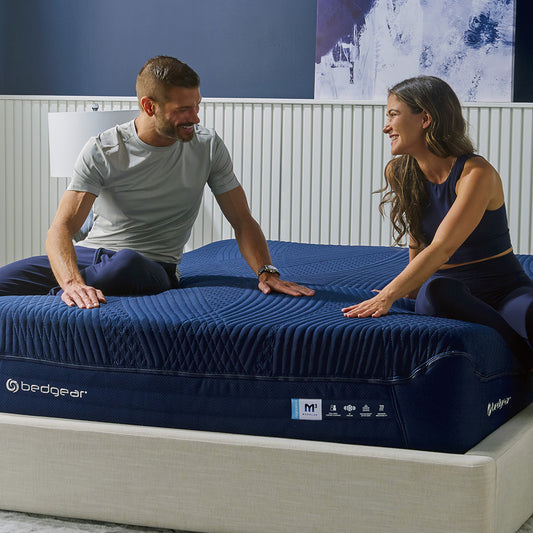
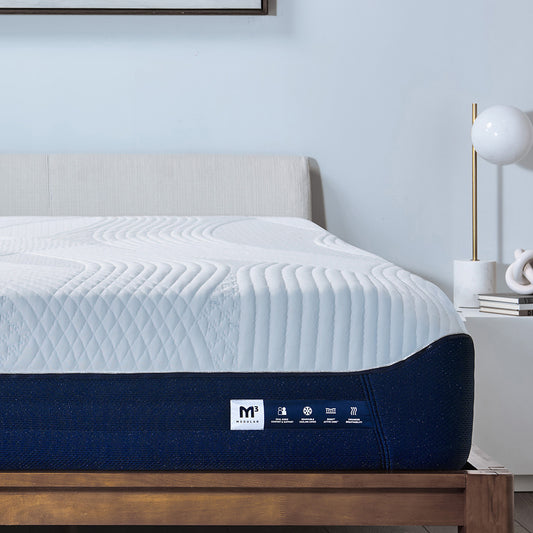
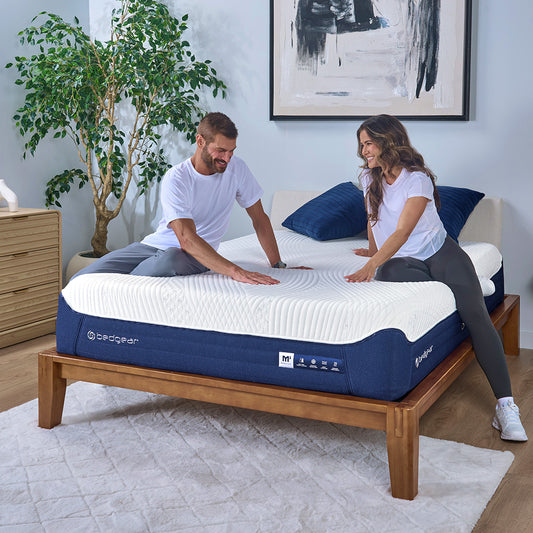
Buying a mattress has never been more complicated. Plus, it's never been more important. In fact, the category has expanded well beyond the spring mattresses most people grew up with. Today you're choosing between air-adjustable systems, viscoelastic foam, polymer grid technology, and hybrid coil construction. Each one has a story. That being said, not all of those stories hold up when you go looking for the details behind them.
So, who are the major players in the sleep game? And who should your mattress come from? Well, Sleep Number, Tempur-Pedic, and Purple are three of the most recognizable mattress brands in the country, but they've each built their reputation on a single defining technology. BEDGEAR, on the other hand, takes a different approach: a modular system built around individually wrapped coils, active airflow, per-side customization, and inside-out cleanability. Here's how the comparison plays out across every category that determines whether you actually recover overnight.
All Four Mattresses at a Glance
Before getting into the detail on each brand, here's a full side-by-side snapshot. Every category below is covered in full in the sections that follow.
The snapshot above tells most of the story. What follows is the full reasoning behind each category — so you can see not just what's different between these mattresses, but why those differences compound into a meaningfully better or worse sleep over time.
BEDGEAR vs. Sleep Number
Sleep Number built a category around a simple idea: let each sleeper pick their own firmness level with a remote. It's an appealing concept, and the marketing around it has been effective for years. The problem isn't the idea. It's the technology used to execute it.
Air is an inherently imprecise support medium. It moves, it leaks, and it doesn't distribute body weight the way solid materials do. The M3 starts from a different premise: steel coils, modular construction, and per-side customization that doesn't depend on inflating or deflating a chamber to get where you need to be.
Support Technology
Sleep Number's air chambers are adjusted by remote — inflate for firmer, deflate for softer. It works in principle. The challenge is that air under a body's weight doesn't stay evenly distributed. It just migrates toward the head and feet, leaving the midsection without the lumbar support it needs through the night. That's not a theory; it's the mechanical consequence of using a compressible fluid as a support medium under concentrated load.
The result shows up in the morning. Sleepers on air-based mattresses who wake up with lower back stiffness or hip soreness often assume it's the firmness setting, so they just adjust the number and move on from there. However, they're usually adjusting the wrong variable because the problem isn't the number; it's the material. Air can't hold neutral spinal alignment the way individually wrapped steel coils can.
The M3's Independent Suspension units contain hundreds of individually wrapped coils. Each one responds to the specific load applied above it. Heavier areas sink slightly; lighter areas stay elevated. That's body-mapped support; the spine stays in neutral alignment because the surface is responding to the body rather than the body adapting to the surface.
Customization and Couples
Both mattresses offer independent left and right sides. The difference is in how that customization is delivered and how reliably it holds. Sleep Number's remote-controlled adjustment is convenient — but air pressure changes over time, and a slow leak will shift your sleep number without any warning. You'll feel it as degraded support before you identify the cause.
The M3's customization is physical and permanent. You choose a firmness level from 0.0 (firm) to 3.0 (plush) by selecting the Independent Suspension unit that matches your preference. That unit goes in, and it stays exactly where you set it — no remote required, no recalibration, no overnight drift. When preferences change significantly, the unit swaps out. It's a more deliberate process, but it's also a more reliable one.
For couples with very different sleep needs, the M3 delivers true independence. Each side of the bed has its own unit. Partner movement is isolated by the individually wrapped coils, which means movement on one side doesn't transfer to the other. That's something air chambers, which share a common base, are fundamentally limited in achieving.
Temperature
Sleep Number's air chambers are plastic. Plastic doesn't breathe. For hot sleepers, that's a significant problem — body heat builds at the sleep surface, has nowhere to go, and the result is a warmer night than the foam and fabric layers above the chambers can compensate for. The mattress can feel comfortable in the showroom and noticeably warm after a few weeks of actual use.
The M3 is engineered for airflow at every layer. The Ver-Tex cooling cover pulls heat away from the body on contact and continues to refresh throughout the night. The Air-X chassis and built-in air vents create cross-ventilation inside the mattress. The individually wrapped coils are each encased in breathable fabric, so air moves between them rather than pooling. There's no insulating plastic anywhere in the construction.
BEDGEAR M3 vs. Sleep Number: How They Compare
Steel coils, active airflow, and true per-side independence versus air chambers that shift, insulate, and require ongoing calibration. Here's the full breakdown.
| Category |
BEDGEAR M3Winner
|
Sleep Number |
|---|---|---|
| Support Tech | Individually wrapped steel coils; body-mapped pressure relief | Inflatable air chambers; shifts under body weight |
| Spinal Alignment | Coils maintain neutral position regardless of sleep position | Air migrates toward head and feet; midsection support inconsistent |
| Per-Side Customization | Swappable units, 0.0–3.0; no drift over time | Remote-controlled; convenient but subject to pressure changes |
| Motion Isolation | Individually wrapped coils contain movement per side | Air movement transfers across shared base |
| Temperature | Ver-Tex cover + Air-X vents + breathable coil wrapping | Plastic chambers insulate heat; no active airflow system |
| Reliability | No mechanical parts to fail; no leaks | Air chambers develop slow leaks; remote systems require maintenance |
| Cleanability | Machine-washable covers; deep clean inside the mattress | Cover washable only; interior inaccessible |
| HSA/FSA | Eligible | Eligible |
Sleep Number's remote-controlled adjustability is a compelling feature until you examine what's actually happening under the surface. Air shifts, leaks, and insulates. Steel coils hold, breathe, and isolate. For couples who want true independent customization without the mechanical complexity of an air-based system, the M3 is the more reliable answer.
BEDGEAR M3 vs. Tempur-Pedic
Tempur-Pedic is the most recognized name in premium mattresses. Their TEMPUR material — a proprietary viscoelastic foam developed from NASA pressure-absorption research — genuinely changed how the industry thought about pressure relief. That legacy is real. It's also the source of Tempur-Pedic's most significant limitation.
Memory foam and heat retention are structurally inseparable. The material that makes Tempur-Pedic mattresses feel like they're conforming to your body is the same material that traps your body heat through the night. Cooling treatments and gel infusions help at the surface; they don't solve the underlying thermal physics. The M3 approaches temperature from a fundamentally different direction.
The Memory Foam Heat Problem
Tempur-Pedic's cooling story has evolved considerably over the years. The brand now offers cooling covers, SmartClimate systems, and TEMPUR-Breeze models designed to address the heat retention that became one of the most common complaints about memory foam mattresses. These additions help — particularly the Breeze lineup, which uses phase-change materials to absorb heat at the surface.
The limitation is that these are surface interventions applied to a core material that is still, fundamentally, a dense foam structure with limited internal airflow. A cool-to-the-touch cover addresses what you feel when you first get into bed. It doesn't change what happens two or three hours later when body heat has built up through the layers below. Memory foam absorbs and retains heat from your body as part of its pressure-contouring mechanism. You can't fully decouple those two properties with a cover treatment.
The M3's thermal management is structural rather than supplemental. Ver-Tex technology at the cover level refreshes continuously rather than absorbing heat passively. Air-X chassis fabric and built-in air vents create active cross-ventilation inside the mattress itself. The individually wrapped coils are breathable by design — open space between them allows air to circulate through the support layer rather than pooling. There's no dense foam core creating a thermal mass problem to solve in the first place.
Pressure Relief Without the Trade-Off
Memory foam's pressure relief credentials are genuinely strong. The material conforms to the body's shape, distributes weight across a broad surface area, and reduces concentrated pressure at the hips and shoulders. For side sleepers especially, that contouring is meaningful — it keeps the spine level by allowing the heaviest contact points to sink slightly rather than pushing back.
The M3 delivers pressure relief through a different mechanism. Individually wrapped coils respond independently to the load applied directly above them. Under the hip, they compress more; under the lower leg, they stay extended. The result is contoured support that follows the body's shape without the foam's thermal penalty. You get the pressure distribution without the heat buildup — and without the motion transfer that even dense foam can transmit when a partner shifts position.
Personalization
Tempur-Pedic mattresses are fixed-construction products. You choose your model and your firmness level at purchase, and that's what you sleep on for the life of the mattress. If your sleep position changes, if your body changes, or if you start sharing the bed with a partner who needs a completely different feel — you're looking at a new mattress.
The M3's modular design addresses this directly. Comfort preferences change; the mattress changes with them. Swap the Independent Suspension unit on either side and the feel changes. No new mattress required. For a product category where a single purchase is supposed to serve you for a decade or more, that adaptability is a meaningful long-term advantage over fixed-construction foam.
BEDGEAR vs. Tempur-Pedic: How They Compare
Memory foam's pressure relief is real. So is its heat retention. Here's how the two mattresses stack up once you account for both sides of that equation.
| Category |
BEDGEAR M3Winner
|
Tempur-Pedic |
|---|---|---|
| Temperature | Structural airflow; Ver-Tex cover refreshes continuously | Dense foam retains heat; surface treatments are supplemental |
| Pressure Relief | Body-mapped coil response; distributes weight without heat penalty | Strong — TEMPUR material is a genuine pressure relief standard |
| Motion Isolation | Per-coil independence; movement contained to point of contact | Excellent — dense foam absorbs and contains movement effectively |
| Customization | Swappable per-side units; adapts as needs change | Fixed construction; firmness set at purchase |
| Couples | Independent sides with full motion isolation between them | Single construction; no per-side adjustment |
| Cleanability | Machine-washable covers; inside-out deep clean access | Cover washable; foam interior cannot be cleaned |
| Longevity | Modular; individual components replaced as needed | Durable construction; not modular |
| HSA/FSA | Eligible | Not eligible |
Tempur-Pedic's pressure relief and motion isolation are legitimately strong. The heat retention problem is equally legitimate, and surface-level cooling treatments don't fully resolve it. The M3 delivers comparable pressure relief and superior motion isolation with an airflow architecture that doesn't require supplemental fixes — and adds per-side customization that memory foam construction fundamentally can't offer.
Not Sure Which M3 Configuration Is Right for You?
BEDGEAR's sleep experts are trained to match each sleeper to the right Independent Suspension unit based on sleep position, body type, and how you've slept on your current mattress. No upsell — just the right configuration.
BEDGEAR vs. Purple
Purple introduced something genuinely new to the mattress category: a hyper-elastic polymer grid designed to flex under pressure points while remaining firm everywhere else. The GelFlex Grid is a real innovation — it provides pressure relief and better airflow than traditional foam, and it has a distinct feel that many sleepers prefer on first contact.
The limitations become apparent over time. The grid is a fixed structure. It can't be adjusted. And like any polymer material subject to regular compression, it changes over time in ways that affect how it performs. The M3 addresses both of those issues before they become problems.
The Grid vs. The Coil
Purple's GelFlex Grid works by buckling at the columns under pressure points, allowing the body's heaviest areas to sink through while the surrounding grid provides support. It's an elegant mechanism. In practice, it provides excellent pressure relief and better airflow than foam — the open grid structure allows air to pass through in ways that dense foam cannot.
The M3's individually wrapped coils achieve a similar outcome through different physics. Each coil responds independently to the load above it — compressing under heavier areas, staying extended under lighter ones. The result is body-mapped support that follows the sleeper's shape without the buckling mechanism of the grid. Where the grid provides binary response (buckle or don't), coils provide continuous, proportional response across the full range of pressures a sleeping body applies.
The practical difference shows up most clearly in spinal alignment. The M3's coil response is gradual and proportional; the spine stays in neutral position because the support surface is meeting the body at every point along it. The grid's buckling behavior can create zones of high compliance adjacent to zones of firm support, which some sleepers experience as an inconsistent feel rather than a graduated one.
Customization and Long-Term Fit
Purple's mattresses come in different firmness levels, and their hybrid models layer the grid over coil support. What they don't offer is per-side customization. You choose your feel at purchase, and both sleepers on that mattress share the same grid. For couples with different firmness preferences, that's a real constraint — and one that doesn't resolve without buying a different mattress or going to a split configuration.
The M3 is built for exactly this situation. Each side of the bed has its own Independent Suspension unit, chosen independently from the full firmness range. Partners don't compromise; they each get the surface that matches their body and sleep position. And when those preferences change, which they do, over a decade of sleeping on the same mattress, the units swap out rather than the whole mattress.
Durability and the Sag Problem
Purple's grid is a hyper-elastic polymer, so it's designed to compress and recover repeatedly. For the early years of a mattress's life, it does this well. Over time, however, polymer materials fatigue under regular compression. The grid walls that buckle under pressure begin to buckle more easily; the feel that was firm around the pressure points becomes softer across a broader area. This is the sag problem, and it's not something that's unique to Purple, but the grid structure makes it particularly noticeable when it begins because the whole value proposition of the mattress is the precision of the grid response.
The M3's steel coils don't fatigue the same way. Steel under compression within its elastic limit returns to its original shape reliably over a much longer period than polymer. And when a component of the M3 does wear — a cover, a comfort layer — it's replaceable. You're not replacing the mattress; you're replacing the part that's worn. That's a fundamentally different relationship with the product over time.
BEDGEAR M3 vs. Purple: How They Compare
Grid technology and coil technology each have real merits. Where they diverge matters more the longer you own the mattress.
| Category |
BEDGEAR M3Winner
|
Purple |
|---|---|---|
| Support Mechanism | Individually wrapped coils; continuous proportional response | GelFlex Grid; buckling mechanism under pressure points |
| Pressure Relief | Body-mapped coil response across full sleep surface | Strong — grid buckles cleanly at pressure points |
| Airflow | Ver-Tex cover + Air-X chassis + coil ventilation | Open grid structure allows good airflow; better than foam |
| Per-Side Customization | Independent units on each side; full firmness range per sleeper | Single construction; no per-side adjustment |
| Couples | True independence; each side set and maintained separately | Shared grid; both sleepers on the same feel |
| Long-Term Durability | Steel coils maintain response; modular parts replace as needed | Polymer grid fatigues over time; sag becomes noticeable |
| Cleanability | Machine-washable covers; inside-out deep clean access | Cover only; grid and foam layers inaccessible |
| HSA/FSA | Eligible | Eligible |
Purple's grid is a genuine innovation with strong pressure relief and better airflow than foam. The limitations are customization and longevity. The grid can't be adjusted per side, and polymer fatigue eventually changes how it performs. The M3 matches the pressure relief and airflow with coil technology that holds up longer, adjusts independently for each sleeper, and replaces by component rather than whole mattress when anything wears.
What Sets the M3 Apart from Every Competitor
Comparing the M3 to Sleep Number, Tempur-Pedic, and Purple separately is useful. But stepping back and looking at the full picture makes the M3's engineering advantage clearer. Each competitor owns one category strongly. Sleep Number owns adjustability — conceptually, if not always in execution. Tempur-Pedic owns pressure relief and motion isolation. Purple owns innovative material science and a genuinely differentiated feel. None of them owns all three simultaneously, and none of them addresses the durability and cleanability gaps the way the M3 does.
Modular Construction Is a Long-Term Advantage
Most mattresses are sealed systems. When something wears out — a comfort layer compresses, a cover frays, the support loses its original response — you replace the mattress. That's an expensive solution to what is often a partial problem. The M3 is designed to be taken apart. Covers unzip and go in the washing machine. Independent Suspension units swap when firmness preferences change. Individual components replace rather than the whole system. Over a ten-year ownership window, that architecture saves money, reduces waste, and keeps the mattress performing closer to its original condition for longer.
Inside-Out Cleanability
Every mattress accumulates dust, allergens, and biological material over time. Most mattresses seal that material in permanently. The M3 is the only mattress on the market you can clean from the inside out. Unzip the Ver-Tex cover. Unzip the comfort layer. Vacuum inside. Wash the covers. The interior stays clean in a way that no other mattress — not Sleep Number, not Tempur-Pedic, not Purple — can claim. For allergy sufferers, that's not a minor differentiator. It's a fundamentally different product.
Sustainability Built Into the Design
BEDGEAR's Eco-Drive sustainability mission is reflected in how the M3 is constructed. No latex foam, no poly-batting, no glue layers, no bound edges. Every component is designed to be replaced, recycled, or upcycled. The modular architecture means fewer mattresses in landfills — individual parts fail and get replaced; the whole system doesn't get discarded. Air chamber systems, dense foam, and polymer grids don't share that design philosophy.
Frequently Asked Questions
Common questions about the BEDGEAR M3 compared to Sleep Number, Tempur-Pedic, and Purple, answered.
How Does the BEDGEAR M3 Compare to Sleep Number?
How Does the BEDGEAR M3 Compare to Tempur-Pedic?
How Does the BEDGEAR M3 Compare to Purple?
What Makes the BEDGEAR M3 Different from Other Mattresses?
Is the BEDGEAR M3 HSA/FSA Eligible?
BEDGEAR M3 vs. Sleep Number, Tempur-Pedic, and Purple: The Bottom Line
Comparing the BEDGEAR M3 against Sleep Number, Tempur-Pedic, and Purple makes one thing clear: each competitor has a strong story in one category, and we respect that. Overall, Sleep Number leads on the concept of adjustability, Tempur-Pedic leads on pressure relief and brand authority, and Purple leads on material innovation and a genuinely different feel. That said, none of them owns the full picture.
The good news? Our M3 mattress does. Steel coil technology that delivers body-mapped support and motion isolation that air and foam can't replicate, structural airflow engineering solves the temperature problem from the inside out rather than patching it at the surface, and swappable Independent Suspension units give each sleeper a fully personalized surface without compromise. What's more, modular construction means the mattress adapts as needs change and replaces by component rather than whole unit. Finally, inside-out cleanability means it stays genuinely hygienic in a way no sealed mattress can.
If you're taking your sleep seriously, the M3 is built for exactly that. Air chambers, memory foam, and polymer grids each had their moment. This is what comes next.