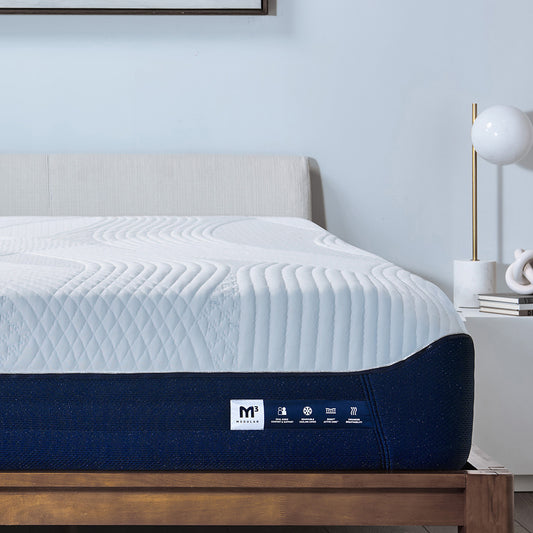
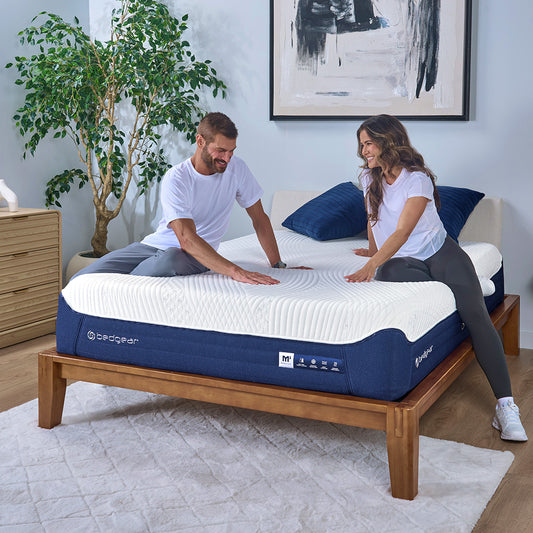
Most people spend more time picking a mattress cover than thinking about what's actually inside. That's understandable, sure, but the coil system isn't exactly front-page stuff. However, it's one of the most important variables in how a mattress performs, and the difference between a connected coil system and a pocket coil system shows up every single night.
In fact, the two systems work in fundamentally different ways. One treats the mattress as a single unit; the other lets each coil respond on its own. That distinction drives everything else. This includes motion transfer, airflow, support, and how well the mattress holds up over time. To help you sort through all the noise, we have your back with this comprehensive guide. So, stick around and find out what you actually need to know.
What Are Connected Coils?
So, what are connected coil systems? Connected coils. also known as Bonnell coils or offset coils depending on the shape, are exactly what they sound like. The individual springs in the mattress are physically linked together by a wire helical system that runs across the top and bottom of the coil unit. They function as a network, not as independent parts.
The design has been around for well over a century. It was the dominant spring system in mattresses for most of the 20th century, and it's still used in lower-cost mattress constructions today. And hey, we get it, the appeal is simple: it's inexpensive to manufacture and provides consistent, firm support across the entire surface.
How the Interconnected Design Works
When you press down on one part of a connected coil mattress, you're not just compressing that single coil. You're compressing the entire network, so the helical wire transfers force laterally across the system, which means adjacent coils respond whether or not there's any weight on them. The mattress moves as a whole.
For a single sleeper who doesn't move much, this isn't necessarily a dealbreaker, and it's probably just fine. On the other hand, for anyone sharing a bed, or anyone whose sleep position changes through the night, that connected movement creates real problems. But don't worry, we'll have more on that shortly.
Where Connected Coils Show Up (and Why They've Stuck Around)
Connected coils are most common in entry-level innerspring mattresses, and there's nothing wrong with that. The manufacturing cost is lower, the coil count is typically lower, and the construction is simpler. That keeps the price point accessible, which is why the design persists, and like we said, that's not a bad thing at all.
connected coils are also found in some older hotel mattresses and institutional sleep environments where cost drives the decision more than performance. Therefore, if a mattress feels bouncy in a way that transfers movement to the other side of the bed, connected coils are almost always the reason.
What Are Pocket Coils?
Now, let's move on to the good stuff: the pocket coils, which are our favorites here at BEDGEAR. First things first; Pocket coils — sometimes called pocketed coils or individually wrapped coils — take a different approach entirely. Instead of linking springs together into a shared network, each coil is wrapped in its own fabric pocket. They sit next to each other, but they don't connect. When one compresses, the ones beside it don't move unless there's direct weight on them too.
The result is a coil system that responds to the body on a much more granular level. Heavier parts of the body get more compression; lighter parts get less. The surface adapts to the sleeper rather than treating every part of the bed the same way. For couples? Good luck finding a better sleep system.
Independent Coil Movement, By Design
The fabric enclosure around each coil does two things. It lets the coil compress and extend without pulling on its neighbors, and it dampens the vibration that would otherwise travel laterally through a connected system. Those two properties — independent movement and vibration absorption — are what separate pocket coils from everything that came before them.
It's a meaningful engineering difference, not a marketing one. The physics are straightforward: isolated springs can't transmit force to adjacent springs the way a wired network can. That's not a feature anyone invented; it's just how the mechanics work.
Why Hybrid Mattresses Use Pocket Coils
Pocket coils became the standard for hybrid mattress construction for a simple reason: they work with foam comfort layers, not against them. A connected coil system pushes back against the body uniformly; foam layers on top of that surface still have to fight the underlying spring tension across the entire grid. Pocket coils compress where the body applies pressure and stay neutral everywhere else, which lets the foam above do its job — contouring, pressure relief, temperature management — without interference from below.
Every BEDGEAR Performance® Mattress is built on this foundation. The pocket coil system underneath isn't an afterthought; it's what makes the rest of the construction work.
Motion Transfer in Pocketed Coil and Connected Coil Mattresses
Motion transfer is the most immediately noticeable difference between the two coil systems — and for couples, it's often the deciding factor. It's exactly what it sounds like: when one person moves on the mattress, how much of that movement does the other person feel?
With a connected coil system, the answer is: a lot. With a pocket coil system, the answer is: almost none.
The Ripple Effect of a Shared Coil System
When a connected coil mattress absorbs movement, that force has nowhere to go except through the wire network connecting every spring in the bed. A partner rolling over at 2am sends a wave across the entire sleep surface. It's not subtle, and it's something you can really fix without addressing the issue at the source. So, you end up with a mattress that behaves more like a trampoline. Any pressure applied in one spot creates tension and movement everywhere else.
For light sleepers, that's a real problem. Sleep disruption doesn't have to fully wake you to do damage. Micro-arousals — brief moments where the brain shifts out of deep sleep without reaching full consciousness — still reduce sleep quality and recovery. A mattress that transmits partner movement is generating those disruptions every time the other person shifts position.
How Pocket Coils Isolate Movement
Because each pocket coil is mechanically independent, movement on one side of the bed doesn't travel to the other. The coil compresses, the fabric absorbs the lateral vibration, and the surrounding coils stay still. The physics don't allow the force to transfer the way it does through a wired network.
This is one of the clearest performance differences between the two systems — and it's measurable, not subjective. BEDGEAR's pocket coil construction keeps motion contained to where it originates. For anyone sharing a bed with a partner who has a different sleep schedule, or who simply moves more through the night, that containment is the difference between interrupted sleep and uninterrupted recovery.
Individually Wrapped Coils vs Connected Coils: Airflow and Temperature
Most people think of temperature regulation as a foam problem. The reality is that the coil system underneath plays a significant role too — and connected coils and pocket coils handle airflow very differently.
A mattress that traps heat disrupts sleep. The body needs to drop its core temperature to enter and maintain deep sleep stages. When the sleep surface works against that process, the result is lighter sleep, more frequent waking, and less recovery overnight. The coil system is part of that equation.
How Coil Structure Affects Heat Buildup
Connected coil systems are built as a dense, wired unit. The helical wire connecting each spring fills the space between coils and reduces the open airflow channels running through the mattress. There's less room for air to circulate, and the metal-on-metal contact points in the wire network can conduct and retain heat through the night.
It's not the primary reason connected coils underperform — but it's a real one. A mattress that already has motion transfer issues and limited targeted support is also compounding the problem with reduced breathability. The issues stack, so good luck staying cool at night.
The Airflow Advantage of Independent Pocket Coils
Individually wrapped pocket coils create a fundamentally more open internal structure. Because each coil stands independently without connecting wire running between them, there are natural air channels throughout the coil layer. Heat and moisture can move through the mattress rather than building up inside it.
BEDGEAR builds on that structural advantage with breathable mesh borders, ventilated foam layers, and performance fabric covers designed to support the body's natural temperature drop. The pocket coil foundation makes all of that possible. A connected coil system underneath the same materials would close off the airflow those features depend on.
Pocketed Coils vs Connected Coils: Support and Spinal Alignment
Support and temperature are related problems. Spinal alignment is a different one, and it's where the gap between connected coils and pocket coils is most consequential for how your body actually feels in the morning.
A mattress that keeps your spine in neutral alignment through the night lets your muscles switch off. One that doesn't, well, it keeps them partially engaged, compensating for a surface that isn't doing its job. You wake up stiff, sore, and less recovered than you should be, and most people blame it on anything except the mattress.
The Problem with One Surface Moving as One
A connected coil system responds to the body as a single unit. It can't apply more support under the hips and less under the shoulders; it applies the same resistance across the entire surface. That's fine if every part of your body needed the same amount of support — but it doesn't. The hips and lower back are heavier and need more; the shoulders need give to stay in line with the rest of the spine.
When a connected system pushes back uniformly, heavier areas sink too deep and lighter areas don't sink enough. The spine bows in one direction or another depending on sleep position. Muscles that should be resting are instead holding the body in position all night. That's not recovery; that's work.
Zoned Response and What It Actually Means for Your Back
Pocket coils compress in proportion to the weight applied directly above them. More weight means more compression; less weight means less. That variable response is what creates zoned support, so the mattress naturally provides firmer resistance under heavier body zones and softer give under lighter ones, without any engineering beyond the physics of independent coils.
For back sleepers, that means consistent lumbar support without the hips sinking out of alignment. For side sleepers, it means the shoulder can compress into the surface while the waist stays supported. BEDGEAR's pocket coil construction delivers that zoned response as a baseline; the foam comfort layers above it refine the feel. The two work together in a way a connected coil system simply can't replicate.
Pocket Coils vs Connected Coils: Which Is Better?
The comparison isn't really close when it comes to pocket coils and connected coils. Sure, connected coils made sense when they were the only option. They're inexpensive to produce, they provide basic support, and for decades there wasn't a better alternative at scale. That's no longer the case.
Pocket coils outperform connected coils on every variable that actually affects sleep quality: motion isolation, airflow, targeted support, and spinal alignment. The only area where connected coils have an edge is manufacturing cost — and that savings gets passed on to the consumer in the form of a cheaper mattress, not a better one.
What the Comparison Between Pocket Coils and Connected Coils Tells You
If you're evaluating mattresses and the spec sheet doesn't mention individually wrapped or pocketed coils, that's worth paying attention to. A vague reference to an "innerspring system" or "coil support layer" without specifying independent wrapping almost always means a connected coil construction. The omission is the signal.
The other thing the comparison tells you is what to prioritize when you're shopping. Motion transfer, temperature, and targeted support aren't premium features that only matter at the high end. They're the baseline for a mattress that actually does its job. A connected coil system makes all three harder to deliver regardless of what's built on top of it.
How BEDGEAR Builds Its Pocket Coil Systems
Every BEDGEAR Performance® Mattress uses an individually wrapped pocket coil system as its foundation. That's not a differentiator in the sense that BEDGEAR invented it — it's a commitment to not cutting corners on the part of the mattress that determines how everything else performs.
The pocket coil layer works in concert with BEDGEAR's foam comfort layers, breathable construction, and performance fabric covers. Each component is doing a specific job; the coil system is doing the foundational one. Get that wrong and nothing above it works as well as it should. Get it right and the rest of the sleep system can perform the way it was designed to.
Built on Pocket Coils. Built for Performance.
Every BEDGEAR Performance® Mattress starts with an individually wrapped pocket coil system. Independent support, motion isolation, and airflow — built in from the foundation up.
Frequently Asked Questions
Still have questions about coil systems and how they affect your sleep? Here are the most common ones.