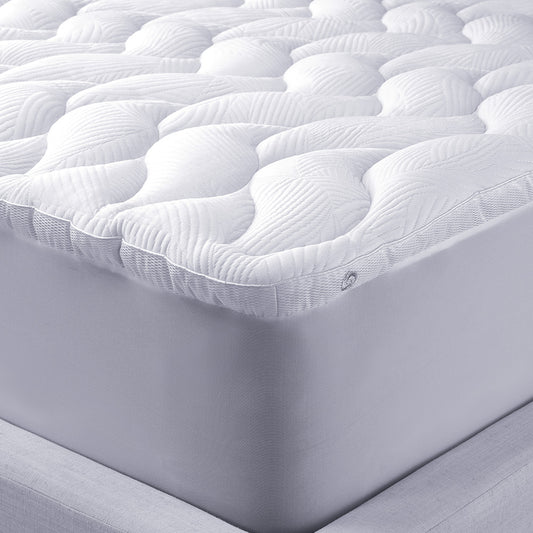
Mattress shopping comes with its own secret language, and it's a disservice to customers. Walk into any showroom and you will hear "tight top," "pillowtop," and "euro top" tossed around like everyone already knows the difference. Unfortunately, most people don't, and that's completely fine. That said, it all comes down to one simple question: what sits between you and the uncomfortable part of your mattress; in other words, all the internal components.
In this guide, we break down pillowtop vs tight top mattresses in plain English. Read on and learn more about both mattress types below.
What Is a Tight Top Mattress?
A tight top mattress has no extra cushion layer sitting on top of it. Its comfort foams or fibers are sealed under a single cover that is sewn snugly across the surface, which makes sense. In fact, that's where the name comes from; the cover is pulled tight over everything underneath. The result? A flat, smooth, tailored look to your mattress.
Now, lie down on one and you'll notice a more direct feel and a flat one. Sure, you still get cushioning from the comfort layers, but you sit more "on" the mattress than "in" it. Moreover, many tight tops land in the medium to firm range, though softer versions do exist. After all, firmness depends on what's inside, not just the cover.
So, what does tight top mean for you day to day and night to night? Mostly, it means a steady, predictable surface that's easy to move around on. It also means a slimmer profile, standard sheets that fit without a fight, and one less layer to wear down. Now, for plenty of sleepers, that simplicity is the whole appeal.
What Is a Pillowtop Mattress?
A pillowtop adds a distinct layer of cushioning above the mattress's comfort layers, so it's a little more mattress. On traditional designs, that layer is a separate padded compartment stitched onto the top panel. You can usually spot the seam and a small gap running around the edge. Pillowtop mattresses are usually built to give you that soft, sink-in feeling the moment you lie down.
Newer designs build the pillowtop directly into the mattress instead of sewing it on, and let us be the first to tell you that it looks way better. Plus, that one change makes a big difference in how the layer holds up over time. We dig into the history, types, and tradeoffs in our complete guide to pillowtop mattresses.
For this comparison, though, the key takeaway is simple: a pillowtop adds softness up top, while the support underneath can be identical to a tight top.
Where Do Euro Top Mattresses Fit into the Equation?
Euro top mattresses are the third style you'll see on the showroom floor, and they cause plenty of confusion as well; Euro even sounds a little too fancy for what it may be. That being said, a euro top also adds an extra cushion layer.
The difference is that it's sewn flush with the mattress edges instead of sitting on top like a separate pad. That gives it a squared-off, boxy look with no visible gap, which is why you may also hear it called a box top mattress.
What's more, because the layer runs right to the edge, euro tops often feel a little denser and more even than traditional pillowtop mattresses. The edges tend to feel sturdier too, which helps when you sit on the side of the bed.
Overall, you can think of it as a middle ground. You get more cushion than a tight top with a more structured feel than a classic sewn-on pillowtop.
Here's an easy way to keep them straight: A tight top has no extra layer, a euro top has an extra layer sewn flush, and a pillowtop has an extra layer that sits on top. Once that clicks, most mattress labels start to make a lot more sense.
Pillowtop vs Tight Top: How They Compare Side by Side
Now for the head-to-head. The table below lines up the differences that matter most once you're actually sleeping on the bed.
| Feature | Pillowtop | Tight Top |
|---|---|---|
| Surface feel | Soft, cushioned, sink-in | Smooth, flat, more direct |
| First impression | Plush right away | Steadier and a bit firmer |
| Pressure relief | Extra cushion at shoulders and hips | Depends on the comfort layers inside |
| Ease of movement | A little more hug to push against | Easy to shift and roll over |
| Heat | Extra layer can hold warmth unless materials breathe | Less material up top to trap heat |
| Body impressions | Sewn-on tops can compress sooner | Fewer layers to wear unevenly |
| Flippable | No, one-sided | Usually no; most modern beds are one-sided |
| Sheet fit | Often needs deeper pockets | Standard pockets usually fit |
| Often best for | Side sleepers and plush-feel fans | Back, stomach, and combination sleepers |
Notice that support isn't really on this list. The top style mostly changes the feel; the coils or foam core underneath do the heavy lifting. In fact, two mattresses with the same core can feel completely different depending on what's on top of it. If you're comparing mattress cores too, which is always worthwhile before you buy, our breakdown of hybrid vs traditional mattresses is a great next read.
How Pillowtop and Tight Top Mattresses Feel by Sleep Position
Your sleep position is the best shortcut for choosing between pillowtop and tight top mattresses. This is due to the fact that each position loads your body in a different way, so each one asks something different from the surface. Learn more about how it usually shakes out below.
Side Sleepers
Side sleepers put most of their weight on the shoulder and hip. Therefore, a pillowtop gives those points room to sink in a little, which may help relieve pressure and keep your spine closer to level. On a firm tight top, those same spots can feel jammed. Our guide to the best mattress for side sleepers with back pain goes deeper on this.
Back Sleepers
Back sleepers usually do well on either style, as long as the hips don't sink too far into the mattress. However, we give the edge to a tight top because it keeps things even and steady. However, a medium-firm pillowtop adds comfort without letting your lower back dip. The goal is balance: enough cushion to feel good and enough support to stay level.
Stomach Sleepers
Stomach sleepers generally want a firmer, flatter surface. Too much sink at the midsection can pull the lower back out of line. That makes a tight top the more common pick here, and we agree with that wholeheartedly. If you love a plush feel, anyway, choose a firmer pillowtop instead of the softest bed on the floor.
Combination Sleepers
Combination sleepers change positions all night, so ease of movement matters. A tight top makes rolling over feel effortless, whereas a pillowtop can work well too, as long as the top layer is responsive. So, make sure you look for foam that springs back quickly instead of slow fill that holds your shape.
Pillowtop vs Tight Top Heat and Breathability
First and foremost, more cushion means more material between you and the air. On a traditional pillowtop, dense padding and fiberfill can hold body heat close to the surface, and this can make your hot night even hotter.
If you already sleep warm, that extra layer can be the difference between comfortable and kicking off the covers at two or three a.m. Tight tops, on the other hand, have less material up top, so they tend to hold less heat by default. Makes sense, right?
Now, this does not mean that hot sleepers have to give up on plush. It just means the materials matter. Therefore, make sure you look for a breathable cover, foams that let air move, and a suspension coil core with room for high airflow sleeping. When those pieces work together, a pillowtop can reduce heat buildup instead of adding to it and ruining what could be a good night's sleep.
Pillowtop vs Tight Top Durability: Which One Holds Up Longer?
This is where traditional pillowtops take their biggest hit, especially an older model that's been overstaying its welcome. This is because a sewn-on compartment of loose fill can shift, compress, and form body impressions faster than the mattress beneath it.
Over time, some develop a noticeable valley or divot right where you sleep. And because pillowtops are one-sided, flipping isn't an option for spreading out the wear.
Tight tops have fewer layers to break down, so they often keep their shape longer. Still, a cheap tight top with thin foams won't outlast a well-built pillowtop, and we've seen lots of tight tops with craters in them.
At the end of the night, materials and construction matter more than the label. A pillowtop built into the mattress, instead of sitting on it, removes the weak point that gave pillowtop mattresses their reputation.
Furthermore, a little care goes a long way with either style, and it can be low effort too. If you rotate the mattress head to foot every few months so wear stays even. Use a breathable mattress protector to keep spills and sweat out of the comfort layers. If you go pillowtop, however, make sure you grab a set of deep pocket sheets.
Pillowtop Mattress Pros and Cons (and the Tight Top's, Too)
Still on the fence? Here's a quick scorecard for each style.
| Style | Pros | Cons |
|---|---|---|
| Pillowtop | Plush first feel; extra cushion at pressure points; cozy, hotel-bed comfort | Sewn-on tops can sag or shift; can hold heat; one-sided; taller profile needs deeper sheets |
| Tight Top | Steady, even surface; easy to move on; slimmer profile; fewer layers to wear out | Can feel firm for side sleepers; less plush up front; may need a topper for extra cushion |
Look closely and you'll see that most pillowtop cons trace back to one thing: sewn-on construction. Fix that, and the list gets a lot shorter. That's exactly the problem BEDGEAR sets out to solve.
Meet Our H Performance® Pillowtop Mattress
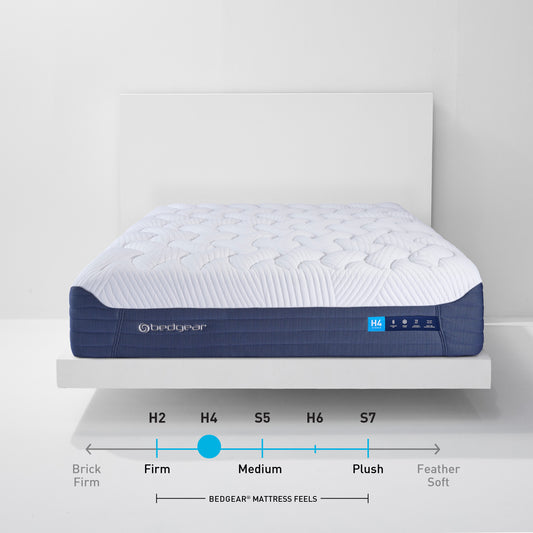
At BEDGEAR, we love a plush pillowtop feel; we just didn't love how traditional ones age. The solution? We built the H Performance® Pillowtop Mattress around an integrated React™ Blend Pillowtop. It's built into the mattress rather than sewn on top, so it stays connected to the support underneath.

Heat was the other thing we refused to compromise on, and you'll notice that trend across our whole product line. The Ver-Tex™ cover is cool to the touch. Air-X® mesh side panels and air vents keep air moving through the mattress to help reduce heat buildup. It's a pillowtop made for people who usually avoid pillowtop mattresses because they run warm.
Here's what's inside at a glance.
| Detail | H Performance® Pillowtop |
|---|---|
| Firmness | Medium-firm (H4) or medium-plush (H6) |
| Profile | 12 inches |
| Comfort | Integrated React™ Blend Pillowtop and React™ comfort layer |
| Support | Foam-encased unit of individually wrapped coils |
| Cover | Ver-Tex™ cool-to-the-touch cover |
| Airflow | Air-X® mesh side panels and air vents |
| Sizes | Twin through Cal King, plus split king and split head options |
| Warranty | 10-year limited warranty |
Two firmness options let you choose how much plush you want. The H6 leans softer for side sleepers who want more sink. The H4 keeps more structure for back and combination sleepers who still want that pillowtop comfort.
Can a Topper Turn a Tight Top Into a Pillowtop Mattress?
Pretty much, yes, and it's a smart move if your tight top is still in good shape. After all, a quality topper adds a cushioned layer to a firm mattress without the cost of a new bed. Of course, it won't be identical to a built-in pillowtop, but it can close most of the gap. What's more, it's also easy to remove if you change your mind.
Look for a topper that conforms without trapping heat and make sure it fits snugly so it doesn't slide. Our React Pro Performance® Mattress Topper is designed for exactly this very job, so take a peak if you're interested in affordable pillowtop mattress comfort.
Pillowtop vs Tight Top Mattresses: Which Mattress Should You Choose?
The pillowtop mattress vs tight top mattress decision comes down to how you sleep and how you like a bed to feel. We say go for a pillowtop if you sleep on your side, love a plush first impression, or want extra cushion at your pressure points. On the other hand, shoot for a tight top if you sleep on your back or stomach, prefer a steady surface, or move a lot at night. At the end of the night, both can be great beds when the support underneath is right.
Frequently Asked Questions We Get About Pillowtop and Tight Top Mattresses
If you have more questions about the tight top and pillowtop debate, don't worry, because we answer some additional questions below.
What Does Tight Top Mattress Mean?
Do Pillowtop Mattresses Wear Out Faster?
How Long Does a Pillowtop Mattress Last?
Can You Flip a Pillowtop Mattress?
What Is the Difference Between a Pillowtop and Memory Foam?
Is a Euro Top the Same as a Pillowtop?
Still deciding? Start with how you sleep, then pick the top that matches. Your back, shoulders, and mornings will thank you.