What a Pregnancy Pillow Actually Does
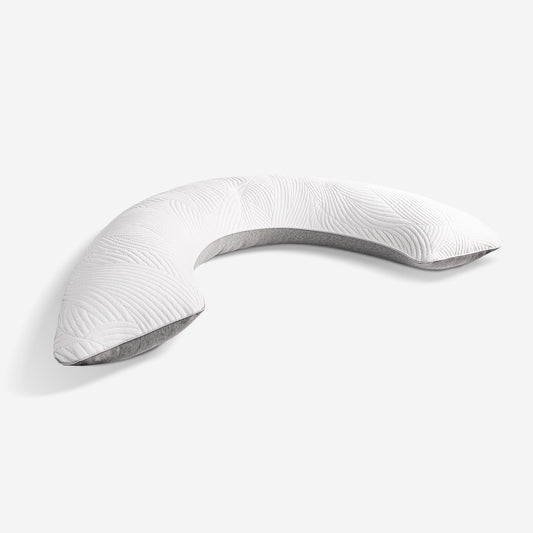
A pregnancy pillow is an oversized support pillow shaped to hold a side-sleeping body in one position for longer. Yes, that's the whole job. It's not doing anything clever or clinical; it is simply filling gaps.
In fact, you can easily run a little test. Lie on your side and pay attention to where your body is unsupported; your belly hangs slightly forward with nothing under it and your top knee drops toward the mattress, which pulls your top hip out of line with the bottom one.
What's more, your lower back has an open pocket behind it. Each of those gaps is a small amount of muscular work your body does all night to hold position.
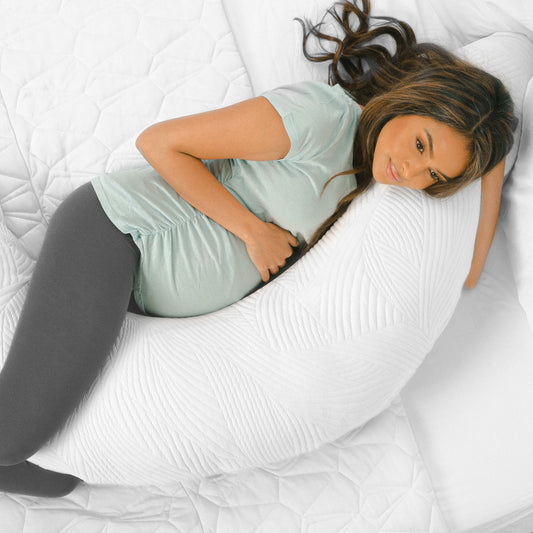
A pregnancy pillow occupies those gaps so the muscles can stop compensating. That is why people describe the difference as waking up fewer times rather than as one dramatic change. At the end of the night, you are removing the reasons to shift, not adding a feature.
How Pregnancy Pillows Differ From Regular Pillows
A standard bed pillow supports one thing: your head and neck. It is sized for that job and it stops there. Anything below your shoulders is on its own.
Pregnancy pillows are built long, and often curved, so a single piece of foam or fill can reach from your head down all the way past your knees. The curve is what lets one pillow do the work of all three.
Moreover, a full-length body pillow achieves something similar with a straight shape, which is why plenty of people skip the specialty shapes entirely. After all, why not sleep with something that's personally fit to you instead?
When to Start Using a Pregnancy Pillow
There is no week on the calendar when a pregnancy pillow becomes required, so let's clear that myth up right away. Therefore, if you are searching for when to start using a pregnancy pillow, the honest answer is that comfort is the trigger.
That said, patterns do exist, we can't ignore that. Most people reach for one somewhere in the second trimester, roughly weeks 16 through 20, because that is when the belly starts genuinely changing how the body settles onto its side. Before that, a regular pillow between the knees usually handles it for you, or maybe just an extra pillow or two.
Of course, some start much earlier. If you were already a restless side sleeper with hip discomfort before pregnancy, week eight is a perfectly reasonable time to buy one. Others never feel the need until the third trimester, when sleeping through the night gets genuinely difficult. So, don't worry at all, all of those are normal.
Signs It Is Time for a Pregnancy Pillow
Rather than watching the calendar, watch for these signs that it's time to get a pregnancy pillow:
- You are waking up to reposition more than two or three times a night
- Your top knee keeps sliding forward and pulling your hips out of line
- You keep ending up flat on your back and having to correct
- You are stacking three or four regular pillows and they keep sliding apart
- You wake up with a stiff lower back that eases once you are upright
That last one, the stack of regular pillows that will not stay put, is the most reliable signal of all. If you have already improvised a pregnancy pillow out of spare bedding, well, it's time to get one for real.
How to Use a Pregnancy Pillow Step-by-Step
There's a little bit of an art to setting up a pregnancy pillow or body pillow. Set it up in this order.
Pro Tip: Working from the bottom up is easier than trying to arrange the whole thing at once while already lying down.
Get on Your Side First
Lie down on your side before you even touch the pillow. Trying to build the arrangement first and then climb into it never works; you will end up shoving everything out of place on the way in. Settle in, get your head pillow sorted, then reach for the big one.
Trap a Section Between Your Knees
This is the single highest-impact move, so do it first. Pull a section of the pillow between your knees and let your top leg rest fully on it, ankle included. The goal is your top knee sitting level with your top hip rather than dropping toward the mattress.
If your ankle is dangling off the end, the pillow is way too far up. Slide it down. A dangling ankle rotates the leg and undoes most of the alignment you just created. If you are using a straight body pillow, this is simply the bottom third of it.
Bring the Top Section Up Under Your Belly and Arm
Next up, it's time to pull the upper portion up so it runs along the front of your torso. You want light contact under the belly, not a wedge shoved underneath it, right? Well, the pillow is there to stop the forward drift, not to lift.
The, drape your top arm over it at whatever height feels natural. Most people end up hugging somewhere around chest level. If your shoulder feels cranked forward, the pillow is too high or too thick at that point; slide it lower.

Fill the Space Behind Your Lower Back
This is the step everybody skips, and it is the reason most pregnancy pillows underdeliver. With a U-shape, the back arm is already there; just scoot back until you make contact. With a C-shape, rotate the tail behind you. And with a straight body pillow, you will need a second pillow or a rolled blanket.
Once there is something firm behind your lower back, you can lean into it slightly. In fact, it's that backward lean is what stops the slow rotation toward your back over the course of the night, which is the thing that wakes most people up.
Adjust Your Head Pillow Last
Once the body is set, your head pillow height is probably wrong, even if you were already someone who messed around with your pillow loft. Building support along the torso changes how your shoulder sits, which changes the gap between your head and the mattress.
Usually you need slightly more loft than before, not less. If you are waking with neck stiffness that started when the pregnancy pillow did, your head pillow is the culprit; our guide to choosing a pillow for your sleep position walks through how to size that correctly.
How to Use Each Pregnancy Pillow Shape
The five steps above apply to every shape, but the mechanics differ depending on what you bought. Here is how the four common shapes compare on the things that actually matter night to night.
| Shape | How You Use It | Main Advantage | Main Tradeoff |
|---|---|---|---|
| U-shape | Straddle the curve; one arm in front, one arm behind, head resting on the top bend | Supports front and back at once, so turning over needs no rearranging | Takes up most of a queen bed |
| C-shape | Head on the top curve, body along the spine of the C, tail rotated between the knees or behind the back | Full-body support in roughly half the footprint of a U | Has to be flipped when you change sides |
| J-shape or wedge | Tucked under the belly or behind the lower back as a single targeted support | Smallest and easiest to travel with | Solves one gap at a time, not all three |
| Straight body pillow | Hug the top half, trap the bottom half between the knees, add a second pillow behind the back | Most versatile and useful long after pregnancy | Needs a partner pillow to cover the back |
If you are undecided, the straight body pillow is the safest bet for most people, and it's a good place to start. It is the only shape on that list you will still be reaching for two years from now, and it leaves room in the bed for whoever else is in it. We dive into some tips for how to use each type of pregnancy pillow below.
How to Use a U-Shaped Pregnancy Pillow
The U-shape is the least fussy to use and the most demanding on space. Sit in the middle of the curve, lie back so your head lands on the top bend, then roll onto your side. Both arms of the U should now run down either side of you.
Pull the front arm between your knees and let the back arm sit flush against your spine. When you want to switch sides, just roll; the pillow stays exactly where it is. That is the entire appeal.
How to Use a C-Shaped Pregnancy Pillow
The C-shape asks for a decision: is the tail going between your knees or behind your back? Both work, and different people swear by each.
Try knees first, since that is the higher-impact contact point. Head on the top curve, torso against the long spine of the C, tail curled forward between the legs. If you keep rolling backward anyway, flip the pillow so the tail sits behind your lower back instead and use a separate knee pillow up front.
How to Use a Body Pillow During Pregnancy
A straight body pillow is the most flexible of the four because nothing about its shape dictates how you use it. Hug the top half, trap the bottom half between your knees, and let it run at a slight diagonal so it follows the line of your body rather than fighting it.
Furthermore, the diagonal matters. A body pillow laid perfectly parallel to your spine leaves your knees reaching for it. Angled slightly, the top sits at your chest and the bottom lands right where your legs need it. Now, pair it with a knee pillow or a second small pillow behind your back and you have covered all three contact points.
How to Lay on a Pregnancy Pillow in Each Trimester
First and foremost: What feels good in week 14 will not feel good in week 34. The pillow does not change, but where you put it does. We have some tips that will help you get the most out of your pregnancy pillow below.
First Trimester
Most people do not need much yet. If you are using a pillow at all, keep it simple: something between the knees to keep the hips stacked, and that is usually enough. This is a good stage to get used to side sleeping before it becomes the only comfortable option.
Second Trimester
This is where the full setup starts earning its keep. Add the front support under the belly and start paying attention to the space behind your lower back. Many people find they want slightly more loft under the head at this stage too, as the shoulder takes more of the load.
Third Trimester
Everything gets more specific. The belly support does more work, the back support becomes non-negotiable, and small adjustments matter more than they used to.
Two additions help here. A slight elevation of the upper body, achieved by adding loft under the head and shoulders rather than propping the neck alone, makes lying down more comfortable for many people. And a small wedge under the belly, separate from the main pillow, gives you finer control than a single large pillow can.

Using a Pregnancy Pillow for Back and Hip Comfort
Back and hip discomfort is the most common reason people go looking for a pregnancy pillow in the first place. All that being said, the setup for it is slightly different from the general arrangement.
For hips, for example, the fix is almost entirely about the knees. Your top leg needs enough support underneath it that your top hip stays level with the bottom one, and the support needs to run all the way to the ankle. A thin pillow that only reaches the knee lets the lower leg drop, which rotates the hip anyway. Thicker is usually better here than thinner, so keep that in mind.
For the lower back, on the other hand, work behind you rather than in front. Fill the pocket between your lower back and the mattress with something firm enough to lean against, then actually lean into it. A pillow resting lightly against your back does nothing; a pillow you are pressing into changes how your pelvis sits.
If discomfort persists regardless of setup, though, that is a conversation for your OB, midwife, or physical therapist rather than a bedding problem to solve. A pillow can remove the mechanical reasons you shift at night; it cannot address anything underneath that.
Not Sure Which Pillow Setup You Need?
BEDGEAR's Pillow ID system matches you to a pillow based on your sleep position, body size, and how hot you sleep, which becomes a moving target during pregnancy.
Five Mistakes That Make a Pregnancy Pillow Feel Useless
If the pregnancy and/or body pillow is not working, it is almost always one of these five things rather than the pillow itself.
-
01
Ignoring the Back
Supporting only the front leaves you free to roll backward all night. Fill the space behind your lower back.
-
02
Knee Support Too Short
If your ankle dangles off the end, the leg rotates and the hip goes right back out of line.
-
03
Wrong Head Pillow
Body support raises the shoulder and widens the neck gap. Most people need more loft, not less.
-
04
Overheating
A large pillow traps heat against you. Look for breathable fill and a cover that moves air.
-
05
Quitting Too Early
The first night with a new setup is usually the worst one. Give it three or four before deciding.
Overheating deserves a little extra attention, because it is the one people rarely connect to the pillow. You have just added a large insulated object against most of your body, at a stage when many people are already running warm.
A pillow with breathable, cool-to-the-touch materials handles that better than a dense foam block wrapped in a plush cover (This what we specialize in at BEDGEAR).
How to Wash and Store a Pregnancy Pillow
Pregnancy pillows get more use than any other pillow you own, and they are also the most annoying to clean. A little planning up front saves a lot of hassle.
Check the care tag before anything else. Most pregnancy pillows have a removable, machine-washable cover and an inner pillow that is spot clean only. Wash the cover every one to two weeks alongside your sheets. Adding a pillow protector under the cover buys you considerably more time between deep cleans, and our pillow care guide covers the washing details.
For storage, please make sure you resist the urge to compress it into a vacuum bag for months at a time. Extended compression can leave fill matted in ways it does not fully recover from. A large breathable storage bag in a closet works better; keep it out of anywhere damp, since a pillow that size takes a long time to dry out if it absorbs moisture.
BEDGEAR Pillows That Work During Pregnancy
BEDGEAR does not make a dedicated pregnancy shape, and that is deliberate; the pillows below cover the same three contact points and stay useful long after the pregnancy ends. After all, there is nothing clinical about a pregnancy pillow, anyway.
The Body Pillow
The BEDGEAR Body Pillow is the workhorse here. Full length, so it covers the torso and knees in one piece, and built with the same breathable performance materials as the rest of the pillow line rather than a dense block that traps heat against you.
It is also the option you will still be using afterward, for side sleeping, for reading in bed, or for nursing support. Pair it with something small behind your back and you have the full three-point setup.

The Knee Pillow
If your main complaint is hips rather than belly support, the Knee Pillow may be all you need, especially earlier on. It is contoured to sit between the knees without sliding out, which is the failure mode of using a folded regular pillow there.
It also works well as a companion to a body pillow. Use the body pillow up front and behind, and let the knee pillow handle the leg alignment on its own.

Cuddle Curve Performance Pillows
Head pillow loft changes when you start using body support, and the Cuddle Curve shape is built for side sleepers who need the shoulder accommodated rather than crushed. If your neck started complaining the same week your pregnancy pillow arrived, this is where to look.
The full range is worth browsing, since loft needs vary by frame size and how much your shoulder is now lifted.

How to Use a Pregnancy Pillow for a Better Night's Rest
At the end of the night, knowing how to use a pregnancy pillow comes down to one habit: think in three contact points, not one. You have your belly, knees, lower back. Fill all three and the pillow does exactly what you bought it for.
Moreover, expect the whole pregnancy pillow and/or body pillow arrangement to change. What works in the second trimester will need adjusting in the third, and the head pillow you were happy with before may not be the right one anymore. That is normal, and it's worth re-testing every few weeks rather than assuming the first setup is permanent.
And if discomfort continues no matter how you arrange things, talk to your OB. A pillow can clear away the mechanical reasons you keep waking up; the rest is a conversation for your healthcare provider or a medical professional
Frequently Asked Questions
Still working out the details? Here are the questions that come up most.