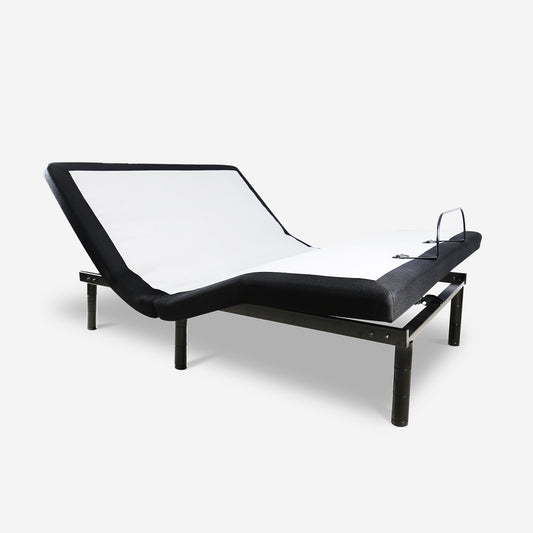
If your shoulder is fine all day and furious at 6 a.m., you have probably already tried the obvious fixes. You know, a new pillow, maybe a different side, or even the old arm under the head move. For the real rebels, maybe you've gone with the arm over the head or the arm hugging a pillow like a life raft.
What you've probably noticed is that none of it sticks, because none of it changes the fundamental problem: you are lying flat, and flat puts your whole upper body on one joint.
This guide covers what a base can do for a sore shoulder, what it cannot, the exact angles worth trying tonight, and why the mattress underneath decides whether any of it works.
| Position | Best For | Rough Angle | Why It Helps the Shoulder |
|---|---|---|---|
| Back sleeping, head raised | Most people with one sore shoulder | 15° to 30° head, slight knee lift | Takes weight off both shoulders entirely; the knee lift stops you sliding down and flattening the lower back. |
| Zero gravity preset | Back sleepers who also deal with lumbar discomfort or snoring | 30° head, 120° torso-to-thigh | Distributes weight across the widest possible surface, so no single joint carries the load. |
| Mild head lift, side sleeping | Committed side sleepers who cannot switch to their back | 10° to 15° head only | Reduces the tendency to roll fully onto the sore shoulder without rotating the joint forward. |
| Foot elevation only | Sleepers whose hip aches on the same side | Flat head, 10° to 20° foot | Eases lower body tension without changing shoulder loading; useful as a partial step. |
| Full flat | Stomach sleepers | 0° | Head elevation increases neck rotation in this position, which tends to make shoulder strain worse rather than better. |
This table is the short version, and it will get you most of the way there tonight. However, make sure you stick around because the rest of this guide explains how to read it for your body, because sleep position and mattress flex change the answer more than any preset button does.
Why Your Shoulder Hurts More When You Are Lying Flat
Your shoulder is the most mobile joint you own, which is a polite way of saying it's the least protected. For this reason, when you lie on your side, there is almost nothing between that joint and the mattress except skin and a thin layer of muscle. What's more, every pound of upper body weight funnels through one narrow contact point.
Now, on a flat surface, that point has to hold you up for six or seven hours straight. This is because tissue compresses, the joint sits at an angle it was not designed to hold, and your body does what it always does when something is uncomfortable: it makes you move... sometimes, a lot. That is the tossing and turning you half-remember in the morning.
At the end of the night, the timing is the clue. Pain that peaks in the first ten minutes after waking and eases as you move around points at the sleep setup. On the other hand, pain that builds through the day, or that arrived with a specific injury, points somewhere else and is worth raising with your doctor.
The Side Sleeper Problem
Roughly two out of three adults sleep on their side, and that is exactly where shoulder complaints cluster; your shoulder is being drilled into the mattress, after all. In fact, a 2024 case series found that 89% of patients with confirmed rotator cuff tears were habitual side sleepers, well above the general side-sleeping rate.
The proposed mechanism is sustained compression: lying on the shoulder for hours can limit blood flow to tendons that are supposed to be repairing overnight. This results in a lot of pain and tightness.
What's more, back and stomach sleepers spread their weight across a wide surface. Side sleepers concentrate that same weight onto two narrow zones, the shoulder and the hip. Those two points do the structural work all night.
Now, an adjustable base cannot widen your shoulder, but what it can do is make back sleeping comfortable enough that you actually stay there.
And for a lot of people, that is the entire intervention.
Tonight, before you change anything, try this: Lie on your back on your current setup and notice where your shoulders sit relative to your chest. If they are riding up toward your ears, your body is bracing rather than relaxing.
Now, raise the head section about 20 degrees and add a small knee lift. Give it two minutes. If your shoulders drop and your arms feel like they have somewhere to rest, you have found the reason a base helps; and you have found roughly the angle you want.
How an Adjustable Base Actually Changes the Math
Most people who talk about adjustable beds and shoulder pain talk about elevation as if raising your head is inherently soothing or something. Well, let us be the first to tell you the truth: It is not. The benefit is mechanical and specific, and it works in two ways.
Adjustable Bases Make Back Sleeping Tolerable
Plenty of people sleep on their side because lying flat on their back just feels kind of wrong. Flat back sleeping can leave the lower back unsupported and the airway more prone to collapsing, which is why snoring gets louder in that position. So, they roll onto the shoulder that hurts, and the cycle continues.
Raise the head 15 to 30 degrees and add a knee lift, and back sleeping stops feeling like lying on a board. The lower back has somewhere to rest, the airway stays more open, and both shoulders are off the hook. That is the single biggest thing a base does for shoulder pain, and it works by changing which position you can tolerate rather than by cushioning anything.
Adjustable Bases Reduce the Roll
If you genuinely cannot sleep on your back, no worries at all, because a mild head lift still helps. A slight incline makes it marginally harder to complete a full roll onto your side during the night.
That said, it will not stop you entirely, but it can turn a full-side position into a three-quarter one, which distributes the load across the shoulder blade instead of the joint itself.
The key word here is mild. We're talking around ten to fifteen degrees. More than that and you start pushing the top shoulder forward, which rotates the joint and creates a new problem while solving the old one.
The One Thing Presets Cannot Do
Preset buttons are calibrated for average bodies in average positions. Shoulder comfort usually lives inside a five-degree window that no preset will find for you. This is why programmable memory positions matter more than the length of the preset list; you find your angle once, then save it.
The Best Adjustable Bed Positions for Shoulder Pain
Are we ready to kick things off? Here is where to start, in order of how likely each one is to help.
Give any position at least four or five nights before you judge it, though, because your body will resist an unfamiliar angle for the first few; trust us on that one.
1. Start Here: Back Sleeping With Head and Knee Lift
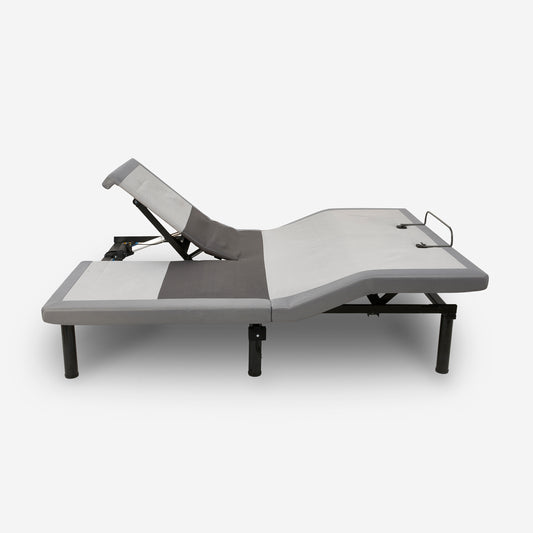
Raise the head section to roughly 20 degrees and the foot section to about 10. The knee lift is not optional; without it, gravity slowly slides you down the incline and your lower back flattens out against the mattress.
That slide is why people try head elevation once, wake up bunched at the bottom of the bed, and decide it does not work for them.
If you have a lumbar zone, engage it lightly. The goal is contact, not lift. You want the lower back supported so the upper body can relax instead of bracing.
2. If You Must Side Sleep: Gentle Incline Only
Set the head to 10 or 15 degrees, leave the feet flat or very slightly raised, and sleep on the shoulder that does not hurt. Hug a pillow against your chest so the top shoulder cannot roll forward and rotate. This is the position where your pillow does the heavy lifting, and we cover that in a minute.
Our full breakdown of whether side sleepers can use zero gravity goes deeper on why the full preset tends to feel wrong in a lateral position and how to modify it. That said, you shouldn't have too many issues there.
3. Zero Gravity: Powerful, but Aimed at Your Back
Zero gravity sets a roughly 120-degree torso-to-thigh angle with about 30 degrees of head elevation. It distributes body weight across the widest possible surface area, which is exactly why it is so effective for lumbar discomfort.
The best part? Every BEDGEAR Flex base includes it as a one-touch preset, and it's not something that just sounds cool.
Now, for shoulder pain, though, zero gravity is a means to an end. It is not targeting the shoulder; it is making back sleeping comfortable enough that you stay off the shoulder.
If that is what you need, it works well. If you are set on side sleeping, dial the knee angle back and treat it as a starting point rather than a destination. Our guide to what zero gravity can and cannot do for back pain covers the position in full.
What Not to Do with Your Adjustable Base
Two things reliably make shoulder pain worse on an adjustable base, and both are common. Plus, you should never make an adjustable base the sole solution to your shoulder pain problems; talk to a licensed doctor if you're having issues that go way beyond bedding.
- Cranking the Head too High: Sitting up at 45 degrees pushes your chin toward your chest and rounds the shoulders forward. It feels supportive for ten minutes and awful by morning.2
- Head Elevation While Stomach Sleeping: Stomach sleeping already forces the neck into rotation and extension at once. Adding an incline increases both. Now, if you sleep on your stomach, stay flat and focus on the mattress and pillow instead.
We get it. Both mistakes come from the same instinct, which is assuming more elevation equals more relief. For shoulders, though, the opposite is usually true; small changes hold up over eight hours in a way that dramatic ones do not.
Your Mattress Decides Whether the Angle Works
At the end of the night, how you sleep really comes down to the system. This is the part most guides skip, and it is the reason plenty of people buy an adjustable base for shoulder pain and feel nothing.
A base sets the angle, sure, but that's not the whole bedtime story. The mattress determines whether your body is actually supported within that angle. When a mattress is too rigid to articulate properly, it does not follow the bend; your body ends up bridging across a surface that has not moved with you. The result is new pressure points in places you did not have them before.
A very firm mattress on an elevated base, as an example, is particularly rough on side sleepers. The incline redistributes weight, but if the surface will not contour around the shoulder and hip at that angle, you get concentrated pressure at precisely the spots that needed relief. The base and the mattress end up working against each other.
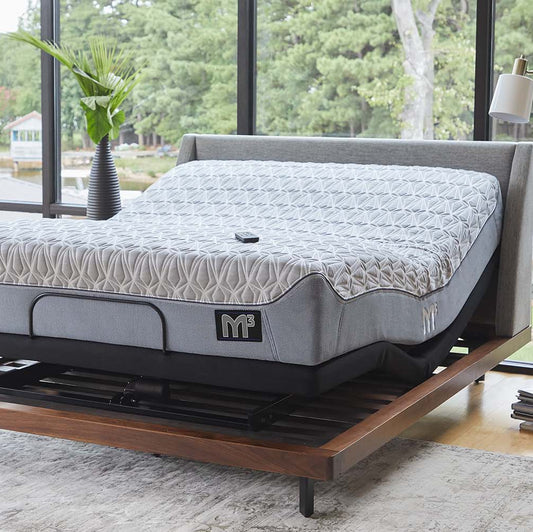
Instead, what you really want is a surface flexible enough to bend with the base and contouring enough to let the shoulder settle in once it does. If you are shopping for both at once, our guide to the best mattress for shoulder pain covers the surface side of this equation in detail, including how shoulder width and body weight change which comfort layer makes sense.

Two Sleepers and Two Very Different Shoulders
Many beds are shared, and most couples do not have matching shoulder widths, matching body weights, or matching opinions about how high the head should be. On a single-motor setup, one angle has to satisfy both people, which means somebody compromises every night. It is usually the person with the aching shoulder, and that can ruin sleep for the other partner.
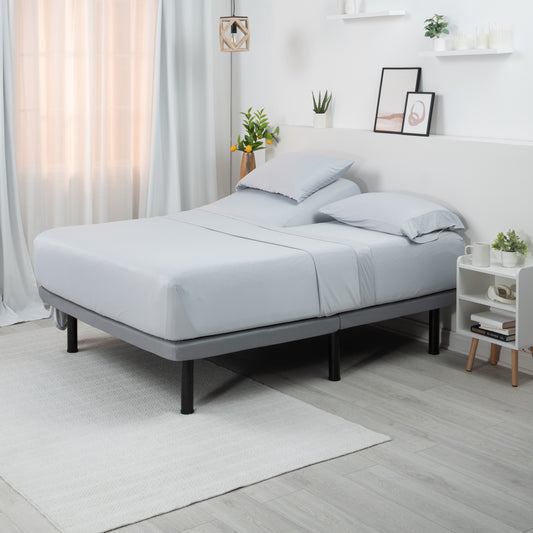
Thankfully, BEDGEAR as a solution. A split configuration removes the negotiation. Two independent bases, synced by cord or wirelessly, let each side hold its own position. One partner sleeps at 20 degrees with a knee lift; the other stays flat. Nobody has to make a sales pitch for it at 11 p.m.
If you are running a split king or split head setup, that pairing is worth planning around from the start rather than retrofitting later.
Does the Massage Feature Help Sore Shoulders?
Short answer: it is a comfort feature, and a good one, but it is not treatment for shoulder pain. Still, we love it, and you'll find it in most of our adjustable base options.

The massage function on a Flex base uses vibration motors built into the head and foot sections, each with independent intensity levels. Plenty of people find it a genuinely pleasant way to wind down, and winding down well is not nothing when you are trying to fall asleep with a sore shoulder.
What it will not do, of course, is resolve a shoulder problem. After all, a massage bed is not the same as physical therapy, it is not a professional massage, and we are not going to pretend otherwise.
Instead, treat it as part of your bedtime routine rather than as the reason you bought the base. Our guide to what a massage bed does and does not do gets into how the feature works and who tends to get the most out of it.
If shoulder pain is persistent, severe, or came on after a specific injury, an adjustable base is not the answer you need first. Positioning changes the mechanical conditions your body sleeps in, which is meaningful, but it does not diagnose anything. That conversation belongs with a healthcare provider.
What to Look for in the Best Adjustable Base for Shoulder Pain
Strip out the spec-sheet noise and four things actually matter for a sore shoulder. Everything else is nice to have. We cover what you really need in detail below.
- Independent zone control: Head, neck, and lumbar sections that move separately let you build a position rather than pick one. This matters more than any preset.
- Programmable memory positions: Shoulder comfort lives in a narrow band. Once you find your angle, you want to return to it with one button instead of hunting for it every night.
- Quiet motors: If you wake at 3 a.m. and need to adjust, a loud motor wakes your partner and ends any chance of falling back asleep quickly.
- Mattress compatibility: The base is only as good as the surface it bends. Confirm your mattress articulates properly before you pair them.
Across the BEDGEAR Flex lineup, the practical difference comes down to how much granular control you want.
The Flex LSX adds independent neck and lumbar zones on top of head and foot, which is the most useful configuration if you are chasing a specific shoulder angle. The Flex LS covers the core positions with a simpler remote, and the Flex SH handles split head setups where only the upper body needs to move independently.
Do Not Forget the Pillow!
You can dial in a perfect angle and still wake up with a sore shoulder if the pillow is wrong. After all, it has the most impact on your neck and spine. Therefore, the base controls how much weight the shoulder carries and the pillow controls whether your head stays level once you are up there.
It's important to note that an incline changes what your pillow needs to do. A pillow sized for flat back sleeping will often feel too tall at 20 degrees, pushing the chin toward the chest and rounding the shoulders forward. Side sleepers on an incline usually need slightly less loft than they did flat, because the base has already closed part of the gap.
The good news? Our guide to the best pillows for shoulder pain walks through how to measure that gap for your frame, and it is worth reading alongside this one. At the end of the night, the two decisions are genuinely linked.
Find Your Angle, Then Save It
Every BEDGEAR Flex base is built to be adjusted rather than preset and forgotten. Match it to a mattress that bends with it and the setup starts working together.
Finding the Best Adjustable Base for Shoulder Pain Today
At the end of the night, the best adjustable base for shoulder pain is the one that gets your shoulder out from under your body weight. For most people, that means back sleeping at 15 to 30 degrees with a knee lift. On the other hand, for committed side sleepers, it means a gentler 10-to-15-degree incline and a pillow that fills the remaining gap.
Whatever your motivation, the two decisions that matter most are granular control and mattress pairing. A base with independent zones and memory positions lets you find your angle and keep it. A mattress that articulates properly makes sure that angle actually reaches your shoulder instead of stopping at a surface that will not bend.