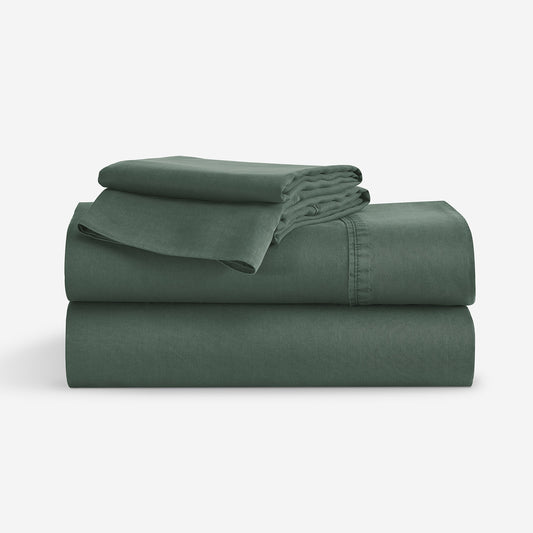
How Long Do Bed Sheets Last?
Most bed sheets last about two to three years with regular use and washing. Now, while that’s a common guideline, it's not a hard and fast rule. In fact, some sets of sheets may even wear out in a year, and some stay comfortable for much longer periods. Plus, linen and cotton sheets may even feel better after their first wash.
All that being said, the gap comes down to three things: what the sheets are made of, how they’re constructed, and how they’re handled in the laundry. A well-made set that’s washed gently and rotated can easily beat the average. A cheap set that goes through a hot dryer every week probably won’t.
If you’re shopping for durable bed sheets, it helps to know which of those factors you can control. Spoiler: you can control most of them, so no need to automatically think something is better than the others.
What Affects How Long Your Bed Sheets Last
Every set of bed sheets wears out eventually; no way around that. But a few factors decide whether that happens in one year or several. Below, we cover what matters the most for bed sheets:
- Fiber: Long, strong fibers make tougher yarn. What's more, short fibers loosen faster and lead to pilling.
- Construction: Weave, knit, and fabric weight all change how your bed sheets handle friction and contact.
- Washing: Hot water, harsh detergent, and bleach break down sheet fibers over time.
- Drying: High heat is one of the fastest ways to age any bed sheet fabric.
- Fit: Fitted sheets that strain at the corners wear out at the seams first.
- Rotation: One set of sheets used every night takes twice the wear of two sets swapped weekly.
While these factors are important, body oils, sweat, and skincare products play a role too. They build up in sheet fabric and can weaken fibers if sheets aren’t washed often enough.
Does Thread Count Affect How Long Sheets Last?
Thread count is something we're not huge fans of at BEDGEAR, and that's because of how it's always marketed. Long story short, the answer is not as much as the packaging wants you to believe. A sky-high thread count can come from thin, multi-ply yarns that don’t hold up any better. Fiber quality and construction tell you a lot more about durability.
Now, for the full story, check out why thread count matters less than you think. It covers everything you need to know about this giant myth.
How Long Different Bed Sheet Materials Last
When it comes to how long bed sheets last, fabric is the biggest factor in how your bed sheets age. What's more, it's important to note that natural fibers and engineered fibers each wear in their own unique way. So, in the chart below, we cover how long these materials last.
| Material | Durability | How It Ages | Biggest Enemy |
|---|---|---|---|
| Cotton Percale | Good to very good | Softens over time; can thin with heavy use | High heat and bleach |
| Linen | Very high | Gets softer and more relaxed with each wash | High heat and over-drying |
| Bamboo Fabrics | Good with gentle care | Stays silky when washed gently | Hot water and rough cycles |
| Polyester Performance Knits | Very good | Holds shape and color well | Fabric softener and high heat |
| Nylon | Very good | Smooth, strong yarns resist abrasion | Fabric softener and high heat |
| Flannel | Moderate | Brushed flannel can pill as fibers loosen | Friction and hot dryers |
You notice a theme developing in this chart? It's that heat shows up in almost every single row. Still, no matter what your sheets are made of, a lower dryer setting is the easiest way to add life into them, and this is something you can do today.
How Long Do BEDGEAR Sheets Last? Our Materials, Explained Down to the Thread
At BEDGEAR, We build our sheets collection around different fabrics for different sleepers, after all, it's all about being personally fit to you, right? At BEDGEAR, each material has its own strengths and its own care needs. Below we cover how to get the longest life out of every one.

Cotton Performance®: 100% Cotton Percale
Our Cotton Performance® sheets are 100% cotton with an open percale weave for airflow, and they're some of our newest sheets in the line-up. Percale is a tight, one-over-one-under weave, which gives it that crisp and cool-to-the-touch feel. Percale is also a sturdy construction that softens nicely over time.
To help our cotton sheets last, machine wash them on warm with a mild detergent, skip the bleach, and tumble dry on low for the best results. Don't worry, if you want the full wash load of information, our guide on how to wash cotton sheets walks through every single step in a bit more detail.
Bamboo Performance®: Lyocell From Bamboo
Our Bamboo Performance® sheets are made from lyocell derived from bamboo, so they're bamboo sheets, essentially. Our bamboo sheets have a silky, smooth feel and a breathable build that hot sleepers tend to love. Bamboo fabrics stay their softest when you handle them gently in the wash.
Wash warm on a gentle setting with mild detergent, skip all the bleach, and tumble dry on low heat. And like our cotton sheet guide, our guide on how to wash bamboo sheets covers the details.
Linen Performance®: Cotton, Linen, and Kapok
Our Linen Performance® sheets blend 91% cotton, 6% linen, and 3% kapok. You get linen’s relaxed texture with softness from night one. And since cotton leads the blend, these sheets wear like a quality cotton sheet set.
And the best part? Care is the same as our cotton sheets, since they share many materials. So, wash on warm, use mild detergent, hold off on the bleach, and dry on low heat.
Ver-Tex™ Performance®: 100% Nylon
Ver-Tex™ sheets are inspired by activewear, so think nylon sheets. They’re made from 100% nylon, which feels cool to the touch, wicks moisture, and has a smooth stretch. Plus, nylon is known as a strong fiber with good abrasion resistance, so it handles nightly friction well.
From there, the key to long life here is the care label. So, make sure you wash cold on a gentle cycle, skip fabric softener, and tumble dry on low. You should skip the softener because it coats performance fibers and can get in the way of moisture-wicking.
Dri-Tec® Performance®: Moisture-Wicking Comfort Stretch
Dri-Tec® sheets use smooth, moisture-wicking polyester fibers that pull sweat away from your skin. You'll find that the fabric has a soft stretch, kind of like your favorite workout shirt. Performance knits like this hold their shape and color well over time.
Care matches our Ver-Tex™ sheets: Prepare to use cold water, gentle cycle, no fabric softener, and keep the heat low.
Hyper-Linen, Hyper-Cotton, Hyper-Wool, and Essentials
Our Hyper sheets blend natural fibers with bamboo-based rayon or viscose for extra softness. Hyper-Linen Performance® is 93% rayon from bamboo and 7% linen. Hyper-Cotton™ is 60% rayon from bamboo and 40% cotton.
The Hyper-Wool™ Flannel Performance® Sheet Set blends polyester, viscose, and a touch of wool. It’s unbrushed, so it skips the fuzzy surface that makes traditional flannel pill. Our Essentials Sheet Set pairs polyester with rayon from bamboo for easy, everyday care.
Rayon and viscose fibers like gentle handling, so always check the care tag. Cooler water and low heat go a long way with these blends.
BEDGEAR Sheet Care Cheat Sheet
Care labels are the most skipped instructions in the house, especially if you toss them out the second you open the packaging. In the chart below, we have a quick reference for our main sheet materials.
| Sheet Set | Material | Wash | Bleach | Dry |
|---|---|---|---|---|
| Cotton Performance® | 100% cotton | Warm, mild detergent | No | Tumble dry low |
| Bamboo Performance® | Lyocell from bamboo | Warm, mild detergent | No | Tumble dry low |
| Linen Performance® | 91% cotton, 6% linen, 3% kapok | Warm, mild detergent | No | Tumble dry low |
| Ver-Tex™ Performance® | 100% nylon | Cold, gentle; no softener | Non-chlorine only, when needed | Tumble dry low |
| Dri-Tec® Performance® | 100% polyester | Cold, gentle; no softener | Non-chlorine only, when needed | Tumble dry low |
If there's one thing you take away from this it's the one rule covers every set on this list: low heat in the dryer. Oh, and skip the iron; none of these sheets need it, and you'll ruin your new and improved sheet care habits.
Why Fit Matters for How Long Sheets Last
Fitted sheets usually wear out before flat sheets do, and this tends to be because you lay on top of them. Every time a corner strains to stay on, it puts stress on the elastic and the seams. Therefore, a sheet that’s too shallow for your mattress is fighting a losing battle.
The good news? That’s why many of our sheets use Powerband®, a wide band that grips your mattress on all four sides. A secure fit means less tugging, less bunching, and fewer popped corners. At the end of the night, it's a small detail that makes daily life with your sheets a whole lot easier.
Why Sheets Pill and How to Find Sheets That Don’t
Bed sheet pilling happens when short or broken fibers work loose and tangle into little balls. Friction speeds this process up, so pills often show up where your feet and shoulders rub. Harsh washing and high heat makes this even worse, so tread carefully.
And if you want sheets that don’t pill, look for long, smooth fibers and quality construction. In this category, linen’s long flax fibers resist pilling. Also, the smooth, continuous synthetic yarns, like the nylon in our Ver-Tex™ sheets, also hold up well against friction.
Do you already have some pilling? There's no need to panic: A fabric shaver can tidy up a few pills. But if pilling covers large areas, the fibers are breaking down, and it’s probably time for a new sheet set for a fix instead of a patch.
How to Make Your Bed Sheets Last Longer
When it comes to making your bed sheets last longer, there's a lot of things you can do. Plus, we have some good news: making durable sheets last even longer doesn’t take much effort. We cover a few small habits that add up to years of extra use below.
- Follow the care tag: Our product care tags are written for that exact fabric.
- Go easy on heat: Cool or warm water and a low dryer setting.
- Skip bleach: Use non-chlorine options only if the tag allows it.
- Don’t overload the washer: Sheets need room to move and rinse clean.
- Pull them out promptly: Overdried sheets get stiff and wrinkle a lot harder.
- Store them dry: A cool, breathable closet beats a plastic bin, and use a dehumidifier for basement storage.
These habits work whether you sleep on cotton, bamboo, or nylon bed sheets. They also keep your sheets feeling better day to day, not just lasting longer, and this can even take your cotton, linen, and bamboo sheets to the next level.
How Often Should You Wash Bed Sheets?
Most people should wash their sheets about once a week, usually on a weekend to keep things consistent. Hot sleepers, pet owners, and anyone who sweats a lot at night, however, may want to wash more often. Regular washing clears out sweat and oils before they can weaken fibers.
How Many Sets of Bed Sheets Should You Own?
Two sets per bed is the sweet spot for most homes. One is on the bed while the other is washed and resting. Each set takes half the wear, so both bed sheet sets last longer.
A third bed sheet set can make sense for kids’ rooms or guest beds that see a lot of action. It also means you’re never stuck waiting on the dryer, and if you have kids you may even want to grab another sheet set just in case of spills.
Signs It’s Time to Replace Your Bed Sheets
Even the most durable sheets don’t last forever, and while you can reduce the impact of wear and tear, they have to go eventually. Below, we help you watch for the most common signs that your bed sheet set has earned a retirement:
- Thin spots: Hold the sheet up to a light. See-through areas are on borrowed time, although this can be tricky on darker sheet colors.
- Holes or tears: Small holes tend to grow fast once they start, so act fast.
- Heavy pilling: A few pills are normal. A carpet of them means fibers are breaking down, and it's time to sound the alarm.
- Stains or odors that won’t wash out: If a deep clean doesn’t help you out, it’s time for new sheets.
- Loose fitted corners: Worn-out elastic means your sheet won’t stay put.
- Faded color or rough feel: Sheets should feel great. If they don’t, upgrade them right away.
One sign might mean you can squeeze out a few more months. Two or three usually means a new set will feel like a real upgrade, so make sure you keep this in mind.
How Long Do Bed Sheets Last on Your Bed? The Verdict
So, how long do bed sheets last? At the end of the night, two to three years is a fair average for most bed sheets, but the right fabric and good habits can stretch that further. Linen and well-made cotton age gracefully, while nylon and polyester performance fabrics hold up well with cool, gentle care.
Therefore, make sure you pick bed sheets that match how you sleep, follow the care tag, and rotate two sets. And that wraps up this bedtime story.
Frequently Asked Questions About the Longevity of Bed Sheets
Still have questions about how long your bed sheets will last? Here are quick answers to the ones we get the most at BEDGEAR.