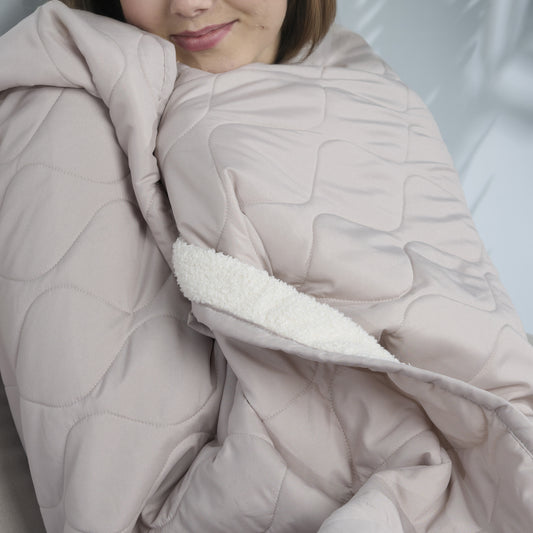
Sherpa is one of those words that gets printed on a label and never explained. You know it means soft and fuzzy. You probably assume it involves wool. Most people do, and most people are wrong. The good news? We have your back in this guide; read on to learn more about sherpa blankets.
What Does Sherpa Even Mean?
Before it was a fabric, Sherpa was a people. The Sherpa are an ethnic group of roughly 150,000 living in Nepal, India, and Tibet, concentrated in the Solu-Khumbu district in the valleys below Mount Everest. They are of Tibetan descent, and the name itself is descriptive: "shar" means east and "pa" means people, so Sherpa translates roughly to "easterner."
That name traces a migration. Beginning in the 15th century, Sherpa ancestors crossed the high passes from Kham in eastern Tibet into what is now northeastern Nepal, settling at elevations reaching 14,000 feet. They lived as traders, herders, and farmers, and they traditionally did not climb the surrounding peaks at all, regarding them as the homes of gods.
That changed in the early twentieth century, when British Himalayan expeditions began hiring Sherpa porters and guides. Their capacity for work at altitude became legendary, and in 1953 Tenzing Norgay reached the summit of Everest alongside Edmund Hillary.
The association between the name and high-altitude endurance was cemented permanently, which is why many people leverage Sherpas to hike Mount Everest to this day.
How the Name Ended Up on a Blanket
From there, the word drifted. "Sherpa" became shorthand for anyone carrying a heavy load through hard conditions, which is why you now hear it applied to political negotiators and project managers. The textile industry borrowed it the same way, attaching the name to a fabric that imitates the thick fleece lining of a mountaineering coat.
It is worth being clear that the fabric has no material connection to the Sherpa people, though. It contains nothing they produce, and it is not made in the Himalayas.
The name is borrowed imagery, evoking cold mountains and warm shearling; that is the whole of the relationship. Understanding that also clears up the most persistent misconception about what the fabric actually is. The more you know, right?
What Is Sherpa Fabric?
Sherpa is a knit fabric, almost always polyester, that has been finished to imitate the wool lining of a shearling coat. The name is a reference to the Sherpa people of the Himalayas and the heavy fleece-lined garments associated with high-altitude climbing. That said, Sherpa is a marketing name for a texture, not a description of the material.
What makes sherpa distinct is the pile. Instead of the uniform brushed nap you get on standard fleece, sherpa has an irregular, bumpy surface of curled loops.
Those loops sit at different heights and angles, which creates pockets of still air across the whole surface. Still air is an excellent insulator, and that is the entire reason sherpa feels so warm so quickly.
What Sherpa Is Made Of
The overwhelming majority of sherpa on the market is 100% polyester. Some versions blend in cotton for a softer hand or acrylic for a slightly different texture, and a small number of premium products use a cotton face with a polyester pile. If the label does not specify, a good rule of thumb to follow is that you can assume polyester.
Still, that polyester composition has real advantages. Polyester sherpa is machine washable, resists shrinking, does not attract moths, and costs a fraction of what real shearling does.
It is also a solid choice for anyone who finds wool itchy or who avoids animal fibers, since the texture is the whole point and none of the wool comes along with it.
Is Sherpa Actually Wool?
No, and this is the single most common misconception about the fabric. Real wool sherpa exists in specialty outerwear, but it is rare and it is not what you are buying in a blanket.
This matters practically. Wool and polyester wash differently, insulate differently when damp, and age differently. Treating your polyester sherpa blanket like wool, or vice versa, is how you end up with a ruined blanket.
Sherpa vs Fleece: What's the Actual Difference?
This is the comparison people search for most, and the honest answer starts with a technicality: sherpa is a type of fleece. When people ask about sherpa versus fleece, they mean sherpa versus standard flat fleece, the smooth brushed material used in pullovers and lightweight throws.
The difference comes down to surface structure. Flat fleece is brushed to a consistent, even nap across the entire face. Sherpa, on the other hand, is finished into curled, uneven loops. That structural difference drives everything else: warmth, weight, drape, and how each one holds up over time.
Here is how the sherpa and fleece compare across the factors that actually affect how a blanket feels in use.
| Factor | Sherpa | Standard Fleece |
|---|---|---|
| Texture | Nubby, curled, irregular loops | Smooth, uniform brushed nap |
| Warmth | Higher; loops trap more air | Moderate; thinner profile |
| Weight | Heavier, more substantial drape | Lighter, easier to layer |
| Breathability | Lower; loft holds warm air in | Slightly higher; less loft |
| Common Use | One side of a dual-sided throw | Single-layer blankets, apparel |
| Main Failure Mode | Matting and flattened pile | Pilling on the surface |
The practical takeaway: choose sherpa when warmth is the priority and the room runs cold. Choose flat fleece when you want something lighter that layers easily or travels well.
Sherpa vs Plush, Minky, and Faux Fur
Sherpa is not the only fuzzy fabric competing for the same shelf space, and the names blur together fast. Plush fleece, minky, and faux fur all deliver softness through different constructions, and each one trades off differently between feel, warmth, and durability.
Knowing which is which saves you from buying the same blanket three times. The short version is below.
- Plush fleece: A longer, smoother, more velvety nap than standard fleece. It feels silkier than sherpa but insulates a bit less.
- Minky: An ultra-soft polyester with a very short, dense, uniform pile. It is popular for baby items and feels sleeker than sherpa.
- Faux fur: Uses long fibers designed to imitate animal pelts. It is the most decorative option and the most prone to shedding and tangling.
- Sherpa: Sits between plush and faux fur: more texture than plush, far more durable than faux fur, warmer than both.
If you want one blanket that handles cold nights without becoming a maintenance project, sherpa is usually the practical pick.
Faux fur looks better in photos; sherpa survives more washes.
Why Sherpa Blankets Are Dual-Sided
Almost every sherpa blanket on the market has two different faces, and that is a design decision rather than a manufacturing shortcut. The sherpa pile is bonded to a second fabric, usually a smoother knit or plush surface, so the finished blanket gives you two distinct experiences.
Flip the sherpa side toward you and you get maximum warmth against your skin. Flip it away and the sherpa becomes an insulating outer layer while the smoother face sits against you. That single flip is the easiest temperature adjustment in bedding, and it is why one dual-sided throw can work across more of the year than a single-face blanket.

The photo above shows the contrast of each sherpa blanket side clearly. That structural difference between the two sides is the feature, so when you are shopping, look at what the reverse face actually is.
A sherpa blanket backed with a cheap, non-breathable shell gives you warmth and nothing else, so keep that in mind.
Is a Sherpa Blanket Warm Enough for Winter?
Yes, and for most people it is more than enough. The lofted pile makes sherpa one of the warmest blanket constructions you can buy without moving into down or heavy wool territory. In a cold bedroom, a sherpa throw over your existing bedding often replaces an entire extra layer.
The flip side is that sherpa is genuinely warm, which means it is the wrong choice for a warm room or a hot sleeper in summer. Loft and breathability pull in opposite directions; the same air pockets that keep you warm also slow the escape of heat and humidity. There is no way to engineer around that tension completely.
The practical answer is seasonal rotation. Use sherpa from late fall through early spring, then switch to something low-loft when the weather turns.

Performance Sherpa Throw
Our sherpa throw pairs a lofted sherpa face with a smoother performance knit on the reverse, so you can flip for more warmth or less without swapping blankets. Built for cold-weather comfort with construction that still lets moisture move.
Shop the Sherpa ThrowChoosing the Right Sherpa Blanket Size
Size drives how you will actually use the blanket, and most people default to a throw when they wanted bed coverage or the reverse. Sherpa is heavy enough that an oversized blanket becomes genuinely cumbersome, so this decision matters more here than with lightweight fabrics.
Match the size to the primary use case rather than to the room it will live in. A quick breakdown:
Throw
Roughly 50 by 60 inches. Couch use, one person, layering at the foot of the bed.
Twin
Full coverage on a twin or twin XL. Good for kids' rooms and dorm beds.
Queen
Covers a queen with modest overhang. The most common bed-size choice.
King
Full king coverage. Heavy when wet, so check your washer capacity first.
That last point is not a throwaway. A king sherpa blanket soaked with water can exceed the capacity of a standard home washer, which is how blankets end up either unwashed or damaged in an overloaded machine.
If you are buying king, confirm your machine can handle it or plan on a laundromat trip.
How to Wash a Sherpa Blanket
Sherpa care is simple, but the margin for error is narrow. Nearly every ruined sherpa blanket was killed by one of two things: heat or fabric softener. Avoid both and the blanket will outlast most of your bedding.
Here is the process that preserves the pile.
- Wash alone, or with only a few light items, so the pile has room to move.
- Use cold water on a gentle or delicate cycle.
- Use a mild liquid detergent, and use less than you think you need.
- Skip fabric softener and dryer sheets completely.
- Tumble dry on low heat, or air dry flat if you have the space.
- Remove promptly once dry rather than letting it sit in a warm drum.
The fabric softener rule surprises people, since softener seems like exactly what a soft blanket wants. In practice it coats polyester fibers with a waxy residue that clumps the loops together, which is the direct cause of that stiff, matted texture.
Wool dryer balls do the job that softener is supposed to do, without the coating.

Heat is the other half of the equation. Polyester begins to soften and deform at temperatures a hot dryer reaches easily, and once individual fibers melt together, the damage is permanent.
Low heat takes longer and costs you nothing. In fact, it might save you some cash on your electric bill this winter.
How to Fix a Matted Sherpa Blanket
Matting is the characteristic sherpa failure. Thankfully, there's no need to panic... not yet at least.
The curled loops clump together, the surface goes flat and slightly crunchy, and the blanket loses both its look and a measurable amount of its warmth. If yours has gotten there, it is usually recoverable.
The goal is to strip whatever is coating the fibers, then mechanically separate the loops again. Work through these steps in order.
- Wash in cold water with one cup of white vinegar and no detergent at all. The vinegar breaks down softener residue and mineral buildup.
- Run a second cold rinse cycle with nothing added, to clear the vinegar.
- Tumble dry on low with three or four wool dryer balls, which physically agitate the pile as it dries.
- Once fully dry, brush the matted sections with a soft pet slicker brush or a wide-tooth comb.
- Brush in short strokes, always in one direction, and stop as soon as the loops separate.
Most blankets come back substantially with this process, though rarely all the way to new. Fibers that have actually melted together from high dryer heat will not separate no matter how carefully you brush, which is why prevention beats repair here every time.
Cold water, mild detergent, low heat, no fabric softener. Those four rules prevent nearly every sherpa problem people write in about. If you only remember one, make it the fabric softener rule.
Choosing a Sherpa Blanket That Lasts
A sherpa blanket is one of the more straightforward bedding decisions once you know what the fabric actually is, and it can take a little bit of learning to really understand the material.
That being said, sherpa is polyester, not wool. It is warmer than flat fleece because of the loops, not the thickness. What's more, sherpa is dual-sided by design so you can adjust without buying a second blanket.
Also, don't forget about sherpa blanket sizes! Match the size to how you will use it, wash it cold with low heat, and keep fabric softener away from it permanently. Do those three things, though, and the blanket stays soft for years rather than months.
And if you run warm, be honest with yourself about seasonality. The right sherpa blanket is excellent from October through March and the wrong choice in July, and that is not a flaw in the product. At the end of the night, it's what warmth costs.
Warmth Without the Compromise
Our blanket lineup covers both ends of the year: lofted sherpa for cold nights, low-loft performance knits for everything else.