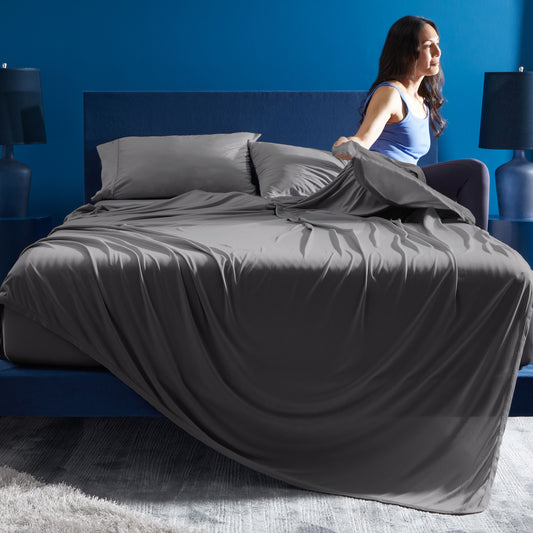
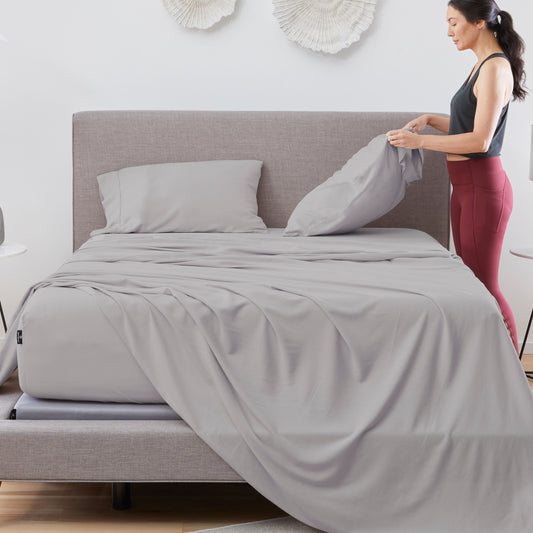
We get it. Choosing sheets used to be simpler. You picked a thread count, grabbed a color, and called it a done deal. That said, performance sleep brands changed that equation; now there are proprietary fabrics, cooling technologies, and engineered fits to sort through. That's a good thing for sleepers. However, it just means the comparison work matters more.
Don't worry, though, because we're here to help, and we tell you how it is straight up. To start, BEDGEAR, Tempur-Pedic, and SHEEX are three of the more prominent names in this space, but you'll fin that each has a distinct approach to what sheets should do; not all of those approaches hold up under scrutiny. This breakdown covers every category head-to-head so you know exactly what you're buying and what you're trading away.
BEDGEAR, Tempur-Pedic, and SHEEX at a Glance
Before getting into the detail, here's a side-by-side snapshot of BEDGEAR, Tempur-Pedic, and SHEEX across the five categories that matter most for sheet performance. The full breakdown follows below.
As you can see, the categories above tell most of the story. What follows is the full reasoning behind each rating so you can see exactly where the gaps are and why they matter in practice.
The Thread Count Myth
Before comparing brands, it's worth addressing the metric most people still use to evaluate sheets: thread count. It's printed on every package, heavily marketed, and almost entirely misleading as a quality indicator.
Thread count measures how many threads are woven into one square inch of fabric. The idea that higher is better made sense when sheet manufacturers were using single-ply yarn and honest weaving methods. It stopped making sense when brands started twisting multiple thinner threads together, counting each strand individually, and calling the result a 1,000-thread-count sheet. The fabric isn't better; the math is just different.
Higher Thread Count Means Less Airflow
Here's what the thread count conversation usually skips: a denser weave means less space for air to move through the fabric. For hot sleepers, a 600-thread-count cotton sheet can actively trap body heat. The sheet feels substantial in your hands at the store and suffocating by 3am.
BEDGEAR's approach runs counter to that entirely. Lower thread counts, used deliberately, create an open structure that promotes airflow rather than blocking it. That's the foundation the performance fabric technologies are built on. To clear it all up, we break down exactly why thread count is the wrong number to chase, and what actually determines how well a sheet performs while you sleep.
What Actually Matters in a Sheet
Thread count tells you nothing about moisture management, cooling technology, fitted sheet grip, or durability. Those are the variables that determine whether your sheets are helping your sleep or just covering your mattress. The comparison below is built around those variables; not the number on the package.
BEDGEAR vs. Tempur-Pedic: The Full Comparison
Tempur-Pedic built its reputation on mattresses. Their sheets came later; and in several meaningful ways, it shows. The brand recognition is strong, but the sheet lineup leans on conventional materials that don't match the performance standard most Tempur-Pedic customers expect from the brand.
BEDGEAR, by contrast, started from a performance sleep framework and built the sheet program around the same engineering principles as the rest of the lineup. That difference shows up clearly in breathability, fabric innovation, and the overall experience for hot sleepers.
Breathability and Temperature Management
This is where the gap between the two brands is most significant. Two of Tempur-Pedic's four sheet options use cotton as the primary construction material. Higher thread count cotton might feel luxurious on contact, but it works against you thermally; the tighter the weave, the less room there is for air to circulate. For sleepers who already run warm, though, that's a real problem and not a theoretical one.
The good news is that BEDGEAR's lineup is built around the opposite philosophy. Lower thread counts, used deliberately, mean more open structure for airflow. Toss in proprietary performance technologies on top of that and you get sheets that don't just allow heat to escape; they actively work to move it away from your body. Dri-Tec, for example, disperses heat and wicks moisture. On the other hand, Ver-Tex delivers an instant cool-to-the-touch feel from the first moment of contact. In fact, neither of those options exists in Tempur-Pedic's sheet program.
Fabric Innovation and Sheet Variety
Tempur-Pedic offers four sheet options. BEDGEAR offers six; and the range covers meaningfully different sleep profiles. First and foremost, the Hyper-Cotton set gives you softness alongside optimized airflow. On the other hand, Hyper-Linen delivers a relaxed, breathable feel suited to warmer climates and warmer sleepers. The knit and woven options in the lineup give sleepers choices based on texture preference, not just brand availability.
Tempur-Pedic's sheet selection is narrower and less differentiated. You're largely choosing between softness levels and colorways; there's no equivalent to BEDGEAR's fabric technology stack.
BEDGEAR vs. Tempur-Pedic: How They Compare
Here's how the two brands stack up across every category that affects your sleep. The gap is wider than most people expect from two names that both show up in the premium bedding space.
| Category |
BEDGEAR Winner
|
Tempur-Pedic |
|---|---|---|
| Breathability | Purpose-built airflow construction; lower thread counts by design | Half the lineup uses cotton; limited airflow at higher thread counts |
| Cooling Technology | Dri-Tec moisture-wicking; Ver-Tex instant cool-to-the-touch | No proprietary cooling fabric technology |
| Sheet Variety | 6 styles across knits, wovens, and hybrid fabrics | 4 styles; limited differentiation beyond softness level |
| Hot Sleepers | Specifically engineered for thermal management | Cotton options trap heat; inconsistent performance |
| Moisture Management | Active moisture-wicking built into Dri-Tec fabric | Standard absorption; no active wicking |
| Sustainability | Lower thread counts reduce energy use and laundering frequency | No stated sustainability advantage in sheet construction |
| Brand Expertise | Performance sleep brand; sheets are a core product category | Mattress brand; sheets are an extension product |
Tempur-Pedic makes excellent mattresses. Their sheets are a different story. Half the lineup relies on cotton, which means half the lineup works against hot sleepers rather than for them. BEDGEAR's purpose-built performance fabrics solve the problems Tempur-Pedic's sheets create.
BEDGEAR vs. SHEEX: The Full Comparison
SHEEX started in athletic fabrics and translated that into bedding, and we respect that. After all, the concept is sound; performance fabrics that feel like your favorite workout gear, applied to sleep. In practice, though, the execution has some well-documented gaps that matter more than they might initially seem.
BEDGEAR operates from a similar premise but with one critical difference: the engineering doesn't stop at the fabric. Fit, durability, and base compatibility all get the same attention as material performance; and that's where SHEEX falls short.
Comfort and Fit
SHEEX sheets use athletic fabric construction and are designed to mimic the feel of moisture-wicking activewear. For many sleepers, that's genuinely comfortable; the fabric is soft and breathable. The problem is what happens during the night. SHEEX sheets have a documented tendency to shift on the mattress. If you move around in your sleep (and most people do), you'll spend part of your night readjusting sheets that have crept off the corners.
BEDGEAR's fitted sheets use Powerband technology; a grip system built into the sheet itself that locks to the mattress edge and stays there. It holds through the night, and it holds through adjustable base movement, which SHEEX isn't specifically designed for. If you're on an adjustable base, that distinction becomes critical every time you change position.
Durability and Long-Term Performance
Pilling is the other SHEEX issue. The athletic fabric construction that makes the sheets feel soft initially is also prone to developing fabric pills over time. Pilling isn't just cosmetic; it changes how the sheet feels against your skin and signals that the fabric is breaking down faster than it should for a premium product.
BEDGEAR sheets are engineered with the same durability standard as the rest of the Performance® sleep system. The fabrics are designed to hold their feel and function over extended use; not to perform well out of the package and degrade from there.
BEDGEAR vs. SHEEX: How They Compare
Fit and durability are where this comparison gets decided. Both brands use performance fabrics; only one of them engineered the rest of the sheet to match.
| Category |
BEDGEAR Winner
|
SHEEX |
|---|---|---|
| Fitted Sheet Grip | Powerband locks to the mattress; stays put all night | Reported shifting during sleep; requires readjustment |
| Adjustable Base Compatibility | Specifically engineered to hold during base movement | Not designed for adjustable base use |
| Fabric Feel | Athletic softness designed to perform across a full lineup | Soft initial feel; comfort level varies by style |
| Durability | Engineered for long-term performance | Pilling reported; fabric integrity decreases over time |
| Cooling Technology | Dri-Tec and Ver-Tex proprietary systems | Athletic moisture management; no proprietary cooling tech |
| Sheet Program Depth | 6 styles covering a wide range of sleep preferences | Multiple options but narrower performance differentiation |
| Sleep System Integration | Designed to work with BEDGEAR mattresses, pillows, and bases | Standalone product; less integration focus |
SHEEX got the fabric concept right but didn't finish the engineering. A sheet that feels good but shifts off the mattress is a sheet you'll be fighting through the night. BEDGEAR's Powerband addresses that problem specifically; and the durability story holds up over time in a way that SHEEX's hasn't.
Not Sure Which Sheet Set Is Right for You?
BEDGEAR's Performance Sheet Selector helps match you to the right fabric, cooling level, and feel based on how you actually sleep. Hot, cold, active, still — there's a sheet set engineered for it.
BEDGEAR's Performance Sheet Lineup
Understanding why BEDGEAR outperforms the competition requires understanding what each sheet in the lineup is actually built to do. The six-style program isn't variety for variety's sake; each option solves a specific sleep problem.
Dri-Tec® Sheet Set: The Best for Hot Sleepers
The Dri-Tec sheet set is built for sleepers who wake up hot. The fabric actively moves moisture away from the body and disperses heat across a larger surface area, preventing the buildup that turns a warm sleeper into a restless one. It's the most aggressive thermal management option in the lineup; and for sleepers who run warm all night, it's the right place to start.
Ver-Tex® Sheet Set: The Best for Instant Cooling
Ver-Tex is cool the moment you get into bed. The fabric reacts to body heat on contact and delivers an immediate cool-to-the-touch sensation. For sleepers who overheat at the surface rather than across the whole night, Ver-Tex is the more targeted solution. Pair it with a cooling pillow and you've addressed both the head and the body simultaneously.
Hyper-Cotton Sheet Set: The Best for Natural Fiber Feel
The Hyper-Cotton sheet set gives you the softness and natural feel of cotton alongside the open-structure airflow that conventional high thread count cotton doesn't provide. If you want the familiar feel of a cotton sheet without the thermal drawbacks, Hyper-Cotton is the answer. It's the natural fiber option that doesn't compromise on breathability.
Hyper-Linen Sheet Set: The Best for Warm Climates
Linen has always been a warm-weather fabric; BEDGEAR's Hyper-Linen sheet set takes the breathability and relaxed feel of traditional linen and optimizes the construction for performance sleep. It's lightweight, airy, and gets softer with use. For sleepers in warmer climates or anyone who runs hot year-round, it's one of the most comfortable options in the lineup.
Here's the full lineup at a glance, including who each style is built for and the technology behind it.
| Sheet Set | Best For | Key Technology |
|---|---|---|
| Dri-Tec® | Hot sleepers; night sweats | Active moisture-wicking; heat dispersal |
| Ver-Tex® | Instant cooling; surface heat | Cool-to-the-touch fabric technology |
| Hyper-Cotton | Natural fiber softness; airflow | Optimized cotton weave; breathable construction |
| Hyper-Linen | Warm climates; year-round heat | Performance linen; lightweight airflow |
| Knit Styles | Athletic feel; stretch comfort | Performance knit fabric; Powerband grip |
| Woven Styles | Traditional feel; structured hand | Performance woven fabric; Powerband grip |
Sustainability: Where BEDGEAR Pulls Further Ahead
The sustainability angle on bed sheets isn't one most brands spend time on. BEDGEAR's approach to it is worth understanding because it's not a marketing add-on; it's built into the product design itself.
Cotton sheets with high thread counts require more energy to dry because the dense weave holds more moisture. BEDGEAR's lower thread count, open-structure fabrics dry faster with less energy. That's a consumption difference that adds up across a year of laundry cycles. The breathable construction also discourages bacterial growth; which means you need to wash the sheets less frequently to maintain freshness. Less laundering means less water, less detergent, and less fabric degradation over time.
For Tempur-Pedic, the cotton-heavy options in the lineup work against this on every dimension. For SHEEX, the pilling issue means fabrics degrade faster, which shortens the product lifecycle and generates more waste. BEDGEAR's sheets are designed to last and to do so with a smaller environmental footprint per wash cycle.
Frequently Asked Questions
Common questions about BEDGEAR, Tempur-Pedic, and SHEEX sheets, answered.
How Do BEDGEAR Sheets Compare to Tempur-Pedic Sheets?
How Do BEDGEAR Sheets Compare to SHEEX Sheets?
What Makes BEDGEAR Sheets Different from Other Brands?
Are BEDGEAR Sheets Good for Hot Sleepers?
Are BEDGEAR Sheets Sustainable?
BEDGEAR vs. Tempur-Pedic vs. SHEEX: The Bottom Line
Comparing BEDGEAR, Tempur-Pedic, and SHEEX sheets comes down to one question: what do you actually need your sheets to do? If the answer is "look nice and feel soft," all three will get you there. If the answer involves temperature, fit, durability, or long-term performance; the comparison isn't close.
Tempur-Pedic built a dominant mattress brand. Their sheets coast on that reputation; and for hot sleepers, two of their four options actively work against you. SHEEX understood the performance fabric concept but didn't solve the fit problem; a sheet that shifts off the mattress at 2am hasn't finished the job. BEDGEAR's six-style lineup solves for every sleep profile with purpose-built fabrics, a fitted sheet that stays put, and a sustainability story that holds up under scrutiny.
Thread count won't tell you any of that. The right sheet for your sleep will.
Sheets That Actually Perform
Six styles. Proprietary cooling technology. A fitted sheet that stays put. Sleep the way your body was built to.