Walk through any airport terminal and you'll see the same scene: a wall of U-shape pillows, a bin of inflatables, and travelers grabbing whichever is closest to the gate. That's how most people choose a travel pillow, and it's why so many end up unused in a closet, or worse, left at the hotel. That said, the four types of travel pillows solve genuinely different problems.
This guide compares common travel pillow types honestly. Each type gets its benefits and its drawbacks, because a pillow that's perfect for a backpacker can be a bad buy for a business traveler. By the end, you'll know exactly which type matches your kind of trip, and hey, it's a bonus if you go with ours.
How We're Comparing These Travel Pillows
Let's talk about how we're breaking this all down; this way, there's no confusion. Every type gets measured against the same six criteria: neck support, in-transit comfort, in-bed usability, packability, durability, and washability.
Those six cover the two jobs a travel pillow can hold; keeping you comfortable while you're moving, and supporting real sleep once you stop. Here's why each criterion made the list, and how to weight them for your own travel style.
Support in Transit and Support in Bed
These are two different jobs, and most travel pillows only apply for one of them. Seated support means keeping your head from rolling or snapping forward while you doze upright in a seat; that's a bracing problem. In-bed support means holding your head level with your spine while you lie down for a full night; that's an alignment problem, and it changes with your sleep position.
A pillow can be great at one and useless at the other, which is why we score them separately. Think about where your actual sleep happens on a typical trip. If ninety percent of it happens in a hotel bed, the in-bed column should drive your decision far more than the seated one.
Packability and Durability
Packability is the obvious travel criterion, but it's a spectrum, not a yes-or-no. There's a real difference between a pillow that vanishes into a jacket pocket and one that rides comfortably strapped to a carry-on handle. The question isn't which packs smallest; it's whether the packed size fits the way you travel.
Durability is packability's hidden partner, because travel is rough on gear. A pillow gets crushed in bins, snagged on zippers, and compressed hundreds of times over its life. However, a design that saves space but dies in a season costs more per trip than one that holds up, so we score how each type ages, not just how it performs new.
Washability and Hygiene
A travel pillow touches more questionable surfaces in one trip than your home pillow sees in a year. Airplane seats, terminal floors, rental cars, and hotel luggage racks all leave their mark. A removable, machine-washable cover means every trip starts clean; a sealed or wipe-down-only design means the grime is cumulative.
This criteria gets overlooked at the checkout and regretted at the laundry machine. It also separates products built for years of travel from products built to be replaced. We weight it heavily, and once you've traveled with a washable pillow, you probably will too.
One note on fairness before we start, though. Each of these designs wins somewhere, and we'll say so plainly, even for the types we don't make. The goal is matching you to the right pillow, not steering you to a predetermined answer. And hey, maybe we'll have the one you're looking for soon.
Side-by-Side: All Four Types Compared
Seeing the criteria in one place makes the trade-offs obvious. Here's how the four types of travel pillows score across the six factors that matter most.
| Criteria | U-Shape | Inflatable | Compressible | Full-Size |
|---|---|---|---|---|
| Seated Support | Strong laterally; can push head forward | Fair; shifts under movement | Weak; too floppy to brace | Strong against window or chest |
| Works in Bed | No | Technically; air feel, not fill | Yes, but loft is low for side sleepers | Yes; every sleep position |
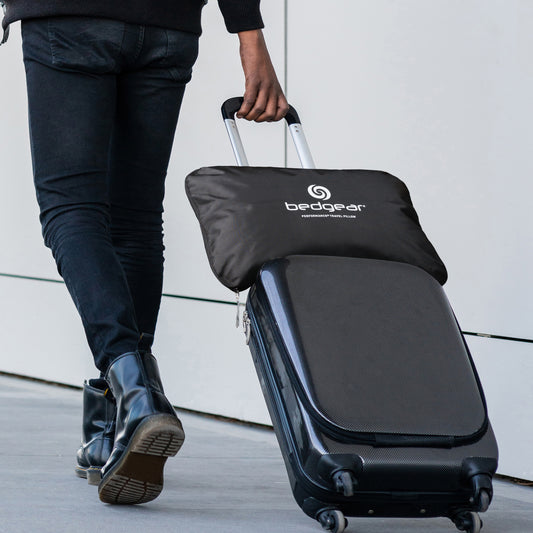
| Packed Size | Bulky; usually worn, not packed | Smallest by far | Water bottle sized | Compact case; straps to luggage |
| Durability | Fill flattens over time | One puncture ends it | Fill degrades with compression | Quality fill holds loft; case protects it |
| Washability | Often not removable | Wipe-down only | Often machine washable | Removable, washable covers on quality models |
| Best Trip Type | Short flights, upright naps | Ultralight backpacking | Camping and road trips | Hotels and multi-night travel |
Read down the columns and each type's identity is clear. The U-shape is a seated-sleep specialist, the inflatable is a weight-savings specialist, and the compressible is a campsite specialist. The full-size is the generalist; it's the only column without a "no" in it, which is exactly why it suits the widest range of trips. The sections below unpack each column, one pillow type at a time.
U-Shape Neck Pillow
The horseshoe around every airport traveler's neck is the most recognizable travel pillow on Earth. It's a specialist tool with one job, and it's worth understanding both what it does well and where it quietly fails.
Benefits of the U-Shape Neck Pillow
For upright seated sleep, the U-shape does something no other design can: it braces the head on three sides. When you nod off in a seat, your head wants to roll sideways or snap forward, and the side arms of a good U-shape catch that motion. For a two-hour flight in a middle seat, that lateral support is genuinely useful.
It's also the most convenient option in the category. It wears hands-free around your neck through security and boarding, requires zero setup, and sits at the lowest price point of any type.
If your travel sleep happens exclusively sitting up, the U-shape earns its popularity.
Drawbacks of the U-Shape Neck Pillow
Did you know that the U-shape design has a hidden posture problem. Many U-shapes are thickest at the back of the neck, which pushes the head forward and out of line with the spine; that's the exact position that leaves your neck sore after a nap. Fit varies wildly between models, and the cheap ones are the worst offenders.
The bigger limitation is that the U-shape retires the moment you land. It can't support your head lying down, so it does nothing for the five hotel nights that follow the five-hour flight.
Add in that many models lack removable, washable covers, and you're carrying a single-purpose item that gets less sanitary with every trip.
Inflatable Travel Pillow
The inflatable is the minimalist's answer; a pillow that essentially disappears when you're not using it. Its case is strongest at the extreme light end of travel, and weakest everywhere else.
Benefits of the Inflatable Travel Pillow
Nothing packs smaller. Deflated, most inflatables fold to the size of a wallet and weigh a few ounces, which is why they own the ultralight backpacking world. When every item in your pack gets weighed in grams, the inflatable is the only pillow that survives the cut.
Air also brings adjustability. You control firmness breath by breath, from board-firm to barely-there soft, which no fixed fill can offer. For side-of-the-trail naps and hostel bunks on a shoestring budget, it's a smart, cheap tool.
Drawbacks of the Inflatable Travel Pillow
Air is not fill, and your head can tell. An inflatable supports by pressure rather than by conforming, so the feel is springy and bouncy instead of cradling. Turn your head and the whole pillow shifts; there's no contouring to hold you in place.
The materials compound the problem. Most inflatables have plasticky surfaces that crinkle with every movement and turn clammy against skin in a warm cabin.
And the entire product depends on an airtight seal, so one puncture or a slow valve leak ends the pillow mid-trip, usually somewhere you can't replace it.
Compressible Camp Pillow
The compressible pillow splits the difference; real fill that stuffs down into its own sack. It came out of the camping world, and that's still where it makes the most sense.
Benefits of the Compressible Camp Pillow
Unlike the inflatable, a compressible pillow feels like an actual pillow. The shredded foam or synthetic fill conforms to your head, and there's no valve to fail or seam to puncture. For car camping, road trips, and cabin weekends, it's a durable and forgiving companion.
Packed size is respectable too. Most models stuff to roughly the size of a water bottle, small enough for a duffel or a trunk without a second thought. Rugged shells shrug off dirt and campsite abuse, and many are machine washable whole.
Drawbacks of the Compressible Camp Pillow
When it comes to camp pillows, loft is the weak point. Most compressible pillows sit low and soft, which back sleepers can tolerate but side sleepers usually can't; there's simply not enough height to fill the gap between shoulder and ear. If you sleep on your side, expect to fold it double or stack it on something.
The compression that makes it packable also shortens its life. Repeatedly stuffing the fill breaks down its structure, so the pillow re-lofts slower and flatter with each season.
It's also an awkward fit for flights; too bulky to wear, too floppy to brace against a seat.
Full-Size Travel Pillow
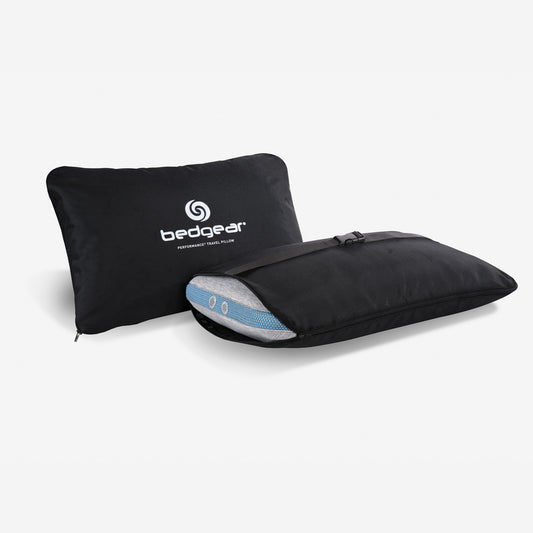
The full-size travel pillow takes the opposite approach from everything above: instead of shrinking a pillow until it barely functions, it scales a real performance pillow down to carry-on size. That makes it the only type built for both halves of the trip.
Benefits of the Full-Size Travel Pillow
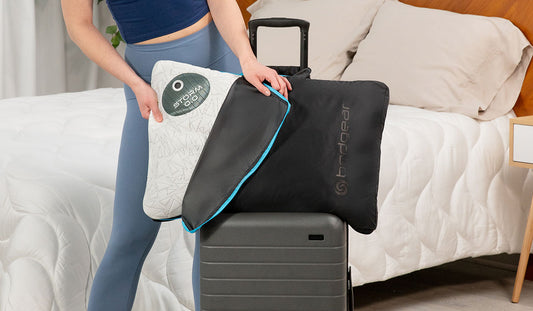
The headline benefit is that it works in a bed. At roughly 12" x 18", a full-size travel pillow supports back, side, and stomach sleeping just like the pillow at home, which means hotel pillow roulette stops mattering. Your neck gets the same support on night one in Denver as it gets every night in your own room.
It holds its own in transit too. Wedged between your head and the window it cushions better than a U-shape's thin arms, and hugged to your chest it supports upright posture on long hauls. Quality versions add removable, machine-washable covers and a protective travel case, which solves the hygiene problem every other type ignores.
Drawbacks of the Full-Size Travel Pillow
Honesty requires admitting the trade-offs. A full-size travel pillow takes more bag space than an inflatable and more money than a kiosk U-shape; quality comes at a higher price point. If your entire trip is a two-hour hop with no overnight, that's more pillow than the job requires.
It also doesn't wear hands-free around your neck, so wandering the terminal with it means strapping it to your bag. For ultralight backpackers counting grams, the 1.5-pound weight that seems trivial to most travelers is a dealbreaker. Every type has its lane; this one's lane is just wider than the others.
BEDGEAR's Full-Size Travel Pillow Options
This is the one type we make, so this is the one section where we'll point to our own. The Flow Performance® Travel Pillow wraps React™ fill in a soft, breathable Air-X® cover for a cozy, familiar feel. The Storm Performance® Travel Pillow adds a removable Ver-Tex™ cover with an instant-cooling feel for warmer sleepers.
The Mavericks Night Ice Performance® Travel Pillow is the maximum-cooling step-up, with a Cooling Active Core™ that prevents heat buildup inside the pillow and a special edition BEDGEAR x Mavs travel case. All three include washable covers and travel cases, and all three pack to the same carry-on-friendly footprint.
Which Type of Travel Pillow Should You Choose?
The honest answer depends on the trip, so here it is by scenario. If you're an ultralight backpacker measuring your pack in ounces, buy the inflatable and don't look back; nothing else competes at that weight. If your travel is car camping and road trips, the compressible camp pillow is durable, washable, and comfortable enough for a tent.
If your flights are short, your naps are upright, and you never sleep at the destination on anything but your own bed, a well-fitted U-shape covers you without a big spend.
But if your trips involve hotels, guest rooms, red-eyes, or more than a night away, the full-size travel pillow is the one type that works the entire trip. It's the strongest all-around choice for the way most people actually travel; that's not spin, it's just what the comparison shows.
Whichever type you land on, make sure it matches your sleep position first.
Ready for a Travel Pillow That Works the Whole Trip?
Our full-size Performance® travel pillows bring washable covers, breathable Air-X® construction, and a travel case that straps right to your carry-on.
Frequently Asked Questions
Still deciding between the types? These are the questions travelers ask most.
What Is the Best Type of Travel Pillow?
Are U-Shape Neck Pillows Bad for Your Neck?
Are Inflatable Travel Pillows Comfortable?
Can You Just Pack Your Regular Pillow?
Does a Travel Pillow Count as a Carry-On Item?
Choosing Between the Types of Travel Pillows Comes Down to the Trip
All four types of travel pillows earn their place somewhere; the mistake is buying for the airport kiosk instead of the itinerary. Match the pillow to the trip: inflatable for the trail, compressible for the campsite, U-shape for the upright nap, full-size for everything that ends in a bed.
For most travelers, most of the time, that last category does the heavy lifting. If your trips include hotels and guest rooms, a full-size performance travel pillow is the one piece of sleep gear that improves the flight and every night that follows. Your neck works hard at home; there's no reason it should work harder on vacation.