You're going to spend roughly 26 years of your life on a mattress. Not near one. Not next to one. On one. And yet most people spend more time picking a laptop than they do picking the surface their body recovers on every single night. That stops here.
This guide covers everything — sizes, types, materials, sleep positions, body types, and the questions nobody thinks to ask until they're three weeks into a back problem they didn't have before. BEDGEAR's approach has always been the same: sleep is personal, and the right mattress isn't the most expensive one or the most popular one. It's the one built for how you actually sleep.
What Your Mattress Is Actually Doing All Night
Most people think of sleep as the absence of activity. You close your eyes, the world goes away, and eight hours later you wake up. What's actually happening is the opposite. While you're unconscious, your body is running one of its most complex recovery cycles — repairing muscle tissue, consolidating memory, regulating hormones, and cycling through sleep stages that each serve a specific biological function.
Your mattress isn't just where this happens. It's either helping or getting in the way.
The difference between a mattress that supports that process and one that disrupts it isn't always obvious. You won't feel a bad mattress the moment you lie down. You'll feel it at 2am when you shift positions for the fourth time, or when you wake up stiff, or when you hit 3pm and can't explain why you're exhausted. The surface you sleep on shapes everything that follows.
Light Sleep
Transition into sleep. Easy to wake. Muscles begin to relax. ~5% of total sleep time.
Light Sleep
Heart rate slows, body temp drops. Memory consolidation begins. ~50% of total sleep.
Deep Sleep
Physical recovery: tissue repair, growth hormone release, immune function. Hardest to wake from.
REM Sleep
Cognitive recovery: memory consolidation, emotional processing, mental restoration.
A mattress that creates pressure points, traps heat, or transfers motion can pull you out of deep sleep or REM without you ever fully waking up. You just feel it the next day.
Temperature Regulation and Sleep Quality
Your core body temperature naturally drops as you fall asleep — it's one of the signals your brain uses to initiate and maintain sleep cycles. When your sleep surface traps heat, it works against that process. Research consistently links thermal discomfort to increased nighttime waking, reduced time in deep sleep, and lower overall sleep quality.
This is why mattress materials aren't just a comfort preference — they're a physiological factor. BEDGEAR's Performance® Mattresses are engineered with breathable airflow systems specifically to support your body's natural temperature drop, not fight it.
Spinal Alignment and Morning Pain
Your spine has a natural curve — and it needs to maintain that alignment throughout the night. When your mattress is too soft, too firm, or worn unevenly, it forces your spine out of position for hours at a time. The muscles along your back, hips, and neck compensate, staying partially engaged through the night to hold your body in place. That's not recovery — that's your body working a night shift it didn't sign up for.
"Your mattress is just as important as any other tool in your recovery routine." — Dr. Glen Rowell, PT, DPT
The right mattress holds your spine in neutral alignment regardless of sleep position, so those muscles can actually switch off.
Motion Transfer and Shared Sleep
If you share a bed, your sleep quality is partially dependent on how well your mattress absorbs movement. Every time your partner shifts, rolls over, or gets up, that motion travels through the mattress surface. Low motion isolation means those micro-disturbances reach you — sometimes enough to shift your sleep stage, often without waking you fully. Over weeks and months, that interrupted sleep adds up.
A mattress with strong motion isolation doesn't just make things quieter. It makes recovery more consistent, for both of you.
Mattress Size Comparison Chart
Need a quick size reference? The chart below covers every standard mattress size — dimensions, who it's built for, and where it makes sense.
| Size | Dimensions | Best For | Min. Room | BEDGEAR Fit |
|---|---|---|---|---|
| Twin 38" W × 75" L | 38" × 75" | Kids, bunk beds, tight spaces | 7 × 10 ft | Solo / Kids |
| Twin XL 38" W × 80" L Split king ready | 38" × 80" | Tall solo sleepers, split king base | 8 × 10 ft | Solo / Couples (split) |
| Full 54" W × 75" L | 54" × 75" | Solo sleepers wanting more width | 10 × 10 ft | Solo |
| Queen 60" W × 80" L Most popular | 60" × 80" | Couples, most bedrooms | 10 × 10 ft | Couples |
| King 76" W × 80" L | 76" × 80" | Couples who want max space | 12 × 12 ft | Couples / Split |
| Cal King 72" W × 84" L Longest size | 72" × 84" | Tall sleepers over 6'2" | 12 × 12 ft | Solo / Couples |
This is only a quick glance at mattress sizes, and you read more about them below or check out our in-depth mattress size guide.
Which Mattress Size Is Actually Right for You?
Picking the wrong mattress size is the kind of mistake you don't fully appreciate until you're living with it. Too small and you're negotiating space every night. Too large and your bedroom feels like the mattress chose the apartment. The right size comes down to three things: your room dimensions, who you're sharing the bed with, and how you actually sleep.
Best Mattress for Couples (And Pets): The King Size Mattress
A king size mattress measures 76 inches wide by 80 inches long — the widest standard mattress size available. For couples who run hot, move frequently, or just want to sleep without negotiating space, a king gives both people room to actually spread out. It's also the natural choice for anyone who shares a bed with a pet that has opinions about personal space.
The tradeoff is square footage. A king needs a room that can comfortably accommodate it — most sleep experts recommend at least a 12 × 12 foot bedroom. If your room is tight, a king can make it feel like the mattress moved in and you're the guest.
Consider split king if you and your partner have different firmness preferences or use an adjustable base. Two twin XLs side by side — and suddenly two completely different sleep setups coexist in the same bed without either person compromising.
Best Mattress for Tall Sleepers: The California King
A California king measures 72 inches wide by 84 inches long. It's four inches narrower than a standard king but four inches longer. If you're under 6 feet tall, a standard king is almost certainly the better choice. If you're over 6'2" and tired of your feet hanging off the end of every mattress you've ever owned, the California king was built for you.
One practical note: California king bedding is its own category. Sheets, protectors, and bed frames designed for a standard king won't fit — worth factoring into the full cost of the decision.
The Best Mattress for Most Situations: The Queen Size Mattress
A queen size mattress measures 60 inches wide by 80 inches long. It's the best-selling mattress size in the country — and the reason isn't complicated. It works for most people in most situations. Solo sleepers get generous room to move. Couples fit comfortably without requiring a large bedroom. And it drops into most standard bedrooms without the spatial negotiation a king demands.
You'll find that queen mattresses are the most widely supported size across frames, sheets, protectors, and accessories. That availability and standardization is part of why it dominates — and part of why it's the easiest starting point if you're building a sleep setup from scratch.
The Best Mattress for Solo Sleepers: The Full Size Mattress
A full size mattress measures 54 inches wide by 75 inches long. For solo sleepers who want more surface area without committing to queen-sized square footage, a full delivers. It fits comfortably in smaller bedrooms, guest rooms, and studio apartments where a queen would dominate the space.
The case for a full gets complicated the moment a second person enters the picture — at 54 inches wide, two adults share 27 inches each. For couples, a full is a short-term solution at best. One note: at 75 inches long, anyone over 6'1" will feel the difference. If height is a factor, step up to a queen or consider a twin XL.
The Best Mattress for College Students: The Twin XL Mattress
A twin XL measures 38 inches wide by 80 inches long — the same length as a queen and a king, making it one of the better options for tall solo sleepers who don't need width but do need length. Twin XL mattresses are also the building block of a split king: two twin XLs side by side, each on its own adjustable base, giving couples complete individual control over firmness and position.
Where the twin XL quietly earns its place is in guest rooms, smaller spaces, and any setup where an adjustable base is part of the plan. The split king configuration in particular is one of the most underutilized solutions for couples with different sleep needs — and it starts here.
The Best Small Mattress: The Twin Mattress
A twin mattress measures 38 inches wide by 75 inches long — the smallest standard mattress size available. It's the default choice for kids' rooms, bunk beds, and tight spaces. For children transitioning out of a crib or toddler bed, a twin is the natural next step and one they can comfortably grow into for years.
For adults, the twin is an honest trade-off. The 75-inch length makes it a poor fit for anyone over 5'11". It's the most affordable entry point into any mattress category — ideal for kids, light-traffic guest rooms, or budget-conscious shoppers. But don't buy one as a compromise when what you actually need is a full.
The Best Mattress Type for You
A mattress's construction, materials, and design determine how well your body recovers, how cool you sleep, and how much you feel your partner moving at 3am. Understanding the differences between types isn't about finding the "best" mattress — it's about finding the right one for how your body actually works.
Cooling
For hot sleepers — active airflow, breathable layers, temperature regulation built in.
Hybrid
Best all-around — foam comfort + coil support + motion isolation + airflow.
Split Head
For couples with different preferences — independent head adjustment per side.
Modular
For customization — swappable comfort layers, evolves with your sleep needs.
Adjustable Base
Foundation upgrade — elevation for snoring, reflux, recovery, and back pain.
Air / Futon
Specialty use — maximum adjustability or dual-purpose guest/studio spaces.
The Best Mattress for Hot Sleepers: Cooling Mattresses
If you've ever woken up at 2am to flip your pillow to the cold side, you already know why a cooling mattress exists. Overheating is the single most common cause of nighttime waking, and the bad news is that most traditional mattresses are part of the problem. Dense foam layers trap body heat, and without active airflow, that heat has nowhere to go.
A cooling mattress is engineered specifically to counter that: breathable materials, airflow channels, and cooling fabrics that actively dissipate heat rather than just passively allowing it to escape. BEDGEAR's M5 Night Ice Performance® Mattress combines a conforming memory-foam feel with ventilated foam layers and breathable mesh construction that promotes continuous airflow. The result is a mattress that works with your body's natural temperature drop. Looking for a more budget-friendly option? Consider the S Performance® Mattress instead.
The Best All-Around Mattress: The Hybrid Mattress
The hybrid mattress exists because foam and coils each solve different problems, and most sleepers need both solved at once. Foam layers conform to your body, relieving pressure points and absorbing motion. Coil systems provide support, promote airflow, and give the mattress the responsive feel that pure foam can't match. A well-built hybrid doesn't feel like a compromise — it feels like someone finally stopped making you choose.
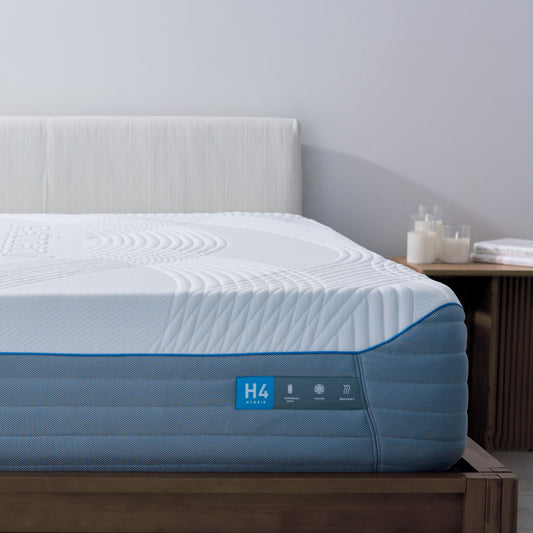
BEDGEAR's H Performance® Mattress features ventilated foam comfort layers sitting above individually wrapped coils with suspension units that adapt to your body weight and position. The wrapped coils work independently — motion on one side of the bed stays on one side — while the breathable mesh border and air vents keep airflow moving all night.
Performance® Sleep Systems — Engineered for Recovery
Every BEDGEAR mattress is built around the variables that actually matter: body type, sleep position, temperature, and who you're sharing a bed with. Not a one-size-fits-all assumption.
The Best Mattress for Couples: Split Head Mattress
A split head mattress divides the upper portion of the mattress into two independent sections while keeping the base unified. Each sleeper can adjust the head of their side independently — elevating for reading, watching, or managing acid reflux — without affecting their partner's position at all.
The split head configuration pairs naturally with an adjustable base. One partner elevates for late-night reading. The other lies flat. Neither person negotiates, neither person compromises, and neither person wakes the other up adjusting position at midnight. For couples who have spent years working around each other's sleep preferences, a split head mattress is often the solution they didn't know existed. Want to learn more about split head mattresses? We have a great read about split head king mattresses.
The Best Mattress for Customization: Modular Mattresses
Most mattresses are built on an assumption: that your sleep needs are fixed, fully understood at the point of purchase, and identical to the person sleeping next to you. None of those things are reliably true. A modular mattress challenges that assumption by making the comfort layers replaceable and adjustable — so the mattress evolves with your needs rather than becoming obsolete when they change.
BEDGEAR's Modular Hybrid Mattress Collection allows comfort layers to be swapped out to adjust firmness and feel without replacing the entire mattress, accommodating two different configurations on the same bed — one side firm, one side soft, each optimized for the person sleeping on it. The M5 Night Ice Performance® Mattress sits at the top of this system, combining modular construction with 3X cooling technology and a washable cover.
The Best Mattress for Flexibility: Adjustable Base Mattresses
An adjustable base isn't a mattress type — it's the foundation that makes every other mattress decision more powerful. By allowing the head and foot of the bed to elevate independently, an adjustable base transforms a static sleep surface into one that actively supports your body in the position it needs. Elevated head positions reduce snoring and acid reflux. Elevated foot positions relieve lower back pressure. Zero-gravity positioning distributes body weight evenly and is widely used for recovery and pain management.
On a split configuration, both partners control their own side independently. BEDGEAR's adjustable bases are engineered to work seamlessly with their Performance® Mattress lineup, including the Powerband® Secure Fit system on all BEDGEAR protectors and sheets — so everything stays in place regardless of position.
The Futon Mattress — More Versatile Than You're Giving It Credit For
The futon mattress has spent decades being underestimated. In reality, it's one of the most practical sleep solutions available for the right situation — a dual-purpose surface that functions as both a sofa and a bed without requiring two separate pieces of furniture. For studio apartments, guest spaces, and rooms that need to work harder than a single-use bedroom, a futon mattress is a genuinely smart choice.
What separates a good futon mattress from a bad one is construction. Thin, poorly supported futon mattresses create the back pain reputation that follows the category around. If you're buying a futon mattress for a space that sees regular nightly sleep, treat it like any other mattress decision: match the construction to the sleep need.
The Good Old Air Mattress
Modern air mattresses use adjustable air chambers as a support system, allowing firmness to be dialed in precisely rather than locked into whatever the foam or coil construction allows. For couples with different firmness preferences, a dual-chamber air mattress means both people get exactly what their body needs without either person settling.
The use cases are specific but genuinely underserved: sleepers whose preferences shift over time, couples at opposite ends of the firmness spectrum, and anyone recovering from an injury who needs to adjust support as their body changes. If your sleep needs are static and well-understood, a hybrid or foam mattress will likely serve you better. But if adjustability is the priority, a quality air mattress solves problems that no fixed-construction mattress can.
Buying a Kids Mattress: What Parents Get Wrong
Most parents spend more time researching a car seat than a mattress — which is backwards. A child spends 10 to 14 hours a day sleeping, depending on their age. The surface they sleep on affects spinal development, sleep quality, and how they show up the next day.
The two most common mistakes: buying too soft and buying too small. A mattress that feels plush and comfortable to an adult can lack the support a growing spine actually needs. And parents who buy small to save money often find themselves replacing the mattress two years later anyway.
Crib Mattress — The Foundation That Starts Before Day One
A crib mattress is one of the most safety-critical purchases a parent makes. The American Academy of Pediatrics is unambiguous: infants should sleep on a firm, flat surface with no soft bedding, pillows, or padding. A crib mattress that is too soft creates a suffocation risk. Firmness here is a safety specification, not a comfort preference.
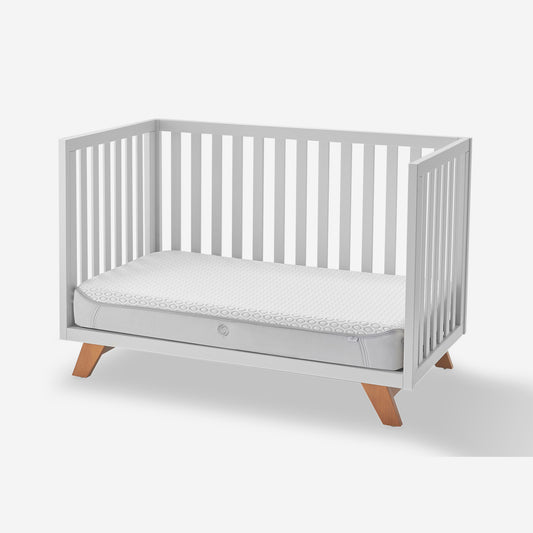
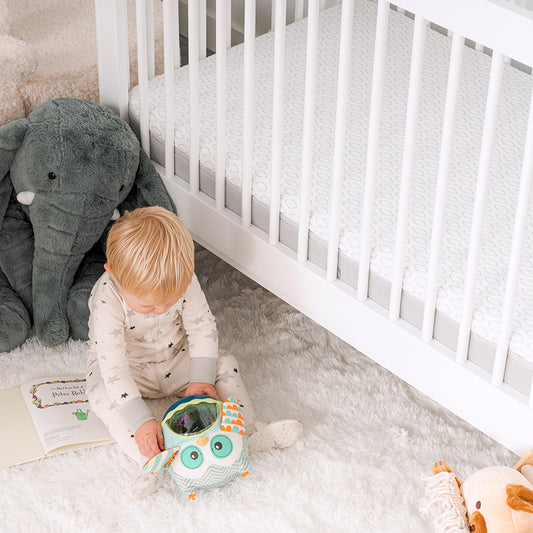
Standard crib mattress dimensions are 28 inches wide by 52 inches long. The fit test is simple: if you can fit more than two fingers between the mattress and the crib frame, the mattress is too small. BEDGEAR's Air-X Performance® Crib and Toddler Mattress is built for this stage — firm, flat, and engineered with Air-X breathable construction that promotes continuous airflow. Pair it with the Dri-Tec Crib Mattress Protector from day one. Moisture-wicking, waterproof, and washable — because it will need to be. Regularly.
Toddler Mattress — Firm, Safe, and Built for the Transition
A toddler mattress is the bridge between a crib and a full kids' bed — and firmness remains the non-negotiable. Toddlers need a firm, flat sleep surface to support proper spinal alignment during some of the most rapid physical development of their lives. This is one of the rare cases where comfort and support diverge, and support wins every time.
Most crib mattresses, including BEDGEAR's Air-X Performance® Crib and Toddler Mattress, are designed to carry through the toddler stage as well — so the transition from crib to toddler bed doesn't automatically mean a new mattress. The Dri-Tec Kids Performance® Mattress Protector is built for this stage — moisture-wicking fabric that handles the inevitable accidents while keeping the sleep surface breathable and dry.
Kids Mattress — Built for the Years That Actually Wear a Mattress Out
Once a child moves into a twin or full bed, the mattress requirements shift. Support is still the priority — but now you're also dealing with a kid who moves, sweats, grows three inches in a year, and tests the limits of every surface they sleep on. A kids' mattress needs to hold up to all of that while still delivering the sleep quality a growing body needs.
BEDGEAR's X1 Kids Performance® Mattress brings the same performance engineering as the adult lineup — breathable construction, proper support layers, and materials designed to regulate temperature — scaled for a child's body and sleep needs. Pair it with the Astro Kids Pillow, which comes with a bonus pillowcase and is designed to support younger sleepers who need proper neck alignment without the loft of an adult pillow.
The Right Mattress Changes Everything
Sleep isn't a passive activity. It's the most important recovery tool you have — and your mattress is either working for you or against you every single night. The wrong one shows up as back pain, 3am wakeups, afternoon exhaustion, and years of compounding sleep debt you never quite shake. The right one disappears beneath you and lets your body do what it's actually supposed to do while you're sleeping.
What makes a mattress right has nothing to do with price points or popularity. It comes down to your body type, your sleep position, your temperature, and who you're sharing a bed with. BEDGEAR builds every mattress around those variables — not around a one-size-fits-all assumption that stopped making sense the moment two different people tried to share the same sleep surface.
If you're not sure where to start, start with the body. How you sleep, how hot you run, and how much you move during the night will tell you more about the right mattress than any review ever will. BEDGEAR's sleep experts are trained to match sleepers to their system — not to sell the most expensive option, but to find the configuration that actually works.
Frequently Asked Questions
Have more questions about choosing the right mattress? We answer the most common ones below.