Your neck spends more time in one position during sleep than it does in any other single activity during the day. When that position is off (even slightly) the muscles alongside the cervical spine stay partially activated to compensate, and that's just a terrible mix. When this happens, neck muscles can't fully relax. They don't recover. And you feel it the moment you wake up.
The good news is that neck pain from sleep is a pillow fit problem more often than it's anything else. It's not about brand or price point; it's about whether the pillow you're using is actually matched to your body and your sleep position. This piece covers what the science says, what to look for, and how to find what works. Read on to learn more and discover the best pillows for neck pain.
Your Pillow Is Probably the Problem
It's easy to chalk morning neck stiffness up to stress, age, or just bad luck. But there's a more straightforward explanation most people overlook entirely. In fact, the experts agree with us on this one.
Expert Perspective"Most people don't realize this, but your pillow plays a huge role in how your neck feels every morning. When your pillow is wrong, your neck is forced into a bad position for 6–8 hours straight."
— Dr. Patrick Malartsik | Pain & Mobility Specialist
That's not a small thing. Six to eight hours of sustained misalignment is enough to produce the kind of muscle fatigue, stiffness, and tension that bleeds into the rest of your day. And because most people replace their pillow infrequently and choose by feel rather than fit, the problem compounds over time.
In fact, research published in the National Library of Medicine found that pillow height has a direct, measurable effect on cervical spine curvature and neck muscle activity during sleep. Therefore, a pillow that's too high or too low doesn't just feel uncomfortable; it changes how the muscles of the neck and upper back function through the night. The study found that an appropriate pillow height (specific to the sleeper's position and shoulder width) reduced neck muscle activity compared to pillows that were too high or too low.1
How Cervical Alignment Fits into the Pillow Conversation
The cervical spine has a natural inward curve, called lordosis. During sleep, the goal is to maintain that curve rather than flatten it or exaggerate it. A pillow that keeps the cervical spine in neutral alignment means the head, neck, and spine form a continuous, unforced line regardless of sleep position.
When a pillow is too thick, it pushes the head forward, flattening or reversing that curve and putting the posterior neck muscles under sustained stretch. When a pillow is too thin, the head drops toward the mattress and the lateral neck muscles on the opposite side are forced to compensate. Either scenario means those muscles are working when they should be resting, and that's bad news for recovery.
We found that a 2021 review in the National Library of Medicine noted that sleep posture is among the modifiable factors most consistently associated with musculoskeletal pain, with the cervical spine being particularly sensitive to pillow height and firmness.2 The review highlighted that pillow interventions, those specifically matching pillow characteristics to sleep position, showed measurable improvement in neck pain symptoms across multiple studies.
Why Pillow Shape Matters Too
A standard rectangular pillow distributes support evenly across a flat surface, regardless of the pillow size. That works reasonably well for back sleepers but creates a specific problem for side sleepers: the shoulder pushes against the lower edge of the pillow, reducing effective loft at the point where the neck actually needs it most.
A contoured or curved pillow shape addresses this directly. By conforming to the shoulder and supporting the neck simultaneously, it maintains the height relationship between head and spine without requiring the sleeper to position themselves perfectly on a flat surface. BEDGEAR's Cuddle Curve design works on this principle; the curved shape cradles the shoulder while keeping the neck supported, which is why it tends to outperform flat-form pillows for side sleepers dealing with neck and shoulder pain.
Loft, Fill, and Sleep Position
The three variables that determine whether a pillow helps or hurts your neck are loft (height), fill (what's inside), and shape. All three interact; getting one right without the others still leaves gaps. Here's how each one works and what the right choice looks like for each sleep position.
Loft recommendations are a starting point. Shoulder width, mattress firmness, and body size all affect the ideal height for any individual sleeper. BEDGEAR's PillowID quiz accounts for all of these variables.
Fill: What's Inside the Pillow
Fill affects both how a pillow supports the neck and how it responds to movement. So, a fill that's too rigid holds the head at a fixed height without conforming to the cervical curve. A fill that's too loose, on the other hand, compresses quickly and provides little consistent support. Finally, a responsive, medium-density fill sits between those extremes; it offers gentle conforming resistance that adapts slightly as the sleeper shifts position.
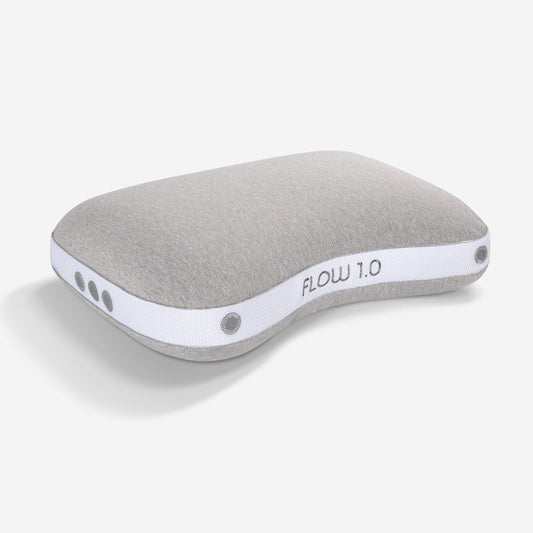
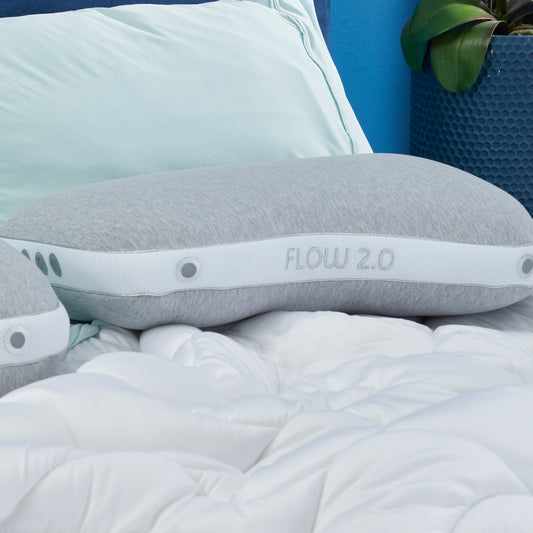
Memory foam fills conform closely but can resist repositioning; they're slow to recover when you change position, which can feel restrictive for active sleepers. Shredded or blended foam fills offer more adaptability. BEDGEAR's React™ blend fill combines shredded responsive foam with silk-like fibers, delivering a feel that's soft enough to relieve pressure but supportive enough to maintain cervical alignment. The Flow Cuddle Curve uses this construction; it's a strong option for back and side sleepers who need conforming support without the density of a solid foam pillow.
Pillow Shape and the Shoulder Problem
For side sleepers especially, the shape of the pillow interacts directly with the shoulder. A rectangular pillow of the correct loft height will lose effective height when the shoulder pushes into its lower portion. The neck ends up with less support than the overall pillow height would suggest.
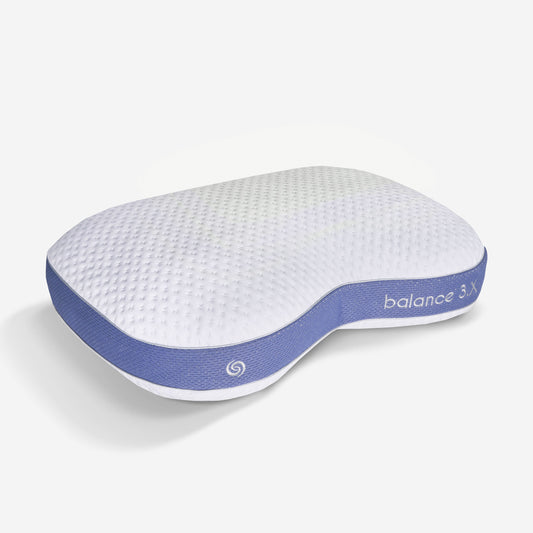
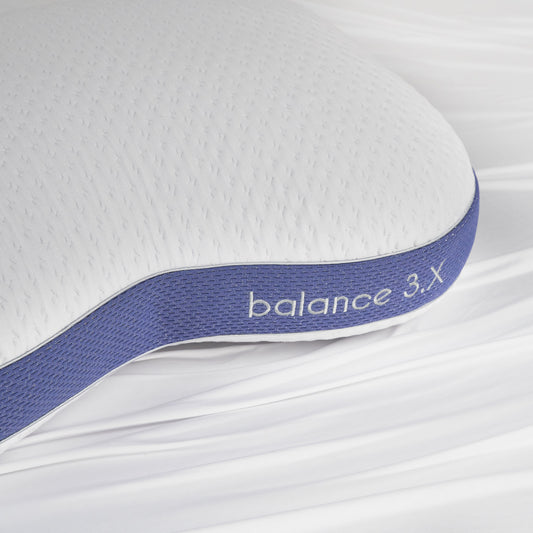
A contoured shape that accommodates the shoulder maintains loft where it's actually needed: under the neck. The Storm Cuddle Curve and Balance 3.X Cuddle Curve are both built around this idea. The curved Cuddle Curve design cradles the shoulder while the fill supports the cervical spine; together they keep the spine in better neutral alignment than a flat pillow at the same stated height. The Storm adds active cooling via a Ver-Tex cover and Air-X mesh, which is relevant for anyone whose sleep is disrupted by heat on top of pain.
What to Look for in a Pillow for Neck Pain
The variables that matter most come down to fit, fill, and temperature. Here's how to evaluate each one.
Loft matched to sleep position
Height is the single most important variable. A pillow fit to your sleep position and shoulder width keeps the cervical spine in neutral alignment; a pillow that's off by even an inch creates sustained misalignment through the night.
Conforming but resilient fill
The fill needs to support the cervical curve without bottoming out or holding too rigid. A responsive medium-density fill that adapts to position changes outperforms both solid memory foam and loose down alternatives for neck pain sufferers.
Contoured or curved shape
For side sleepers and anyone with shoulder involvement, a contoured shape that accommodates the shoulder maintains effective loft at the neck. A flat pillow at the same height compresses at the shoulder and delivers less support where it matters.
Breathable construction
Heat disrupts sleep continuity; disrupted sleep increases pain sensitivity. A pillow with active airflow or a cooling cover reduces the thermal burden so the body can stay in the deeper restorative sleep stages where tissue repair actually happens.
Consistent, measurable sizing
A pillow labeled "medium" without any reference to body type or sleep position tells you very little. Look for sizing systems that account for shoulder width and sleep position — not just a soft-to-firm scale that doesn't address height at all.
BEDGEAR Cuddle Curve Pillows for Neck Pain
The three pillows below are all built on the Cuddle Curve platform; contoured shape, multi-height sizing, and breathable construction. Each one addresses a slightly different sleep profile. The right one depends on how you sleep and whether temperature is also a factor.
| Pillow | Best For | Key Construction | Sizes |
|---|---|---|---|
| Storm Cuddle Curve Performance® Pillow | Side & back sleepers who run hot | Ver-Tex cooling cover, Air-X mesh vents, dual-sided React™ fill | 0.0 / 1.0 / 2.0 / 3.0 |
| Flow Cuddle Curve Performance® Pillow | Side & back sleepers who want a softer conforming feel | Breathable cover, React™ blend fill, contoured Cuddle Curve shape | 0.0 / 1.0 / 2.0 / 3.0 |
| Balance 3.X Cuddle Curve Performance® Pillow | Back sleepers and those needing firmer, more structured support | 3X balanced fill for structured conforming support, Cuddle Curve shape | 0.0 / 1.0 / 2.0 / 3.0 |
All three come in four height sizes (0.0 through 3.0) that correspond to body type and sleep position; not just a vague firmness scale. If you're not sure which size applies to you, BEDGEAR's PillowID quiz walks through shoulder width, sleep position, and temperature preference to make that match precisely.
Not Sure What Size You Need?
BEDGEAR's PillowID quiz takes less than two minutes. It matches pillow height, fill, and shape to your body type and sleep position — so you're not guessing at a variable that directly affects how your neck feels every morning.
Pillow Fit Is Only a Starting Point for the Best Pillows for Neck Pain
At the end of the day, a pillow matched to your sleep position removes one of the most common and correctable contributors to neck pain. For many people, that's enough to produce a real difference in how they feel in the morning. For others, neck pain has additional causes, like muscle imbalances, posture during the day, stress, or structural issues, and a pillow alone can't address.
Still, a properly fitted pillow does is stop your sleep surface from actively making the problem worse. If you're waking up with neck stiffness that wasn't there when you went to bed, start with the pillow. It's the most direct variable you can change, and the science on pillow height and cervical alignment is consistent: fit matters, and getting it right has a measurable effect on neck muscle activity and morning pain levels.
Sources: (1) Ren S, Wong DW, Yang H, Zhou Y, Lin J, Zhang M. Effect of pillow height on the biomechanics of the head-neck complex: investigation of the cranio-cervical pressure and cervical spine alignment. PeerJ. 2016 Aug 31;4:e2397. doi: 10.7717/peerj.2397. PMID: 27635354; PMCID: PMC5012320.
(2) Lei JX, Yang PF, Yang AL, Gong YF, Shang P, Yuan XC. Ergonomic Consideration in Pillow Height Determinants and Evaluation. Healthcare (Basel). 2021 Oct 7;9(10):1333. doi: 10.3390/healthcare9101333. PMID: 34683013; PMCID: PMC8544534.
Frequently Asked Questions
Common questions about finding the right pillow for neck pain.