Night sweats aren't just uncomfortable. No, they're one of the most disruptive sleep problems you can have; pulling you out of deep sleep, soaking through your bedding, and leaving you exhausted by morning despite technically spending eight hours in bed. The frustrating part is that most people treat it as a personal problem rather than an environment problem. It isn't. Your sleep surface is either making it worse or actively managing it.
The good news is that night sweats are solvable, so there's no need to panic just yet. However, the solution is not a fan pointed at the ceiling or another set of cotton sheets that feel cool for ten minutes. Instead, let us offer you a more unique and tailored solution; a sleep system that's actually engineered to move heat and moisture away from your body all night long. That starts with what sits between you and your mattress — and most people have never thought twice about it.
What Are Night Sweats, Exactly?
First and foremost, it's important to understand night sweats as a concept. Not just "I sleep warm." Not "I forgot to crack a window." No, night sweats are episodes of excessive sweating during sleep — intense enough to soak through your clothes, your sheets, and sometimes your mattress. You wake up drenched. The bed feels like a crime scene. And somehow, you still have four more hours before your alarm goes off.
Medically, they're called sleep hyperhidrosis, but you don't need the Latin to know something's off. What you do need to know is that night sweats aren't random. There's always a trigger; the question is which one you're dealing with. Learn more about some of them below.
The Usual Suspects
Night sweats show up for a lot of reasons. Hormonal shifts are a big one. Perimenopause and menopause are well-documented culprits; research confirms that hot flashes are closely tied to nocturnal awakenings in women. Testosterone fluctuations can drive the same pattern in men. Stress, certain medications, infections, and blood sugar swings can all play a role too.
But here's what most people miss: for a large portion of otherwise healthy adults, the trigger isn't medical. It's environmental. Your body needs to drop its core temperature by 1 to 2°F just to initiate deep sleep. If your sleep surface is trapping heat instead of dissipating it, your body runs out of options fast. Sweating is what happens next. It's not a malfunction — it's your body doing exactly what it's supposed to do with nowhere to send the heat.
Research published in the Annals of Family Medicine found that roughly one in three adults reports night sweats — and half of those people describe soaking through their bedclothes entirely. Annals of Family Medicine, 2006
When to See a Doctor for Night Sweats
Most night sweats are annoying, not alarming. But if yours come with unexplained weight loss, persistent fever, or other symptoms you can't account for, get them checked out. Night sweats can occasionally signal something that needs medical attention — infections, certain medications, or underlying conditions worth ruling out.
If it's just heat and sweat with no other red flags? That's an environment problem. And that's exactly what BEDGEAR is here for.
How to Stop Night Sweats: Fix the Environment First
Most people fighting night sweats are fighting the wrong battle and, well, losing. They're adjusting the thermostat, kicking off the comforter, buying a new set of sheets — and waking up drenched anyway. That's because none of those fixes address the actual problem. Heat and moisture build up at the surface you're sleeping on. So, think about it as if you're sitting outside during a hot and sunny day. If that surface can't move them away from your body, you're just rearranging the deck chairs.

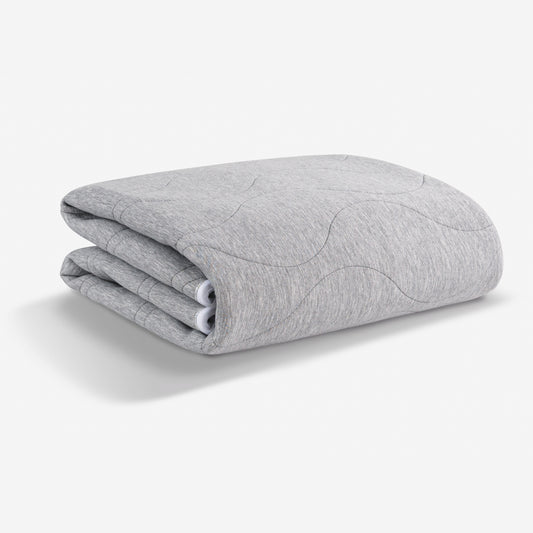
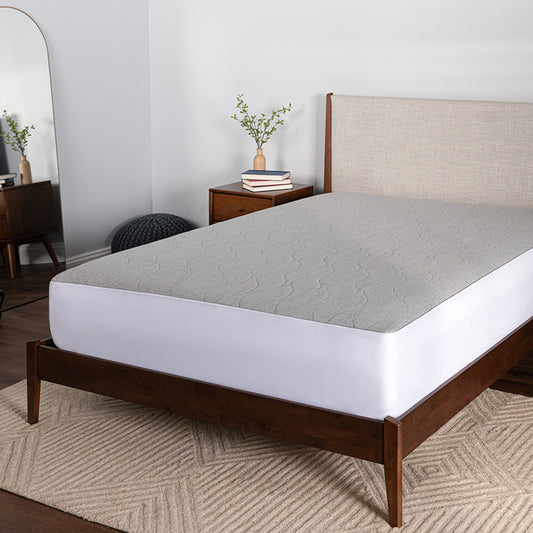
For this reason, the most direct fix is upgrading what sits between you and your mattress. A mattress protector doesn't sound like a performance product. But the right one is engineered to do exactly what your body needs overnight: wick moisture away, allow airflow through, and keep the surface temperature from climbing as the night goes on. That's the difference between waking up drenched and actually staying asleep.
Why Your Sleep Surface Is the Real Problem
Your body starts cooling itself down about two hours before you fall asleep. Core temperature drops; heat moves toward the skin and dissipates. Research from the NIH confirms that even small changes in skin temperature — as little as 0.4°C — can meaningfully affect how quickly you fall asleep and how deeply you stay there.
When your sleep surface traps that heat instead of releasing it, the whole system breaks down. Your core temperature stays elevated. Your body compensates by sweating. And instead of moving through deep, restorative sleep stages, you're waking up at 2am peeling off a damp t-shirt. The mattress protector most people own — thin, plasticky, crinkly — makes this worse. It sits on the surface like a heat seal, blocking airflow and locking moisture in.
What to Look for in a Night Sweats Mattress Protector
Not all mattress protectors are built the same. For night sweats specifically, three things matter most. First and foremost, moisture wicking; the fabric needs to actively pull sweat away from your body rather than just absorbing it and holding it there. Second, breathability; so, airflow has to move through the protector, not get blocked by it. Third, a cool-to-the-touch feel that doesn't disappear after the first ten minutes of contact.
And while standard cotton protectors absorb moisture, they don't move it. Waterproof plastic-backed protectors block moisture from reaching the mattress — which is fine for protection but creates a surface that traps heat and sweat against your body all night. Performance construction changes both of those equations simultaneously; moisture moves through, heat doesn't accumulate, and the mattress underneath stays protected regardless. The good news? BEDGEAR builds every protector around that standard. So, here's how each one does it.
The One That Destroys Moisture at the Source
The Dri-Tec® Performance Mattress Protector (opens in a new tab) is built specifically for sleepers who sweat. Dri-Tec® fabric pulls moisture away from the body and moves it through the protector rather than letting it pool at the surface. It's breathable, it's soft, and it doesn't have that plasticky feel that makes most waterproof protectors miserable to sleep on. If your primary complaint is waking up damp, this is your most direct fix.
The underlying principle is simple: sweat that moves away from your body can't disrupt your sleep the way sweat that sits on your skin does. Your body cools itself through evaporation. A protector that blocks that process forces your system to work harder just to stay at a temperature that supports sleep. One that facilitates it lets your body do its job — and keeps you in the deep, restorative stages that actually leave you feeling rested.
The Mattress Protector That Stops Heat Before It Starts
The Ver-Tex® Performance Mattress Protector (opens in a new tab) leads with temperature. Ver-Tex® fabric is cool to the touch from the first moment of contact, and it stays that way. Where most cooling fabrics lose their effect quickly, Ver-Tex® maintains a consistently cooler surface through the night. For sleepers whose night sweats are driven more by heat buildup than active sweating, this is the right starting point.
Heat accumulation at the sleep surface is a slow build. It starts manageable and compounds through the night until your body has no choice but to respond. Getting ahead of that curve — keeping the surface cool from the moment you lie down — is a fundamentally different strategy than reacting to heat after it's already built up. That's what a temperature-first protector does; it removes the trigger before the cycle starts.
The Mattress Protector Built for Maximum Airflow
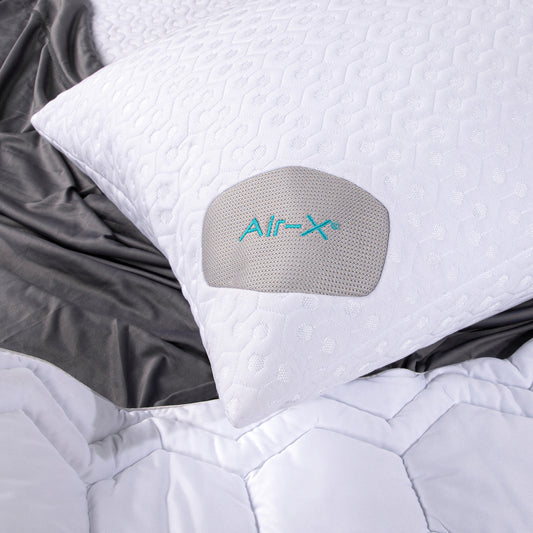
The Air-X® Performance Mattress Protector (opens in a new tab) takes a different approach. Its open-cell construction maximizes airflow through the protector itself, keeping air moving between your body and the mattress all night. Less trapped air means less heat accumulation. For sleepers who run hot across the full surface — not just at pressure points — the Air-X® addresses the problem at a structural level.
This is due to the fact that still air is hot air. When nothing moves between your body and the mattress, heat has nowhere to go. Continuous airflow, on the other hand, changes the equation entirely — it carries heat away passively, without any active cooling technology required. Therefore, for sleepers whose issue is general warmth rather than acute sweating, that constant circulation is often all the system needs to stay in balance through the night.
Night Sweats Don't Stop at the Mattress
Most people fix the mattress situation and call it done. But your face, neck, and head are in direct contact with your pillow for the same eight hours, and we know you've been flipping it around to feel that cool side. So, if that pillow is trapping heat and moisture, you're solving half the problem. The other half is right under your head.
What's more, heat builds in pillows the same way it builds at the mattress surface — slowly, then all at once. A pillow that can't move moisture or allow airflow creates its own microclimate overnight. You've felt it: the instinct to flip to the cool side. That's your body telling you the surface temperature has climbed past the point of comfort. A performance pillow removes the need to flip at all.
Pillows Built for Sleepers Who Run Hot
The Night Ice Performance® Pillow (opens in a new tab) is BEDGEAR's most targeted answer to heat at the pillow. Its cover uses the same cooling technology as the Night Ice mattress lineup — active heat dissipation from the moment of contact, not just a fabric that feels cool for a few minutes before warming up. For night sweats sufferers, it addresses the part of the sleep surface most people overlook entirely.
Cooling at the head matters more than most people realize. The body loses a significant portion of its heat through the head and neck. A pillow that works against that process — holding heat in rather than letting it escape — undermines the same temperature drop your mattress protector is working to maintain. The right pillow and the right protector work together. One without the other leaves a gap in the system.
When You Need Full Pillow Coverage
The Storm Performance® Pillow (opens in a new tab) takes a broader approach. This right here is a pillow that's designed for sleepers who deal with intense heat and moisture throughout the night; its construction combines airflow channels with moisture-wicking materials to keep conditions manageable even on the worst nights. For night sweats sufferers who've already upgraded their mattress protector and still wake up uncomfortable around the head and neck, this is the missing piece.
Overall, the goal isn't just comfort — it's consistency that you can count on every single night. Therefore, a sleep surface that manages temperature and moisture well for the first few hours but fails by 3am isn't solving the problem. It's just delaying it. Performance pillows built for night sweats are engineered to hold up through the full night, not just the easy part.
Night Sweats Are Solvable. Start with the Surface and Protect Your Sleep
Night sweats aren't something you just live with. They're a signal that your sleep environment isn't keeping up with your body's needs. The sweating, the waking up, the exhaustion the next morning — those aren't inevitable. They're what happens when heat and moisture have nowhere to go.
Thankfully, the fix is more straightforward than most people expect, so let us be the first to introduce you to a mattress protector engineered to move moisture and maintain airflow. Of course, we don't stop there and offer a pillow that doesn't work against the same cooling process your body is trying to complete.
Those two changes, and they're small ones at that, address the environment directly — and for most night sweats sufferers, that's enough to change how the whole night feels. BEDGEAR builds every protector and pillow around exactly that problem. At the end of the day, the right setup is there; it's just a matter of finding the one that matches how you sleep.
Not Sure Which Protector Is Right for You?
Dri-Tec® for moisture. Ver-Tex® for heat. Air-X® for airflow. If you're not sure where your night starts breaking down, BEDGEAR's sleep experts can help you figure it out.
Frequently Asked Questions About Night Sweats
The most common questions about night sweats. Answered straight up.
What Causes Night Sweats?
How Do You Stop Night Sweats?
What Causes Night Sweats in Men?
What Causes Night Sweats in Women?
Why Do I Sweat at Night?
When Should I Be Worried About Night Sweats?
Are Night Sweats Normal?
How Long Do Postpartum Night Sweats Last?
Sources
- Mold JW, et al. Associations Between Night Sweats and Other Sleep Disturbances: An OKPRN Study. (opens in a new tab) Annals of Family Medicine, 2006.
- Mold JW, et al. Associations Between Subjective Night Sweats and Sleep Study Findings. (opens in a new tab) Journal of the American Board of Family Medicine, 2008.
- Harding EC, et al. The Temperature Dependence of Sleep. (opens in a new tab) Frontiers in Neuroscience, NIH, 2019.
- Achermann P, et al. Enhanced Conductive Body Heat Loss During Sleep Increases Slow-Wave Sleep and Calms the Heart. (opens in a new tab) Scientific Reports, 2024.
- Haghayegh S, et al. Sleeping for One Week on a Temperature-Controlled Mattress Cover Improves Sleep and Cardiovascular Recovery. (opens in a new tab) NIH, 2024.