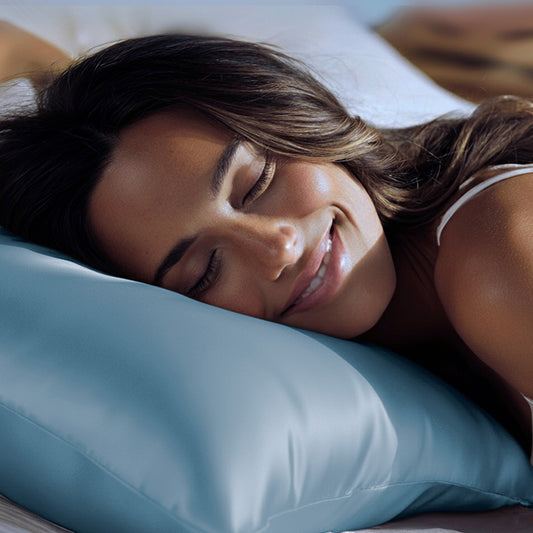
There's a specific kind of morning where you look in the mirror and find a crease running diagonally across one cheek. Sure, it fades by the time you've finished coffee, usually.
Sadly, we have some bad news for you. That crease is your pillowcase leaving a receipt.
We know that silk gets recommended as the fix, constantly and confidently. Some of that recommendation holds up under scrutiny; a lot of it is a claim that got repeated so many times it started sounding like a finding.
This piece separates the two. From there, we'll get right into why BEDGEAR looked at the whole category and decided to build something that isn't even silk at all. However, it still gives you those low friction benefits.
Read on to learn more below.
The Sleep Line Problem
Let's kick things off here with the thing you can see, because it's the least controversial part of this whole entire conversation. Sleep lines are creases formed when your face is compressed and dragged against a surface for hours at a stretch. Unfortunately, side sleepers get them the worst, and they tend to appear in the same spot night after night.
Dermatology literature has tracked this for decades. Repeated mechanical distortion at a fixed contact point is a documented pathway; the crease that vanishes by 9am in your twenties is the crease that lingers until noon in your forties and nobody in the field disputes the mechanism.
That said, here's the part that reframes the whole product category for you. If sleep lines are caused by compression plus drag, then a pillowcase is not a passive object you rest on, right?
No, it's an input.
Why Your Pillowcase Is a Major Skincare Variable
Two properties of a fabric determine what it does to your face overnight, and neither one is thread count, which is a myth anyway, by the way.
The first is how much resistance your skin meets when it slides around your bed. You'll find that cotton fibers are short, staple-length, and microscopically irregular. In fact, when magnified, the surface looks closer to very fine sandpaper than to comfy bedding products.
Silk filaments, on the other side of the fabric spectrum, are long, rounded, and continuous, so skin glides where it would otherwise catch.
The second factor to note is absorbency, which almost nobody thinks about. Cotton is engineered to pull moisture, which is exactly what you want from a bath towel and exactly what you don't want from the surface holding your retinol in place. Some percentage of what you applied at 10pm is in the fabric by midnight.
Now, when put those together and your pillowcase is quietly influencing two things at once: how much your face gets pulled, and how much of your routine survives the night.
What Dermatologists Actually Say About Silk Pillowcase Benefits for Skin
The silk pillowcase conversation runs on three claims, and they are not equally supported in the literature; we'll be the first to tell you that. Sorting them out is the most useful thing this article can do for you, and we get to the bottom of it down below.
The Claim That Holds Up: Less Friction and Fewer Creases
Textile testing has measured this directly, and quite a few times, mind you. Skin and hair both traverse silk with meaningfully less resistance than they do cotton, with lab work commissioned by silk brands reporting reductions in the 30 to 45 percent range.
Read those exact figures with some caution, since brand-funded testing is not always peer review.
The direction, though, is settled. Less resistance means less catching, which means the folding that produces a morning crease happens less.
This is the one benefit you can reasonably expect to notice yourself, and you might notice it as soon as tomorrow morning.
The Claim That's Reasonable but Unproven: Wrinkle Prevention
When it comes to the benefits of silk pillowcases for skin, the long-term benefits happen when you scale that nightly effect across twenty years. Now, the data here is hit-or-miss, but you get the industry's favorite promise. If shear distorts collagen and elastic tissue over time, reducing shear should slow that distortion.
Logically, yeah, it tracks.
The evidence to confirm it, though, does not exist. There is no meaningful body of long-term clinical work showing silk pillowcases reduce wrinkle formation, and dermatologists writing on the topic say so plainly while still ranking it far below sun protection.
Treat it as a reasonable bet, not a proven outcome. If you want the higher-leverage version of this lever, the relationship between sleep itself and skin aging is a bigger factor than what you sleep on.
The Claim That Doesn't Hold: Clearing Acne
This one deserves a hard reality check, and we want to establish this right out of the gate. Silk fabric has been studied in atopic dermatitis with mixed and largely unimpressive results, and none of that research transfers to a pillowcase anyway.
Now, ask a dermatologist about pillowcases and acne and you'll get the same answer repeatedly: laundry frequency beats fiber choice, every time. A cooler and smoother surface may help at the margins, and plenty of people report calmer skin after switching.
But the fabric is not treating anything, and persistent breakouts belong in a dermatologist's office rather than a shopping cart. At the end of the night, sure, silk may help you maintain healthy-looking skin, but it won't cure your acne, and stating that is dishonest.
5 Silk Pillowcase Benefits for Skin

Now that we got the sciency stuff out of the way, we can move along and get to the good stuff. With the evidence sorted, here's what a low-friction surface realistically delivers.
Ranked roughly by how confident you can be in each one.
Your Face Stops Waking Up Creased
This is the benefit you can verify without trusting anyone, and we're confident on this front. You swap the pillowcase, then check the mirror for a week and see whether the diagonal line across your cheek shows up as often or fades as fast.
The mechanism is simple enough that it's hard to argue with. Skin that slides instead of catching does not fold, and skin that does not fold does not crease. Pretty simple, right?
Side and stomach sleepers see the biggest change here because they have the most contact to begin with.
Less Pull on Collagen Night After Night
Every crease that fades by breakfast is still a small amount of mechanical stress your face absorbed. Multiply by roughly 2,500 nights per decade and the cumulative math starts to look less trivial.
Reducing that nightly load is a hedge rather than a guarantee, and it belongs behind sunscreen and sleep position in any honest ranking.
Worth knowing that your skin does most of its structural repair during deep sleep, which means the same hours doing the damage are the hours doing the rebuilding.
Your Night Cream Ends Up on Your Face
Overnight formulas are built around dwell time. A retinol treatment from a brand like Paula's Choice needs hours on skin to do its work, and a hyaluronic acid serum from The Ordinary is holding water at the surface for as long as it stays there.
An absorbent fabric is in direct competition with all of it, starting the second you lie down.
Choosing a less absorbent surface is the cheapest way to get more out of products you already bought. Think of it as protecting the investment rather than adding to it.
A Calmer Surface for Reactive Skin
People with easily irritated skin tend to audit ingredients exhaustively and never look at the fabric. That's a gap, because mechanical friction is an irritant in its own right and it's applied for seven hours without interruption.
Removing one source of physical stress often helps, and plenty of people describe their skin as calmer after switching. How much it helps depends entirely on the person, and no fabric substitutes for actually treating a diagnosed condition.
Less Heat Trapped Against Your Face
Warmth and damp are their own problem. A fabric that holds heat against your cheek makes for restless sleep, and restless sleep means more position changes, which means more of the friction we just spent this article discussing.
A breathable surface that stays cool to the touch reduces heat buildup at the contact point. If you run warm generally or contend with night sweats, this is often the benefit that makes the switch stick. It's a comfort improvement rather than a clinical one, and it compounds with everything above.
Every one of those five reduces to a single property of the fabric. Which makes the comparison below the practical part of the decision.
| Fabric | Drag on Skin | Heat and Airflow | Care |
|---|---|---|---|
| Cotton | Highest; skin catches and folds instead of sliding | Breathes well, but absorbs serums and barrier oils | Easy; machine wash and dry |
| Satin (polyester) | Low at first; climbs as the finish dulls | Limited; tends to hold heat against the face | Easy; low cost |
| Mulberry silk | Very low; the benchmark | Cool on contact; dense weave limits airflow | Delicate; gentle wash, air dry, snags easily |
| BEDGEAR Hyper-Silk® Vegan performance knit | Very low; friction-free and cool to the touch | Knit construction moves air through the fabric | Machine washable; built for regular use |
Sleep Position Matters More Than Fabric
Worth saying plainly and honestly, because no brand selling pillowcases wants to lead with it. The single biggest variable in how your pillow treats your face is which way you're facing. Sounds simple when you put it that way, right?
Now, back sleepers barely make contact, but side sleepers press one half of the face into the surface all night, which is why sleep lines are so often asymmetrical and why one side of the face frequently shows more crepiness than the other.
Stomach sleepers get the worst of it by a wide margin; therefore, you may want to try and adjust your sleep position or build the entire sleep system before you try and use a silk pillowcase as a cure for acne or sleep lines.
What's more, dermatologists have recommended back sleeping for skin for years, and it remains excellent advice that most people find impossible to follow. Sleep position is largely involuntary once you're unconscious. So, the realistic strategy is to improve position where you can and reduce the cost of the position you actually sleep in.
Why Silk Alone Doesn't Solve It
Silk is genuinely good at the surface part; no need to even dispute that. Where it struggles is at being a thing you use every day for years, and that gap is why so many silk pillowcases end up folded in a closet after two months.
- The laundry routine is a commitment: Mesh bag, gentle cycle, pH-neutral detergent, no softener, hang to dry. Miss a step and the surface you paid for starts to go.
- Pulls are permanent: A ragged nail or an earring catches a woven filament, and it does not go back.
- Washing it often gets costly: Dermatologists want that case changed every few days, and that math only works if you own several.
- It will not stay on the pillow: The slickness that helps your skin also sends the case sliding toward the floor by morning.
- Cool to the touch is not the same as breathable: A dense weave feels cool at first contact and then holds the heat you generate.
- It comes from an animal: For anyone shopping vegan or cruelty-free, nothing else on the list matters.
Notice that none of those complaints are about smoothness, that's just not what it's about. They're about durability, upkeep, and cost, which is a strong hint that the problem worth solving was never the fiber to begin with.
How BEDGEAR Hyper-Silk Is Engineered Differently
Hyper-Silk starts from the premise that it can help you maintain healthy-looking skin and hair, but not that it will solve all your problems. It is a vegan, cruelty-free performance fabric engineered to outperform traditional silk on the practical things that decide whether a pillowcase stays in your rotation or not.
The construction is the first departure. Hyper-Silk is knit rather than woven, so air passes through the fabric instead of collecting on the surface of it. Heat and moisture have somewhere to go, which is why the surface against your cheek stays cool to the touch rather than warming up under you.
Hyper-silk fabric also moves. High-stretch fabric flexes as you change position instead of bunching under your jaw or pulling taut across the pillow. Your face keeps contact with a smooth surface for the whole night, not just for the stretch before you turn over.
And the best part? It stays where you put it. A zip closure means no 3am hunt for a pillowcase that migrated and machine-washable matters most of all here. in fact, pretty-much every dermatologist quoted on this topic says wash frequency is the variable that actually affects skin, and a fabric you can throw in with the sheets is a fabric you will actually wash.

Habits That Make the Switch to Hyper-Silk Worth It
The hyper-silk or silk fabric is just one variable. These are the others, and a few of them matter more than the purchase does.
- Change it every two to three days: This is the highest-impact habit on the list, and the one dermatologists actually emphasize.
- Buy two: One case makes that cadence a fantasy. Two makes it a laundry decision.
- Leave the softener out: It films the fibers and blunts exactly the property you paid for.
- Let products set before you lie down: Ten to fifteen minutes is usually enough for actives to absorb rather than transfer.
- Aim for your back: You won't stay there, but starting there buys you the first few hours.
- Check the pillow itself: A collapsed pillow forces your face deeper into the surface, which undoes the point.
Individually these are small changes that won't have too much of an impact.
Together they're the gap between owning a nice pillowcase and running a routine that shows results.
Not Sure Where to Start?
The Beauty collection is built around one idea: the hours you are asleep should be working for your skin, not against it. Start with the pillowcase and build from there.
The Real Silk Pillowcase Benefits for Skin but Minus the Hype
Stack it all up and the picture is a whole lot narrower than the marketing, but a lot more usable. At the end of the night, the silk pillowcase benefits for skin that survive scrutiny are fewer creases in the morning, fewer mechanical stress on your face over years, more of your skincare staying where you put it, and a cooler surface if you sleep warm.
What you should not expect is clear skin, erased wrinkles, or anything resembling a substitute for sunscreen. Brands promising that are well past what the research supports, and the honest version of this pitch is more convincing anyway.
Overall, this is actually the thinking behind our Hyper-Silk product line. If the whole benefit lives in the surface rather than the fiber, the sensible move is to engineer that surface and fix everything silk is bad at along the way: airflow, stretch, a closure that holds, and a wash cycle you'll actually keep up with.
Vegan and cruelty-free, because there was never a reason it needed to come from a silkworm.
Frequently Asked Questions About Silk Pillowcases
Still weighing whether a silk pillowcase is worth it for your skin? Here are the questions we get most.