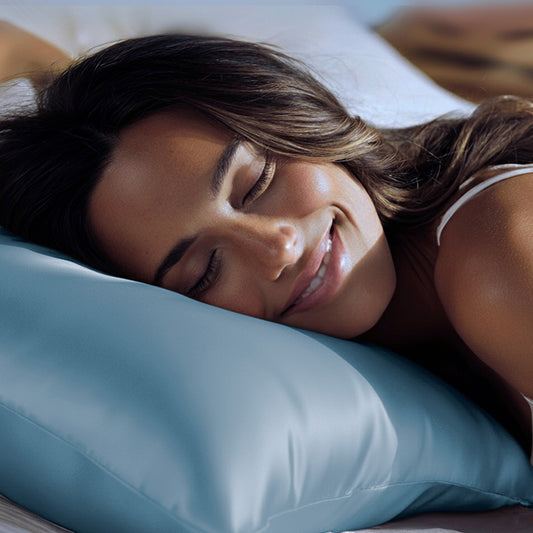
So, what actually makes the best pillowcase for skin? It comes down to a handful of features you can check right before you buy. There are also a few popular selling points that sound great and deliver very little; we'll help you get through all the noise, so don't worry. Read on to sort out which is which.

Hyper-Silk Performance® Pillowcase
Vegan Hyper-Silk® fabric feels smooth and cool to the touch. It helps reduce the sleep lines, frizz, and breakage that cotton and polyester can cause. A breathable knit keeps heat and moisture from building up, and a zip closure keeps everything snug. Best of all, it goes right in the washing machine.
Shop Hyper-Silk PillowcaseWhy Your Pillowcase Shows Up Right on Your Face
Every time you turn over, your skin drags across the fabric underneath it, a bit yucky if you think about it too long, right? Most people shift positions many times a night, so that drag adds up. On a rougher weave, it can leave creases that are still there when you brush your teeth. Those sleep lines usually fade, but nobody wants to wear them to a morning meeting.
Absorbency is the second factor to consider. Cotton is a very thirsty fabric; it pulls moisture from whatever it touches, including the serum you just paid good money for. The bad news? That can leave skin feeling drier by morning. On the other hand, a less absorbent surface lets more of your routine stay where you put it.
Then, there's the buildup and heat. Oils, sweat, and product residue collect in a pillowcase night after night, and this cycle resets every time you wash the pillow. A fabric that traps warmth makes that situation even less pleasant for your pores.
That's why breathability and easy washing belong on your checklist right next to smoothness.
What to Look For in a Pillowcase for Skin
Think of this section as your go-to shopping checklist. And the best part? A pillowcase doesn't need to cost a fortune to hit these points at all. It does, however, need to hit all of them to earn a spot in your nightly routine.
A Smooth and Low-Friction Surface
Smoothness is the feature everyone talks about, and for a very good reason. A slick surface lets your cheek glide as you move instead of catching and folding.
Less tugging means fewer creases waiting for you in the mirror. So, run your hand across the fabric; if it feels grabby on your palm, it'll feel grabby on your face, and your face will be hurting as you toss and turn your way through the night.
Fabric That Won't Soak Up Your Skincare
Your night cream should be working on your skin, not your pillow, right? So, search for fabrics that absorb less than standard cotton. Silk and smooth silk alternatives tend to be far less absorbent on your skin. This way, more of your moisturizer stays put while you sleep, and you remove some of the issues before they have a chance to develop.
Breathability for Warm Sleepers
Heat and sweat don't do your complexion any favors; that's for sure. A breathable fabric lets air circulate so warmth doesn't pool around your face.
In fact, knit constructions are great at this because of the tiny spaces between their loops. If you're always flipping your pillow to find the cool side, put airflow near the top of your list; this way, you don't have to worry sweating all over your pillow.
Easy and Frequent Washing
The cleanest pillowcase is the one you'll actually wash. Delicate fabrics that demand hand washing tend to sit in the hamper for weeks. Machine-washable options fit into real life. Your skin gets a fresh surface more often, and that's the whole point.
All that being said, this does not mean you should skip out on the good fabrics, just because they're annoying to work with. Depending on your skin, they may still be your best option.
A Fit That Stays Put
Fit sounds boring until your pillowcase ends up bunched at the foot of the bed. Loose cases shift, wrinkle, and fold into ridges under your face. A snug fit with a secure closure keeps the surface smooth all night. When it comes to closures, zippers beat envelope flaps every time.

What to Skip When Choosing a Pillowcase for Skin
Plenty of pillowcase marketing sounds convincing and falls flat the second you actually go to sleep on it. In this section, we cover the fabrics and features worth passing on. Stick around because a few of them might be on your bed right at this moment.
Rough or Pilled Cotton
Older cotton cases develop tiny pills and a coarse texture over time. That texture adds friction exactly where you don't want it. If yours feels scratchy or looks fuzzy, it's time to say goodbye to it.
More often than not, simply replacing it is one of the easiest skin upgrades you can make.
Chasing Thread Count
A higher thread count doesn't automatically mean a smoother pillowcase, we'll be the first to get that out of the way. Fiber quality and construction, on the other hand, matter far more than the number on the package.
Some sky-high counts come from thinner, weaker threads. We dig into the details in our guide to thread count myths.
Cheap Polyester Satin That Holds Heat
It's also important to note that polyester satin is smooth and affordable, which explains its popularity; this applies in and out of the skincare world. The trade-off, however, is breathability. Many budget versions trap warmth, and a sweaty face is rarely a happy face at night.
If you run hot, look for a smooth fabric that's also built to breathe.
Fussy, Hand-Wash-Only Care
Traditional silk looks and feels lovely. It also tends to ask for hand washing, special detergent, and air drying. That's a lot of effort to repeat every week. If the care label makes you sigh, the case probably won't get washed as often as your skin needs.
Envelope Closures That Slide Off
Envelope-style cases rely on a fabric flap to hold the pillow in. On a slippery fabric, that flap doesn't hold much at all. The case creeps around, gathers up in one spot, and leaves you sleeping on folds.
A zippered closure, however, solves the problem for good. And at BEDGEAR, we know a thing or two about a zippered closure.
Pillowcases That Promise to Erase Wrinkles
No pillowcase can erase wrinkles or clear up skin on its own, we'll be the first to tell you that (although we hope that we aren't). Therefore, be skeptical of any product that says it will.
A great pillowcase can help reduce temporary sleep creases and support the routine you already have. That's genuinely valuable; it's just not magic.
Best Pillowcase Material for Hair and Skin, Compared
Now let's line up the most common materials side by side. Each row connects back to a feature from the checklist above. Quality varies within every category, so use this as a starting point rather than a final verdict.
| Feature | Cotton | Polyester Satin | Traditional Silk | Hyper-Silk® |
|---|---|---|---|---|
| Surface Feel | Can feel rough, especially when worn | Smooth | Very smooth | Smooth and cool to the touch |
| Breathability | Breathable | Often traps heat | Breathable | Knit construction built for airflow |
| Care | Machine washable | Usually machine washable | Often hand wash or delicate cycle | Machine washable |
| Fit | Varies; often envelope style | Varies; often envelope style | Varies; often envelope style | High-stretch fabric with zip closure |
| Vegan | Yes | Yes | No | Yes |
Cotton wins on price and breathability but loses on friction. That being said, though, satin fixes the friction problem but often runs warm. Traditional silk checks most boxes, as long as you're willing to baby it.
And our top choice, Hyper-Silk®, was engineered to bring those strengths together in a case you can toss in the wash.
Silk vs. Satin Pillowcase for Skin: The Short Answer
Silk and satin are both smoother than cotton, so either can be a step up for your skin. The big differences are fiber and breathability. Silk is a natural fiber; satin is a weave that's usually made from polyester. Silk tends to breathe better, while satin tends to cost less.
If you sleep warm, breathability should tip the scales in your favor again. If budget is the deciding factor, a quality satin still beats a scratchy cotton case. So, there is a lot to think about here. For the full head-to-head, read our satin vs. silk pillowcase guide to learn even more about the topic.
Why Hyper-Silk Checks Every Beauty Box
We built the Hyper-Silk Performance® Pillowcase around the same checklist you just read in this guide. And it starts with the surface. Our vegan Hyper-Silk® fabric is smooth, cool to the touch, and engineered to outperform traditional silk. Plus, it helps reduce the sleep lines, frizz, and breakage caused by cotton and polyester cases.
Next comes airflow, which is practically what our brand was built around. The fabric uses a knit construction that lets air circulate freely. That helps keep heat and moisture from building up against your face overnight. Warm sleepers, this one's for you.
Then, well, there's everything that makes it easy to live with. The high-stretch fabric moves with you as you change positions, and a zip closure keeps the case snug on your pillow.

Match Your Pillowcase to Your Skin Concern
Everyone's skin has its own personality. The right pillowcase depends on what you're trying to solve. We cover how to get a pillowcase that's personally fit to you below.
Morning Sleep Lines
If you wake up with creases, friction and fit should top your list. Side and stomach sleepers tend to see these lines most. A smooth surface that stays taut under your face helps reduce them. It also helps to choose a pillow that suits your sleep position, so your face isn't mashed into the fabric all night.
Acne-Prone Skin
A pillowcase won't treat breakouts. Still, a clean, breathable surface may help some sleepers by limiting the oil, sweat, and residue sitting against their skin. How often you wash matters even more than fabric here. Pick a case that's easy to launder, and wash it at least once a week.
Dry or Sensitive Skin
Dry skin does best on a fabric that doesn't pull moisture away. Sensitive skin appreciates a surface that won't scratch or rub. Smooth, less absorbent fabrics cover both needs at once. When you wash, skip harsh detergents and heavy fragrance, too.
Hot Sleepers
If you run warm, airflow comes first. The knit construction in Hyper-Silk® fabric is built to breathe. If silky just isn't your thing, our Dri-Tec® Pillowcase Set uses moisture-wicking fabric designed to move heat and moisture away. Either way, your face isn't stuck in a heat trap.
Hair and Skin Together
Here's the good news: the features that help your skin also help your hair. Low friction means less tugging on strands, which can mean less frizz and breakage. That makes a smooth, breathable pillowcase a two-for-one upgrade. It's the simplest answer to finding the best pillowcase for hair and skin.

Pillowcase Habits That Help Your Skin
Even the best pillowcase needs a little help from you. These simple habits keep it doing its job.
- Wash it at least once a week: Bump that to twice a week if you're breakout-prone or use a lot of hair product; the more stuff that sits on your pillowcase, the more problems you'll have with your skin.
- Keep a spare on hand: Swapping in a fresh case midweek is easier than running a whole load of laundry, so make sure you have reliable options.
- Let your Skincare Sink In: Give serums and creams a few minutes to absorb before your face hits the pillow.
- Add a Protector Underneath: A pillow protector helps keep sweat and oils from soaking into the pillow itself.
- Choose a Gentle Detergent: Low-fragrance formulas are kinder to sensitive skin.
None of these take much effort, and they work even better when you use them together. At the end of the night, your sheets deserve the same attention, so check out how often you should change your sheets.
A clean, smooth surface every night is one of the easiest beauty moves there is.

Build Your Beauty Sleep Kit
Your pillowcase handles the surface under your face. The Hyper-Silk Sleep Mask covers the delicate skin around your eyes, and the Hyper-Silk Turban keeps hair smooth overnight. Round it out with the Beauty Performance Pillow for support underneath it all.
Shop the Beauty CollectionThe Best Pillowcase for Skin Is the One You'll Use Every Night
At the end of the night, the best pillowcase for skin is smooth, breathable, snug, and easy to wash. Skip rough cotton, heat-trapping satin, and anything that promises miracles. Focus on the features that reduce friction and keep your routine simple.
That's exactly why we engineered the Hyper-Silk Performance® Pillowcase. You get a silky, cool-to-the-touch surface without the fussy care. Your skin gets a better place to rest, and you get one less thing to think about.
Browse more performance pillowcases if you want to compare options; at the end of the night, it does not have to be a beauty of pillowcases. We're a bedding brand after all, and there's a little something for everyone.
Frequently Asked Questions
Do you have more questions about the best pillowcase for skin? No need to worry, we answer some of the most common questions below.