Nobody warns you about the whole 3am thing. Everyone mentions hot flashes; they mention mood and they mention the periods getting a little strange. Then, one night you are staring at the ceiling at 3:04, damp and irritated, doing math on how many hours you have left before the alarm.
It happens to a lot of women, and its clusters in that same early-morning window for reasons that have nothing to do with willpower or stress management.
At the end of the night, it is a collision of three things: how sleep is structured in the back half of the night, what estrogen does to your internal thermostat, and what your bed is doing with the heat you produce.
Here is what is actually going on, and this guide covers what you can change starting tonight.
What Is Actually Happening at 3am
Sleep is not one flat state. You cycle through lighter sleep, deep sleep, and REM sleep roughly every 90 or so minutes, and the mix changes as the night goes on. Deep sleep loads up in the first half; REM sleep dominates the second half.
That matters because deep sleep is hard to interrupt. In the first two or three hours after you go to bed, your body will absorb a warm room, a noisy street, or a partner rolling over without you registering any of it. By 3am, though, you have spent most of that deep sleep budget, and you are cycling through lighter, more fragile stages.
Therefore, the 3am wake-up is not proof that something new goes wrong at 3am. Instead, it is proof that whatever has been happening all night finally has a low enough threshold to pull you all the way out of sleep. Same trigger but much less protection.
Now, body temperature is running its own schedule underneath all of this. Core temperature falls in the evening, bottoms out in the early morning hours, then starts climbing again before you wake.
Your body is already doing thermal work in that window; a vasomotor event on top of it lands hard.
Why Menopause Changes Your Body Temperature at Night
Your brain keeps your core temperature inside a narrow comfortable band, or at least that's the goal. Drift above the top of it and you sweat and flush to shed heat; drift below the bottom and you shiver to make heat. In between, nothing happens and you never think about it.
Estrogen is one of the signals that helps set that band in the hypothalamus, the part of the brain that runs temperature regulation. As estrogen fluctuates through perimenopause and drops through menopause, the band appears to narrow quite a bit. Researchers studying vasomotor symptoms have described this as a shrinking thermoneutral zone.
A narrower band means a much smaller temperature change is required to set off a response. A half-degree rise that your body used to ignore completely now reads as overheating, and the full cooling response fires: blood vessels near the skin open right up, you flush, you sweat, and your heart rate jumps higher than it should.
That is why night sweats feel like they come out of nowhere and hit you when you least expect them. Nothing dramatic happened.

The Chill That Follows the Hot Flash
The sweat is only half the problem, right? Once the flash passes, all that moisture is still sitting on your skin and in your sheets, and evaporation keeps pulling heat away from you. Sounds great in theory, but now you are cold.
Then you pull the covers back up, and the cycle sets itself up to run again. Plenty of women describe the chill as the part that truly ends the night, because that is the point where they give up and check the clock.
Fabric choice matters here more than almost anywhere else, since a sheet that holds moisture will keep you in that cold-damp phase far longer than one that moves it away.
Night Sweats vs. Hot Flashes: What's the Difference?
People use these two terms interchangeably, and clinically they are close cousins, for sure. Both are vasomotor symptoms, which just means symptoms driven by blood vessels widening and narrowing.
The practical difference is timing, and timing changes how much damage each one does to your nights each week.
| Hot Flashes | Night Sweats | |
|---|---|---|
| When it happens | While you are awake, any time of day | During sleep, most often in the second half of the night |
| Warning | Often a few seconds of pressure or unease first | None; you wake up already in it |
| What you feel | Heat rising through the chest, neck, and face; flushing; faster heartbeat | Soaked sleepwear and sheets, racing heart, then a chill as sweat evaporates |
| Typical duration | Seconds to a few minutes | Seconds to a few minutes, followed by a longer cool-down |
| Knock-on effect | Interrupts what you are doing | Fragments sleep, which affects the entire next day |
| What tends to help | Layered clothing, air movement, tracking your own triggers | A cool room plus bedding that moves heat and moisture away from skin |
The line that matters in that table is the last one. A hot flash at 2pm costs you a few minutes; a night sweat at 3am costs you the rest of the night and a chunk of tomorrow. That is why the sleep setup deserves more attention than it usually gets.
The Cortisol and Blood Sugar Piece
Temperature explains most 3am wakeups during the menopause/perimenopause transition, but it is not the whole entire story. Two other things are happening in that same window, and they can turn a brief wake-up into an hour of lying there.
The first is cortisol; the stress hormone. Your body runs a natural cortisol rise in the early morning hours that peaks shortly after you wake; it's part of how you get going in the morning. If you are already awake when that curve starts climbing, you are trying to fall back asleep against a hormone whose job is alertness, stress, and a little bit of panic.
The second is blood sugar levels. A long stretch without food can bring glucose down overnight, and the body's correction involves adrenaline and cortisol, which as we just wrote, can wake you up at night. That combination reads as alert and slightly anxious, which is exactly how a 3am wake-up tends to feel even when nothing is wrong.
Alcohol pushes on both of these, and really badly. It helps you fall asleep and then fragments the back half of the night as it clears, while also nudging blood sugar and body temperature around. A glass of wine at nine can look a lot like a hot flash at three, and it can even add anxiety that goes beyond your average hangxiety.
Worth saying plainly: Night sweats have causes beyond menopause, including thyroid conditions, infections, some medications, and even sleep apnea. If your sweats are new, severe, come with weight loss or a high fever, or do not fit the pattern described here, bring them to your doctor rather than filing them under hormones.
What Perimenopause Insomnia Actually Feels Like
Perimenopause insomnia usually does not look like the classic version where you cannot fall asleep. Most women describe the opposite: falling asleep easily, sometimes on the couch by nine, then waking hard in the early morning and staying awake.
That pattern has a name in sleep medicine, sleep maintenance insomnia, and it is a common complaint during the menopause transition. It also comes with a second layer that makes it worse. After a few weeks of 3am wake-ups, you start going to bed braced for one. And the bad news? This creates one heck of a spiral.
After all, anticipation raises arousal, and higher arousal makes the wake-up more likely and harder to recover from. This is where a lot of women end up frustrated with themselves, which is not useful and not deserved.
Breaking that loop takes some pressure off the bed itself. Part of it is behavioral, and cognitive behavioral therapy for insomnia is well studied and worth asking about. Part of it is much simpler: make the bed a place that does not overheat, so the trigger fires less often in the first place.
How to Build a Cooler Sleep Setup
You cannot negotiate with your hypothalamus and force it to stop making you hot. You can, however, absolutely change what happens to the heat and moisture your body produces, and that is a layer-by-layer job.
Every surface between you and the mattress either moves heat away or holds it against you.

Work from the top down, because the layers closest to your skin have the biggest effect for the smallest cost.
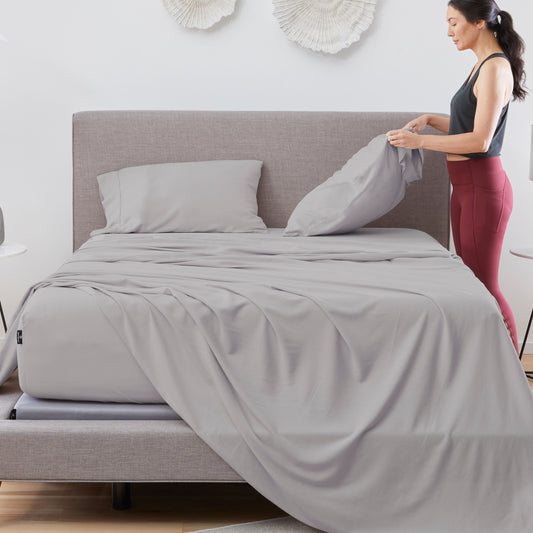
- Sheets: This is the whole-body surface, so it is the highest-impact change you can make. Standard cotton soaks up sweat and holds it; performance fabrics move moisture off the skin and let air pass through.
- Pillow: Your head and neck usually feel the heat first, and a dense pillow with no airflow traps it. Look for ventilated construction and a cover built to breathe.
- Mattress Protector: A cheap vinyl-backed protector will undo everything above it by sealing heat and moisture in. A breathable one protects the mattress without becoming a plastic bag.
- Sleepwear: Cotton pajamas hold what they absorb. Lighter, moisture-moving fabrics, or less fabric overall, keep the damp layer off your skin.
- Room and Air: Cool the room to the low sixties and add air movement with a fan. Moving air speeds evaporation, which is what actually cools you.
Once all of these sleep layers are handled, the hot flash still happens. However, the recovery is what changes things. Instead of lying in a warm damp pocket for twenty minutes waiting to feel normal, the heat and moisture have somewhere to go.
Where BEDGEAR Fabrics Fit
We build two different cooling technologies, and they solve two different problems for women who have menopause; they also help for other types of hot sleepers, like athletes. Confusing them is the most common mistake shoppers make, so here is the short version.
| Technology | What It Does | Best For |
|---|---|---|
| Dri-Tec® | Moves moisture off the skin and keeps air flowing through the fabric | Sweat management across the whole night |
| Ver-Tex® | Phase-change fabric that buffers surface heat and resets as you move | That cool-to-the-touch feel the moment you make contact |
They are complementary rather than interchangeable. Dri-Tec is the answer to being wet; Ver-Tex is the answer to the surface feeling warm. Many women dealing with night sweats end up wanting both, which is why our hot sleeper collection mixes them across sheets, pillows, and protectors.
Not Sure Where Your Heat Is Coming From?
If the pillow is soaked but the sheets are fine, that is a different fix than waking up damp head to toe. Our sleep experts sort that out in a few questions, and the quiz does it in about two minutes.
Small Habit Shifts That Support the 3am Window
Bedding handles the physics, and that's about it. That said, a few timing changes are all that handle the rest, and these are the ones women consistently report as making a noticeable difference.
Move Alcohol Earlier
Finishing three or more hours before bed keeps the rebound out of your 3am window.
Add a Small Evening Protein
A little something before bed can steady overnight blood sugar instead of leaving it to drop.
Drop the Room Temperature
Set the thermostat before you get in, not after the flash wakes you at three.
Keep Layers Within Reach
A light blanket you can throw off and pull back beats wrestling a heavy comforter.
Stop Watching the Clock
Turning the display away removes the math that keeps you alert once you are up.
Get Morning Light
Light early in the day anchors the body clock that is running your temperature curve.
None of these are dramatic, and none of them work in one night. Give any change about two weeks before you decide whether it did anything, since night-to-night variation is large enough to fool you either way.
Why Women Wake Up at 3am During Menopause
Put the pieces together and the 3am wake-up stops feeling mysterious; in other words, you don't need to be Sherlock to get to the bottom of this mystery. Your sleep is lightest in the back half of the night, your temperature regulation has less margin than it used to, and cortisol is starting its morning climb. Any one of those alone might not wake you; stacked, they reliably do.
Most of that stack is not something you can change from bed at three in the morning. What you can change is the surface you are lying on, because a bed that holds heat and moisture guarantees the wake-up lasts longer than the flash did.
So, cooler sheets, a pillow that breathes, and a protector that does not seal you in are the practical version of taking one variable off the table.
And please talk to your doctor about the rest of it. Menopause night sweats and hot flashes are well-studied, treatment options exist, and there is no prize for handling this on your own with a fan and a stubborn streak.
Frequently Asked Questions About Waking Up at 3am
Still sorting out what is happening at 3am? These are the questions we hear most often from women dealing with menopause night sweats.
Why Do I Wake Up at 3am Every Night During Menopause?
Are Night Sweats and Hot Flashes the Same Thing?
How Long Do Menopause Night Sweats Last?
What Temperature Should My Bedroom Be for Night Sweats?
Do Cooling Sheets Actually Help With Night Sweats?
Can Perimenopause Cause Insomnia Before Periods Stop?
For more on managing the sweats themselves, our guide on how to prevent night sweats covers the routine side in more depth. If the pillow is the main offender, start with the Performance® pillow lineup instead.