

Best Mattress for Pressure Points
Quick Summary
Quick Summary
A pressure point is a spot where your body weight concentrates faster than the mattress can spread it out. The fix is redistribution, not softness.
- Pressure builds where your body is widest and heaviest; hips and shoulders take most of it.
- Side sleepers need the most contouring, because the least surface area carries the most weight.
- Firmness should match your weight and sleep position, not a number on a scale.
- Heat causes the tossing that pressure relief is supposed to prevent, so airflow matters as much as foam.

Our Pick for Pressure Relief
Our pick for pressure relief: H Performance® Pillowtop Mattress
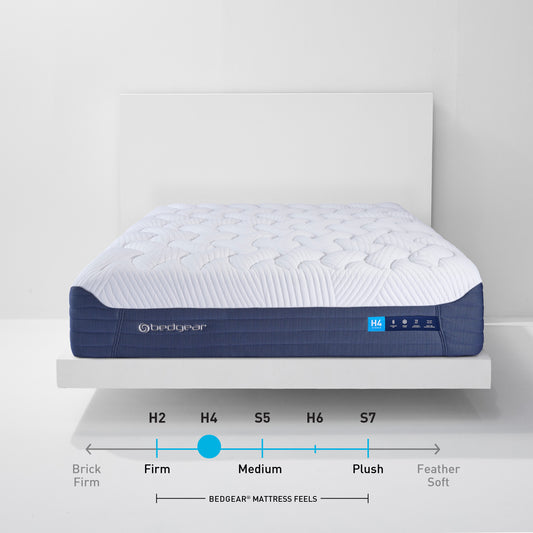
A React™ Blend pillowtop built into the mattress rather than sewn on top, over a 4" React™ comfort layer and a foam-encased coil unit. Conforming where you need give, supportive where you need structure. Available in Medium (H4) and Plush (H6).
Shop the H PillowtopMost people looking for the best mattress for pressure points describe the same thing, and we hear it all the time: they wake up several times a night, roll over, and never feel like they got any sleep.
However, there is usually no sharp pain to point at. That is what makes pressure points hard to diagnose from the inside.
Here is what is actually happening, though. Where your body is widest, your weight concentrates into a small contact area. If the surface underneath cannot spread that load, circulation in the tissue drops, and your nervous system prompts you to shift position before you consciously register discomfort. You never fully settle into deep sleep.
At the end of the night, the mattress is not too hard or too soft in the abstract; it is failing to redistribute weight, and that is where this bedtime story begins.
What Causes Pressure Points When You sleep
Pressure points are not a random pain or pressure issue. They show up in the same few places on almost everybody, for reasons that come down to geometry.
This tends to be where you carry width, because that's where you carry the load, and the surface underneath either spreads that load or it does not.
Here is where it lands and why it pulls you out of deep sleep.
Where Pressure Concentrates
Three places take the brunt of it. The hips, because that is where most body mass sits. The shoulders, because a side sleeper balances the upper body on a narrow joint. And the lower back, which is a different problem; that one is usually a gap, where the mattress does not fill the curve of your lumbar spine and the muscles work all night to hold you up.
Sleep position changes the math completely. A side sleeper puts the most weight on the least surface area, which is why side sleepers feel pressure points first and worst. A back sleeper spreads the same weight across a much larger footprint. A stomach sleeper has the flattest profile but the highest risk of the hips sinking out of alignment.
Why You Wake Up Tired Instead of Sore
Position changes during the night are 100% normal. The problem, however, is the frequency. When a mattress is not redistributing weight, you shift far more often, and each shift interrupts the sleep stage you were in.
Still, you do not remember waking up, so the symptom shows up as fatigue and not even pain. Therefore, if you feel worse on your own bed than in a hotel, that is the signal worth paying attention to.
What Makes a Mattress Relieve Pressure Points
A mattress relieves pressure through construction, not through a firmness label or any one-size-fits-all solution. In fact, four things decide it: how the top layer conforms, how the base holds your spine, how the surface responds point by point, and how well the whole stack breathes. Each does a different job.
Miss one and the other three stop working as well as they should; goodbye good night's sleep.
Contouring and Support Are Two Different Jobs
Now, this is where most buying advice goes off the rails. Contouring is the top layer’s ability to conform around your shoulder and hip so weight spreads out instead of concentrating.
On the other hand, support is the base layer’s ability to hold your spine in line, so you do not sag into a hammock. A mattress that only contours will relieve pressure and then create alignment problems, and a mattress that only supports will hold your spine straight while your shoulder carries all the load.
At the end of the night, you need both, and in that order: a conforming comfort layer over a base that does not give. That construction is the entire argument for a hybrid.
Firmness Matched to Weight and Position
There is no universal firmness number for pressure relief. The right firmness is the one where the comfort layer is deep enough to let your shoulder and hip sink in without your midsection following them all the way down.
As a starting point: side sleepers generally do best in the medium to plush range, because they need the most give at the shoulder. Back sleepers, on the other hand, usually land in the medium range, and stomach sleepers need firmer support to keep the hips from dropping.
Heavier sleepers compress any comfort layer further, so they typically need to go one step firmer than their position alone would suggest, and lighter sleepers one step softer, because they may not sink in far enough for a firm surface to contour at all.
What's more if you and your partner land in different places, that difference is worth solving structurally rather than compromising on.
See our complete guide to the mattress firmness scale for the full breakdown.
Zoned and Independent Support
Individually wrapped coils respond, well, independently, so the coils under your hip can compress further than the coils under your ribs. A connected innerspring cannot do that; press down anywhere and the whole surface reacts, which works against exactly the redistribution you want.
It also means your partner’s movement does not travel across the bed and shift you out of position.
Temperature and Why Heat Undoes Pressure Relief
Overheating causes position changes. So does pressure. And that's a pretty bad mix, right? If the mattress solves pressure but traps heat, you toss just as much, and nothing improves.
This is the trade-off with dense memory foam: the same slow-recovery structure that contours so well also holds heat and restricts airflow.
Any mattress bought for pressure relief needs a breathability answer, or the pressure answer does not hold up over a full night. In fact, you may just wake up with even more problems.
Memory Foam vs. Hybrid vs. Latex for Pressure Relief
These three constructions all handle the contouring and support trade-off, just in different proportions. Now, none of them is the wrong answer on its own.
Instead, you'll find that they simply prioritize different things, and pressure relief is where the differences get really obvious.
Here is how each one performs against the requirements above.
Memory Foam: Contours the most. It responds to heat and weight and molds closely around the body, which makes it excellent at spreading load. The costs are heat retention and a slow response, so you feel like you have to climb out of a position to change it; more effort per position change, on a surface that is already prompting them.
Hybrid: Pairs a conforming foam comfort layer with a coil support unit. You get the contouring where your body meets the mattress and structure underneath, plus airflow through the coil layer that solid foam cannot match. For most people looking specifically at pressure relief, this is the construction that answers all three requirements at once.
Latex: Contours less than memory foam but responds instantly and sleeps cooler than either. It suits people who move a lot at night and dislike the enveloped feeling, though it relieves pressure less aggressively than a well-built foam comfort layer.
Do you want a more comprehensive mattress comparison? Read our hybrid vs. memory foam mattresses guide.
Mattress Topper or New Mattress?
Another big one, and this is the real fork in the road. Now, the honest answer depends on one thing: whether the support layer underneath is still doing its job.
When a Topper is Enough
If your mattress is under roughly five years old, lies flat with no visible dips, and your only complaint is that it feels too firm at the shoulder and hip, a topper is the right call. You are adding the conforming layer the mattress lacks, on top of a base that still supports you.
Thankfully, the React Pro Performance® Mattress Topper adds a conforming React™ layer without sealing in heat the way a dense foam topper does.
When A Mattress Topper Isn’t
Obviously, mattress toppers are not always the solution. If the mattress has a visible dip, if you can feel coils, or if you sleep better away from home, a topper will not fix it.
Adding a soft layer over a failing support core relocates the problem rather than solving it; you sink through the new layer into the same sag, and now your spine is further out of line than before.
Thickness will not compensate. At that point the base is what needs replacing.
BEDGEAR Mattresses for Pressure Point Relief
Every BEDGEAR Performance® Mattress is built on the same principle: conforming React™ foam over structured support, with airflow engineered through the whole stack.
These three differ in how much of each you get, and at what price.
| Mattress | Best For | Comfort and Support | Firmness Options | Cooling Features |
|---|---|---|---|---|
| H Performance® Pillowtop Mattress | Best overall for pressure points | Integrated pillowtop, 4" React™ comfort layer, and 6" foam-encased suspension unit | Medium (H4) or Plush (H6) | Ver-Tex™ cooling cover and Air-X® mesh side panels |
| M5 Night Ice Performance® Mattress | Hot sleepers and couples with different firmness needs | Conforming comfort layer with interchangeable Independent Suspension™ units | Firmness can be set separately on each side | Ver-Tex™ cover, Cooling Active Core™, and perforated comfort layer |
| S Performance® Mattress | Best value for pressure relief | Ventilated React™ foam over a high-density support base | S3, S5, or S7; S5 is the featured medium option | Ver-Tex™ cooling cover, airflow holes, and Air-X® mesh sides |
Best Overall for Pressure Points
Best Overall for Pressure Points: H Performance® Pillowtop Mattress
The pillowtop is integrated into the mattress rather than sewn on, so it cannot shift or separate from the layers below over time.
Underneath it sits a 4" React™ comfort layer and a 6" foam-encased suspension unit; conforming on top, structured beneath, which is the construction this whole guide argues for.
Choose Medium (H4) if you sleep on your back or move between positions often; choose Plush (H6) if you sleep on your side and feel it in your shoulder. A Ver-Tex™ cooling cover and Air-X® mesh side panels handle the heat side of the problem. See the H Pillowtop.
Best for Hot Sleepers
Best for Hot Sleepers: M5 Night Ice Performance® Mattress

If overheating is waking you as often as pressure is, this is the one built for both at once. The M5 Night Ice layers three separate cooling systems: a Ver-Tex™ instant-cooling cover, a Cooling Active Core™, and a perforated cooling comfort layer with airflow channels running through the foam that conforms to you.
It is also modular: the Independent Suspension™ units are interchangeable and set separately on each side, so two people with different pressure profiles can each get the right firmness in the same bed and change it later without replacing the mattress. See the M5 Night Ice.
Best Budget-Friendly
Best Value: S Performance® Mattress

The entry point into conforming pressure relief without the added heat. We're talking a ventilated React™ foam layer with vertically drilled airflow holes sits over a high-density support base, under the same Ver-Tex™ cooling cover and Air-X® mesh sides as the rest of the line.
For pressure points, the S5 (Medium) is the firmness to look at; it carries a 3" React™ layer over a 7" base, which is enough comfort depth to actually contour, where the firmer S3 gives you 1.5".
Side sleepers who want more give should compare it against the S7 (Plush), so there's a little something for everyone in this price range.
Pressure points by sleep position
Side sleepers feel pressure at the shoulder first and the hip second, and need the deepest comfort layer of any position; enough that the shoulder can drop in far enough for the spine to stay level. A pillow that fills the gap between ear and shoulder matters here too; if the pillow is too low, you compensate by pushing the shoulder further into the mattress.
Back sleepers, well, they usually feel it as a lower-back ache rather than a hip or shoulder point. This is actually a gap problem instead of a concentration problem; the surface is not filling the lumbar curve.
Interestingly, stomach sleepers rarely report classic pressure points but tend to need firmer support to keep the hips from dropping below the shoulders.
If your main symptom is back pain rather than pressure, start with the best mattress for back pain. When it comes to side sleepers, specifically, the best mattress for side sleepers with back pain is what you need.
FAQs
These come up most often once shoppers start narrowing the list. If you are stuck between two firmness levels or trying to decide whether a topper will hold you over, we answer some of the most frequently asked questions about the best mattress for pressure points below.
What is the best mattress for pressure points?
What mattress firmness is best for pressure points?
Does memory foam relieve pressure points better than a hybrid?
Can a mattress topper fix pressure points?
Why do my hips hurt on a firm mattress?
How long does it take to adjust to a new mattress?
Get the Best Mattress for Pressure Points From BEDGEAR Today!
At the end of the night, the best mattress for pressure points should contour around the hips and shoulders, support healthy spinal alignment, and move heat away before discomfort interrupts your sleep. The good news? BEDGEAR Performance® Mattresses bring those needs together through responsive React™ comfort layers, structured support, and airflow-focused materials.
BEDGEAR Wake Ready®
Stop Waking Up to Move
Conforming comfort layers, structured support, and airflow through every layer; engineered so you settle in and stay there.
You May Also Like
-

 Regular price $1,599.00Sale price $1,599.00 Regular priceUnit price per
$1,799.00Sale

