This guide walks through the full 1 to 10 scale, what determines where a mattress lands on it, and how to pick your number.
Then, we will get into why that number is a weaker promise than it looks, and what we built to fix it. Read on to learn more below.
What Is Mattress Firmness?
Mattress firmness is a measure of surface feel. Sounds simple, right? It describes how much you sink in when you lie down and how much the surface pushes back. A soft mattress lets your body settle into the top layers, whereas a firm mattress holds you closer to the surface with far less give.
Firmness is also subjective in a way most product specs are not, so keep this in mind. Two people can lie on the same mattress and honestly describe it differently, because body weight, body shape, and sleep position all change how much a surface compresses.
For example, a 150-pound side sleeper and a 250-pound back sleeper are not experiencing the same bed even when it is literally the same bed. That subjectivity is baked into the scale.
Therefore, when a brand says a mattress is a 6, it means a 6 for an average sleeper by that brand's internal testing. Your mileage genuinely varies.
Firmness vs. Support: What's the Difference?
Firmness is how a mattress feels. Support is how well it holds your spine in neutral alignment through the night. They are related, but they are not the same thing, and a mattress can absolutely be one without the other.
A cheap firm mattress with a weak core can feel rigid at the surface while still sagging under your hips. A well-built plush mattress can cradle your shoulder and still keep your spine level, because the support comes from the coil system underneath rather than the comfort layer on top.
As you can see, support is a function of construction. On the other hand, firmness is a function of the top few inches. This distinction matters because it is where a lot of bad advice comes from.
The old rule that a firm mattress is better for your back treats firmness and support as the same variable. They are not. What your back needs is neutral alignment, and the firmness that delivers alignment depends entirely on your body.
The Mattress Firmness Scale Explained
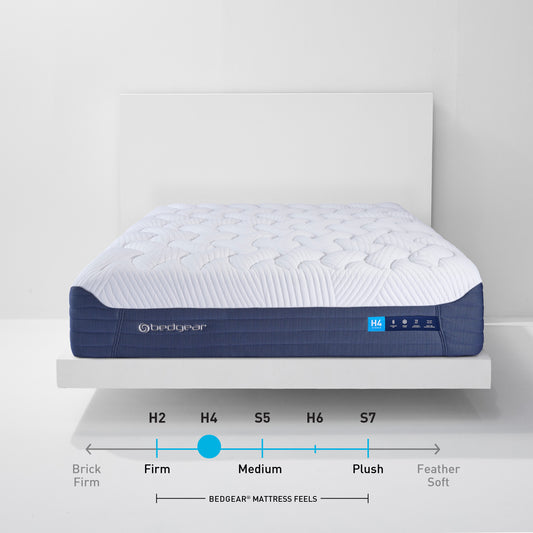
The mattress firmness scale is a 1 to 10 rating where 1 is the softest surface available and 10 is the firmest. Most mattresses sold today sit between 3 and 8, because the extremes at either end serve very few sleepers well.
Here is how the full range breaks down for most brands below.
| Level | Feel | How It Feels | Best Suited For |
|---|---|---|---|
| 1–2 | Extra Soft | Deep sinkage; the surface closely wraps the body | Rare; lighter side sleepers who want maximum contour |
| 3 | Soft | Noticeable give with less sinkage than extra soft | Lighter side sleepers; shoulder and hip pressure |
| 4 | Medium Soft | Contouring with a bit of pushback underneath | Side sleepers; lighter combination sleepers |
| 5 | Medium | Even balance of contour and surface stability | Combination sleepers; couples splitting the difference |
| 6–7 | Medium Firm | Taut surface that still gives at pressure points | The broadest range of sleepers; back sleepers |
| 8 | Firm | Minimal sinkage; you rest on top rather than in | Stomach sleepers; larger body types; back sleepers |
| 9–10 | Extra Firm | Rigid with almost no contour at all | Rare; strong preference for a very flat surface |
The extremes at either end are worth understanding but rarely worth buying.
Below a 3, the surface offers so little resistance that most sleepers settle until their hips drop below their shoulders, which puts the lower spine into a curve the surrounding muscles have to hold all night. Above an 8, there is almost no contour left, so the shoulder and hip get no pressure relief at all.
That leaves roughly 3 through 8 as the range where nearly all real shopping happens. Medium firm dominates because it is the most broadly tolerable answer, not because it is the best answer for any particular person.
If you know your sleep position, you will usually land a step or two off center.
What Actually Determines a Mattress's Firmness
Firmness is not a single ingredient. It is the result of several construction choices stacking on top of each other, and understanding them makes the number on the tag much easier to interpret. This is very important when it's mattress-buying time.
The Comfort Layer
First and foremost, you have the comfort layer. The top few inches do most of the work on perceived firmness. This is the part of the mattress your body actually touches, and it is where the majority of the contouring happens before your weight reaches anything structural underneath.
A thicker, softer comfort layer reads as soft because there is more material to compress before you hit resistance. A thin or high-density one reads as firm for the same reason in reverse.
Two mattresses with identical support cores can land three points apart on the scale purely on comfort layer construction.
The Support Core
Underneath the comfort layer sits the support core, usually coils or high-density foam. Its job is holding your spine in alignment, and it determines how much of your body weight the surface layers have to absorb before you reach something solid.
A weak core lets the midsection sag regardless of how the surface feels, which is how a mattress ends up feeling firm and unsupportive at the same time.
A strong core does the structural work so the comfort layer is free to contour without your hips dropping; this is where the mattress magic happens.
The Materials
Different materials produce genuinely different sensations at the same nominal firmness. Memory foam tends to feel softer and slower, sinking gradually and holding the shape of your body. Latex feels firmer and springier, pushing back almost immediately.
That difference in response speed matters as much as the firmness number itself. Two mattresses both rated a 6 can feel nothing alike if one is slow-response foam and the other is latex.
Hybrid construction sits between the two by design, pairing foam contour with coil responsiveness.
Coil Gauge and Layout
In any mattress with a coil system, the wire thickness and the way the coils are arranged shape the firmness directly. Thicker wire produces a firmer, more responsive surface.
Higher coil counts spread your weight across more contact points, which usually reads as more supportive rather than more firm.
Layout matters too. Connected coils and pocket coils feel different from each other even at matching firmness ratings, because connected systems move as a unit while individually wrapped coils respond only where pressure is applied.
Total Height
A taller mattress has more room for comfort layers, which generally means more contour available before your weight reaches the support core. Height alone does not make a mattress softer, but it changes how much runway the surface has to work with.
This is why a low-profile mattress can feel firm even with a soft top layer. There simply is not enough material between you and the core for the contouring to fully develop.
Notice that none of those variables are standardized either. Two mattresses can share a firmness rating and reach it through completely different construction, which is exactly why they can feel so different once you lie down on them.
How to Choose the Right Mattress Firmness Level
There is no universally correct firmness, which is why we always focus on personalized fit at BEDGEAR. The right number is the one that keeps your spine neutral in the position you actually sleep in, at the weight you actually are.
Four factors do most of the work in narrowing it down, and we cover them in detail below to help you make the right decision.
Your Sleep Position
Sleep position is the single strongest predictor of the firmness you need. It determines which parts of your body carry the load and which ones need somewhere to sink.
Side sleepers generally land between 3 and 6, because the shoulder and hip need room to settle for the spine to stay level. Back sleepers do well from 5 to 8, where the lumbar curve gets support without the hips dropping.
Stomach sleepers usually need 7 or higher to keep the midsection from sagging. Combination sleepers should aim for 5 to 6, since that range works reasonably in every position.

Your Body Type
Body weight changes how a mattress performs against its own rating. The scale is calibrated around an average sleeper, so the further you sit from that average, the more the number drifts.
Lighter sleepers compress the comfort layers less, so a mattress often feels firmer than its rating suggests; dropping a level or two usually corrects for it. Heavier sleepers compress further into the surface, so the same mattress can feel softer than advertised, and moving up a level tends to restore the intended feel.
It may not always be comfortable, but this is a factor worth thinking about, especially if there are two people in the bed.
Where You Have Pain
If you wake up sore, firmness is worth examining, though it is only one variable among several. A surface that pulls your spine out of neutral all night may contribute to the stiffness you feel in the morning.
Shoulder pain in side sleepers may improve with a softer surface that lets the shoulder settle rather than compress against a rigid top layer. Lower back pain may respond to a medium firm surface that keeps the hips from sinking.
Hip pain often sits in the medium soft to medium firm range, enough contour to relieve the joint without losing alignment. Results depend on the individual, and persistent pain is worth discussing with a clinician rather than solving with bedding alone.
Our guides on mattresses for back pain and side sleeping with back pain go deeper, and you should give them a read if you don't know where to start.
Your Partner's Preference
This is where the firmness scale usually breaks down completely. A 140-pound side sleeper and a 220-pound stomach sleeper do not want the same number, and no single mattress rating serves both of them well.
The traditional workaround is to meet in the middle at a 5 or 6 and accept that neither person gets what they need. The better answer is a mattress that does not force the choice at all, which is where our approach diverges from the rest of the industry.
Where the Industry Firmness Scale Falls Short
The 1 to 10 scale is a useful shorthand with two structural problems. The first is that nobody governs it. There is no certifying body, no standardized test, and no requirement that a 6 from one brand match a 6 from another. Each company rates its own products against its own internal benchmark.
That makes cross-brand comparison close to meaningless. A firmness number is genuinely useful for comparing two mattresses within the same lineup, since at least the benchmark is consistent. Across brands, you are comparing two different companies' opinions.
The second problem is bigger. On almost every mattress made, firmness is permanent. The comfort layers are bonded into a sealed unit at the factory, so the number you choose on the day you buy is the number you live with for the next decade.
Your body will not cooperate with that. Weight changes, injuries happen, sleep positions shift with age, and a partner moves in or out. The mattress does not adapt to any of it.
How BEDGEAR's Firmness Scale Works
We build the M-series around a different premise: firmness should be a component, not a permanent characteristic. Inside the mattress chassis sit Independent Suspension Units, coil modules wrapped in perforated fabric that set the firmness of the bed.
There are four levels, and they lift out.

Our scale runs 0.0 to 3.0 rather than 1 to 10, because it describes four discrete physical parts rather than a continuous impression. Here is how those levels line up against the industry scale you have been reading about.
| ISU Level | Feel | Approx. Industry Equivalent | Built For |
|---|---|---|---|
| 0.0 | Firm | 7–8 | Stomach and back sleepers; larger body types |
| 1.0 | Medium Firm | 6 | Most body types and sleep positions |
| 2.0 | Medium Plush | 4–5 | Side sleepers; combination sleepers |
| 3.0 | Plush | 3 | Side sleepers; lighter body types |
You will notice the range stops short of both extremes, and that is deliberate. We do not build a 1 or a 10 because those levels serve very few sleepers well, and a range that spans roughly 3 to 8 covers where almost everyone actually sleeps.
Independent Suspension Units: 0.0 to 3.0
Each Independent Suspension Unit is a full coil system sized to one side of the mattress. The coils are wrapped individually in perforated fabric, which lets them respond to your body separately while air moves through the unit rather than sitting trapped inside it.
Because each coil works on its own, movement stays local. Motion on one side of the bed does not travel across it, which matters as much for light sleepers as it does for anyone chasing a specific firmness.
You can see the full range on the Independent Suspension Units page.

A Different Firmness on Each Side
Every M-series mattress takes two Independent Suspension Units, one for each side of the bed. They do not have to match. A 3.0 Plush on the left and a 0.0 Firm on the right is a completely normal configuration.
This is the direct answer to the partner problem earlier in this guide. Nobody has to argue their way to a compromise number that fits neither of them, because there is no single number to negotiate over. Each person picks their own and the mattress accommodates both.
Change It Later Without Replacing the Mattress
The units are removable, which means firmness is reversible. If you choose a 1.0 and discover six months later that you wanted a 2.0, you order the unit and swap it. The chassis, the comfort layer, and the cover all stay exactly where they are.
That serviceability is the core of our patented modular mattress design, and it changes what a firmness decision costs you. On a conventional mattress, getting the number wrong means living with it or buying a new bed. Here it means replacing one component.
Explore the full lineup in our modular hybrid mattress collection, or start with the M3 Performance Mattress and M5 Performance Mattress.
Not Sure Which Level Is Yours?
Our sleep experts match you to a firmness based on how you actually sleep, your body type, and where you feel discomfort. And if the answer changes later, so can the mattress.
Finding Your Place on the Mattress Firmness Scale
The mattress firmness scale is worth understanding, and it is worth taking with a grain of salt. It gives you a vocabulary for what you want and a rough starting point built on sleep position, body type, and where you tend to wake up sore.
What it does not give you is a guarantee, because no two brands calibrate it the same way.
Use the number to narrow the field, then trust what your body tells you when you lie down. And if you are torn between two levels, or sharing a bed with someone whose ideal sits nowhere near yours, look for a mattress that does not make the decision permanent.
A firmness scale is far more useful when the position you pick on it is one you can change. For more on getting the rest of the decision right, our mattress buyer's guide and our take on personally fit sleep are good next reads.
Frequently Asked Questions About Mattress Firmness Scales
Firmness ratings vary a lot from one brand to the next, and it's important to understand these distinctions.
Here is how the major scales compare and what those differences mean in practice.