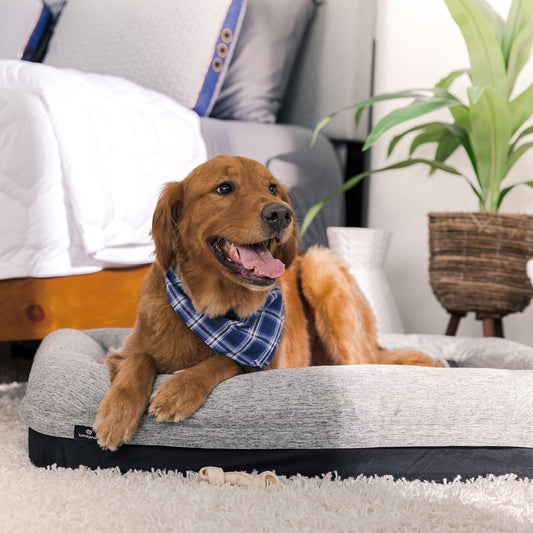
Buying a dog bed feels simple until you actually start looking. Round or rectangular? bolster or flat? memory foam or fill? Or waterproof or washable? These are all the questions that race through a shopper's head, and somehow every single one is described as orthopedic, too. Meanwhile, your dog is asleep on the tile floor, ignoring the bed you already bought. And nobody wants that.
Now, the thing most guides, collections, and products skip: your dog is not being picky if they're not sleeping in your dog bed. They are picking the surface that solves their problem in that moment.
Usually that problem is heat, or a bed too small to stretch out on, or foam that flattened months ago. The good news? This dog bed guide walks through what actually matters so the bed you buy is the one they choose.
Why Your Dog Needs a Real Dog Bed
Dogs sleep a lot, like a lot. Most adult dogs spend twelve to fourteen hours a day sleeping or resting, and puppies and seniors log even more. That is not lazy; it is how their bodies handle recovery, memory consolidation, and immune function. The surface they do it on matters for the same reasons yours does. So, keep that in mind.
For example, hard floors concentrate weight on the elbows, hips, and shoulders. You see the result on older dogs first, usually as calluses on the elbows and a slower start in the morning.
A supportive bed spreads that load out instead of parking it on a few contact points.

A Space That Belongs to Your Dog
Dogs are den animals by instinct. Having a defined spot they can retreat to lowers stress in busy households and gives anxious dogs somewhere predictable to land when the doorbell rings or the vacuum comes out.
That is why so many dogs circle and scratch before settling; they are rearranging a nest that is not there. While cute, it's also insightful and let's us know that dogs are looking to emulate that situation.
Dog beds also help with training. A bed becomes the anchor for "place" or "go to bed" commands, which is far easier to reinforce when the target is comfortable enough that your dog wants to stay there.
Now, for some bad news: a bed they avoid is a training tool that works against you.
Your Furniture Will Thank You
Every hour your dog spends on the couch is fur, dander, oils, and outdoor dirt worked into upholstery you cannot throw in a washing machine. A bed with a removable cover moves all of that onto something you can clean in twenty minutes.
If your dog sleeps in your bed by choice or by house rules, that same logic applies to your mattress; we cover that further down, so you don't have to miss out on sleeping next to your furry friend.
How to Choose the Right Dog Bed Size
Size is the single most common mistake, and it is almost always under-sizing. Owners buy for the dog curled up, then wonder why their dog sleeps half on the bed and half on the floor. Dogs shift between curled and sprawled positions all night, and a bed that only supports one of those gets used part-time.
Measure your dog stretched out on their side, nose to the base of the tail, then add six to twelve inches. Weight ranges are the faster shortcut and how most beds are sized, including ours.
Here is how those ranges typically break down.
| Size | Dog Weight | Typical Dimensions | Good Fit For |
|---|---|---|---|
| Small | 1-25 lb | 18" x 24" x 8.5" | Toy and small breeds, puppies, cats |
| Medium | 26-40 lb | 23" x 36" x 10" | Beagles, spaniels, mid-size mixes |
| Large | 41-70 lb | 30" x 48" x 10" | Retrievers, shepherds, larger mixes |
When your dog lands between two sizes, go up. The extra surface area costs you a little floor space and buys your dog the ability to fully extend, which is where most of the comfort difference shows up.
Sizing for Puppies and Growing Dogs
Buy for projected adult weight, not current weight, unless you want to buy two dog beds. A lab puppy will outgrow a small bed in a matter of months, and buying twice is the expensive path. If the bed feels cavernous at first, that is fine; puppies tend to claim a corner of it anyway.
The exception is a puppy still working through crate training, where a smaller bed sized to the crate makes more sense in the short term. Plan on upgrading once they are out of that stage.
What Makes an Orthopedic Dog Bed Worth It
Okay, so now for one of the more interesting questions: what is an orthopedic dog bed, and is it worth your money? Orthopedic is not a regulated term in pet products.
Any bed can print it on the tag, which is why so many do. What you are actually looking for is a foam core with enough thickness and density to hold your dog's weight without bottoming out.
Thankfully, the test is simple. Press down firmly with your palm. If you can feel the floor through the bed, your dog will too, and the support claim is marketing. Good foam compresses, distributes the load, and returns to shape when the pressure lifts.
Senior Dogs
Stiffness and slower rising are common with age; conforming support may help relieve pressure at the joints.
Large Breeds
More body weight over the same contact points means thin beds compress to nothing fast.
Active Dogs
Working and sport dogs recover between sessions; the sleep surface is part of that recovery window.
Post-Surgery Dogs
Follow your vet's guidance first, then give them a stable surface that is easy to get on and off.
One thing worth flagging: a supportive bed is a comfort feature, not a treatment. If your dog is showing real mobility issues, limping, or reluctance to move, that is a conversation with your vet, not a shopping decision.
Memory Foam Versus Solid Foam Dog Beds
Memory foam contours closely and is excellent for pressure distribution, but traditional memory foam also holds heat. For a dog wearing a permanent fur coat, that trade can backfire in summer.
Solid or ventilated support foam gives you structure with more airflow through the core. The ideal setup pairs a supportive core with a surface fabric that moves heat and moisture away instead of holding it in.
Waterproof and Washable: The Features That Save You
These two get used interchangeably in product listings, and they are not the same thing. Waterproof means a barrier stops liquid from reaching the foam. Washable means the cover comes off and survives a machine cycle. You want both, and plenty of beds only deliver one.
Water resistance is a third category and the weakest of the three. It handles a light spill if you catch it quickly; it does not handle a puppy accident or a senior dog with bladder issues, though, so keep that in mind.
If your dog falls into either group, look for an actual waterproof barrier.

What to Look For on the Tag
Knowing what the fancy marketing jargon on the tag means is important. we cover some of the more notable terms you'll come across below.
- Removable cover with a full-length zipper: Partial openings make getting the foam back in a wrestling match.
- Machine washable and dryer safe: Hand-wash-only covers get washed roughly never.
- Waterproof barrier layer: Protects the foam core, which is the expensive part of the bed.
- Reinforced seams: The first failure point on almost every dog bed, especially with chewers.
- Breathable surface fabric: Waterproof backing plus a non-breathable top equals a hot bed.
That last point is where a lot of waterproof beds fall down. Sealing the bed against liquid is easy; doing it without turning the surface into a heat trap takes better fabric engineering.
How to Clean a Dog Bed
Most dog beds do not wear out. They get gross, and then they get thrown out, and then you're in the hole for another $50.
The good news? Cleaning your dog's bed is a routine takes about ten minutes of active time and roughly doubles how long the bed lasts.
Here is the process, start to finish.
- Vacuum first: Run a brush attachment over the whole surface, including the seams, to lift loose hair and dander before it gets wet and mats together.
- Spot-treat stains: Blot, do not rub. Apply an enzymatic pet cleaner directly to the spot and give it the full dwell time listed on the label.
- Remove and wash the cover: Cold water, gentle cycle, no bleach, no fabric softener. Softener coats fibers and kills moisture-wicking performance.
- Dry on low or air dry: High heat can shrink covers and damage waterproof backings. Reposition partway through so it dries evenly.
- Handle the foam separately: Never machine wash a foam core. Spot-clean with a damp cloth and mild soap, then let it air dry completely before the cover goes back on.
Once the cover is off, take thirty seconds to check the foam for compression or odor that will not air out.
That is your early warning that the bed is nearing the end of its useful life.
Dealing With Accidents and Odor
Enzymatic cleaners are the right tool because they break down the compounds causing the smell rather than covering them. Regular detergent can leave enough residual odor for your dog to detect, and dogs tend to re-mark spots that still smell like them.
Skip anything ammonia-based. Ammonia reads as urine to a dog's nose, so you are essentially labeling the spot as a bathroom. Baking soda sprinkled on the foam and vacuumed off after an hour handles general mustiness between deep cleans.
How Often to Wash Your Dog's Bed
Every one to two weeks is the baseline for most dogs. Go weekly if your dog sheds heavily, spends real time outdoors, has skin allergies, or sleeps in your bedroom where the dander circulates while you sleep.
Two covers make this significantly easier. One is on the bed while the other is in the wash, so your dog is never without their spot and you never skip a cycle because the bed is out of commission.
What Makes BEDGEAR's Performance Dog Bed Different
Most pet beds are built like furniture that happens to hold a dog. Ours started from the other direction: we took the fabric technology we build human sleep gear around and applied it to a species that runs warmer than we do and cannot sweat to cool off.
Dogs shed heat mainly through panting and through the pads of their paws. That makes the surface they lie on far more consequential for them than for us.
A bed that traps heat is a bed your dog abandons at 2am for the kitchen tile.

Dri-Tec Surface Fabric
Dri-Tec is the same engineered fabric we use across our mattress protectors, sheets, and pillow protectors. Its channel-weave construction moves air across the surface and wicks moisture away from the body, so the bed stays cool to the touch and reduces heat buildup underneath your dog.
That matters most for thick-coated breeds, brachycephalic dogs who already struggle with heat, and anyone whose dog gives up on their bed the moment summer arrives.
Ventilated React Foam Core
The support core uses our Ventilated React foam, which gives conforming support that may help relieve pressure at the elbows, hips, and shoulders while letting air move through the structure rather than around it. You get the contouring benefit without the heat penalty that comes with dense traditional memory foam.
It also holds its shape. That is what separates a bed you own for years from one that flattens into a mat by month eight.
Two Beds in One
The bed includes a removable travel pad that lifts out of the main base. Your dog gets a full-size bed at home and a familiar-smelling sleep surface in the car, at the hotel, at the campsite, or at grandma's house over the holidays.
Familiar bedding is one of the more reliable ways to help an anxious dog settle in an unfamiliar place. The travel pad makes that portable without hauling the entire bed. Whether you're moving to a new home or taking your pets on a trip, this is something that will make them feel a lot more comfortable.
Dog Beds Built to Be Washed
With BEDGEAR's dog beds, both covers fully unzip and separate from the foam core, and both are machine washable and dryer safe. Wash cold on gentle, tumble dry low, and skip the bleach, iron, and dry cleaning.
The bed comes in three sizes based on your dog's weight, matching the ranges in the sizing table above.
Give Your Dog the Sleep Gear You'd Want
The same performance fabric technology behind our human bedding, sized and built for your pup.
Alternatives and Add-Ons if Your Dog Sleeps in Your Bed
Plenty of dogs sleep in their owner's bed, and no guide is going to change that. If that is your household, a dog bed is still worth having as a daytime spot, but the more urgent purchase is protecting the mattress underneath both of you.
A performance mattress protector puts a waterproof barrier between your dog and several thousand dollars of mattress. It also reduces the buildup of pet dander and dust mites, which matters if anyone in the house has allergies.

Our Ver-Tex Mattress Protector adds a cool-to-the-touch surface on top of that barrier, which helps when you are sharing a mattress with a furnace-shaped animal. The bed protector buying guide walks through the full lineup if you want to compare options, so don't panic if you're feeling overwhelmed; we'll have you whelmed by the end of our guide.
What Does Not Work as a Substitute for a Dog Bed
We get it, sometimes you want a quick solution or you want to save some money. However, there are a few things you should not use as a substitute for your dog bed. We cover them below.
- Folded blankets and old comforters: No structure, compress immediately, and offer nothing for joints.
- Crate pads alone: Fine inside a crate; too thin to serve as a primary sleep surface.
- Human pillows: Not built for the load or the wash frequency a dog demands.
- Couch cushions: You are not protecting the furniture, you are donating it.
Each of these can work as a temporary layer on top of a real bed. None of them replaces one, because none of them give you a supportive core plus a cover you can strip and wash every week.
If Your Dog Sleeps in Your Bedroom
Placing the dog bed in your room is often the best of both worlds. Your dog gets proximity, which is usually what they were after, and you get your mattress back. Position it away from vents and direct sun so the surface temperature stays consistent through the night.
Our post on sleeping next to your dog covers the trade-offs of co-sleeping in more detail, including how it affects your own sleep quality.
Choosing the Right Dog Bed for Your Pup
A dog bed is a small purchase that gets used more hours per day than almost anything else you own. Work through the same four checks every time: size it to your dog stretched out, press on the foam to confirm it supports real weight, verify the cover comes off and washes, and check that the surface fabric breathes instead of trapping heat.
Those four filters eliminate most of what is on the market and leave you with a bed your dog actually chooses. That is the real test; not the tag, not the price, not the word "orthopedic" printed on the label.