Walk into any bedding aisle and memory foam is still the default answer; it's on like every wall in every single store. In fact, it has been the shorthand for "premium pillow" for two decades; the marketing did its job.
But the question worth asking is not which material sounds more advanced. It is what the material actually does between midnight and 6am. At the end of the night, that's what matters the most.
Memory foam and performance foam behave differently under a warm head for eight hours, let's get that out of the way right off the rip. They rebound at different speeds, move air along different paths, and hold their loft on different timelines.
Here is the honest comparison, including the cases where memory foam is still the right pick.
What Memory Foam Actually Does in a Pillow
Memory foam is viscoelastic. Now, that's a fancy word for something that means it responds to two inputs at once: pressure and heat. Press into it and it yields; keep your head there and your own body warmth softens it further, letting the foam mold closely around the back of your skull and the curve of your neck.
Still, that is a real engineering achievement, and it explains the appeal. The contouring distributes weight across a wider surface instead of concentrating it at a few points. For sleepers who want the sensation of the pillow closing around them, nothing else quite replicates it, and people have fallen in love with the concept for years.
The tradeoff is baked into the same property. A foam that needs to be dense enough to hold a shape is, by definition, a foam that air struggles to pass through. Heat and moisture collect where your face and neck press into the surface, because there is nowhere obvious for them to go.
What's more, gel infusions and perforated channels help at the surface; they do not change what the core of the block is doing. The second tradeoff, well, that is time. Slow rebound feels luxurious when you first lie down. It also means the foam is still catching up when you roll over at 3am, and over months of use it can take a permanent set in the spot you use most.
What Performance Foam Does Differently
Okay, so what even is performance foam? Simply put, performance foam starts from a different design brief. Instead of asking how closely the fill can mold to a head, it asks how much support the pillow can deliver while air is still moving through it. Faster rebound, open structure, and engineered airflow paths are the result.
In practice, you feel it as a pillow that keeps up with you. Shift onto your other side and the fill is already back at full height rather than slowly filling in behind you.
That responsiveness is not a comfort gimmick. Instead, it is what keeps the loft you chose actually present at hour seven, which keeps you asleep for the full 8.
Airflow Is Built into the Structure
The easiest place to see the difference is the gusset, which is the vertical panel that runs around the perimeter of the pillow. On most pillows that panel is a piece of fabric that closes the shape. On a BEDGEAR Performance pillow it's a working part, and one of the most important parts.
In fact, our open-cell gusset construction is covered by US Patent 8887332B2, and the idea behind it is simple. Air needs an entry point and an exit point. Building breathability into the edge of the pillow gives warm, humid air somewhere to leave from instead of pooling in the fill under your head.

Breathability You Can Actually Measure
Every pillow on the market claims to be breathable, but who's being honest about it? Very few brands can tell you what that word means in numbers, because measuring airflow through a finished sleep product is genuinely difficult.
BEDGEAR, though, has built the equipment to get it done the right way. Our airflow measuring device is covered by US Patent 11846572B2, with the accompanying display system under US Patent 10902747B2. The output is CFM, cubic feet per minute, the same standard used to rate airflow in ventilation engineering.
Now, that matters for a comparison like this one because it turns a marketing adjective into a spec. A pillow either moves a measurable volume of air or it does not, and the number is the same whether or not the packaging is convincing.
You can read more about the technologies behind it on our technology listing and patents pages.
The Pillow Fabric Is Doing Work Too
Fill gets most of the attention, but the cover is the layer actually touching your skin. A dense knit that traps moisture will undo a lot of what the fill underneath is trying to accomplish.
Our performance fabrics are engineered to move moisture away from the surface and stay cool to the touch. Ver-Tex is built for sleepers who want that immediate cool sensation on contact; Dri-Tec prioritizes moisture movement and quick drying.
Neither one is a thermostat, though, and we are careful not to pretend otherwise. What they do, however, is reduce the heat buildup that makes you flip the pillow at 2am looking for the cold side every five minutes.
Memory Foam vs. Performance Foam, Side by Side
Stripping away the marketing on both sides, the two materials differ on six practical dimensions. This is the version worth keeping in your head when you are standing in a store comparing two pillows that look nearly identical from the outside.
| Dimension | Memory Foam | Performance Foam |
|---|---|---|
| Response speed | Slow rebound; molds gradually and releases gradually | Fast rebound; returns to height as soon as pressure lifts |
| Airflow path | Dense structure; air movement limited to surface perforations | Open construction with an engineered gusset entry and exit |
| Heat behavior | Softens with body heat; warmth tends to collect at contact points | Built to reduce heat buildup by keeping air moving through the fill |
| Moisture handling | Depends almost entirely on the cover fabric | Moisture-moving performance fabric paired with a breathable core |
| Loft consistency | Can take a set in the most-used spot over time | Springs back between compressions to hold height across the surface |
| Best fit | Sleepers who want a molded, enveloping feel and run cool | Sleepers who move at night, run warm, or need loft to hold all night |
Notice what is not on that list: a winner.
Both columns describe real behavior, and which one you want depends on how you sleep rather than which material has better branding. At the end of the night, it's up to you and how you sleep, which is what personal fit is all about.
The Heat Question Answered Honestly
Now, "cooling pillow" is one of the most overused phrases in bedding, so it is worth being precise about what any pillow can and cannot do. That said, a pillow does not lower your body temperature. It does not run a cycle or hold a set point.
What a pillow can do, thankfully, is manage the heat you generate. Your head is one of the warmest contact points with the bed, and the surface underneath it either lets that warmth disperse or holds it in place.
That is a structural question, not a chemistry one.
The two mechanisms that help are different and complementary. Airflow moves warm, humid air away from the fill so it does not accumulate. Surface fabric handles the first few seconds of contact, giving you that cool-to-the-touch feel when you lie down and moving moisture off your skin through the night.
Neither one is a guarantee, and we will not phrase it as one. What we will say, though, is that a pillow engineered around measurable airflow gives heat somewhere to go, and a dense block of memory foam largely does not. If you have spent years flipping your pillow looking for the cool side, that is the mechanism you have been fighting.
Support Is About Loft and Not Foam Type
Here is the part most comparisons skip. You can pick the perfect fill material and still end up with a pillow that hurts your neck, because the variable that determines alignment is height.
Loft is the distance the pillow needs to fill between the mattress and the side or back of your head. Too little and your head tilts down toward the bed. Too much and it pushes up out of line.
Either way, now, the muscles along your neck spend the night holding position instead of switching off, and this is why the wrong loft may leave you stiff regardless of how premium the foam is.
Two inputs set that number. The first is your primary sleep position: side sleepers have the largest gap to fill because the shoulder lifts the head furthest from the mattress, back sleepers need a middle range, and stomach sleepers need very little. The second is body size, since broader shoulders and a larger frame push you higher within your position band.
The good news? Our PillowID system maps both of those together so the recommendation is not a guess. The chart below is the version you will see in our retail partners, and it is the fastest way to see where you land.

Once you know your loft band, the pillow choice narrows fast. These are the Performance® pillows that map to each range, along with what makes each one distinct.
| Position and Frame | Loft Range | Pillow to Start With |
|---|---|---|
| Stomach or combination, smaller frame | Low | LevelPerformance® Pillow |
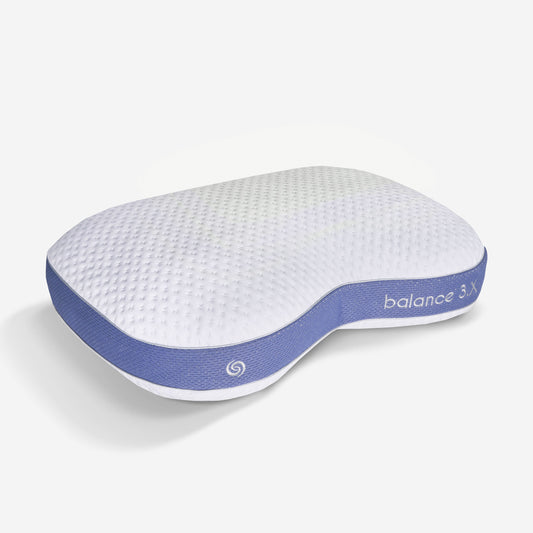
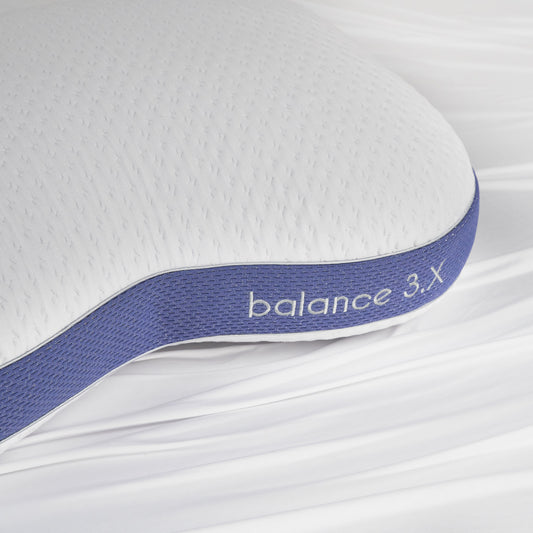
| Back sleeper, average frame | Low to medium | BalancePerformance® Pillow |
| Back or side, average frame, runs warm | Medium | Night IcePerformance® Pillow |
| Side sleeper, average to broader frame | Medium to high | CosmoPerformance® Pillow |
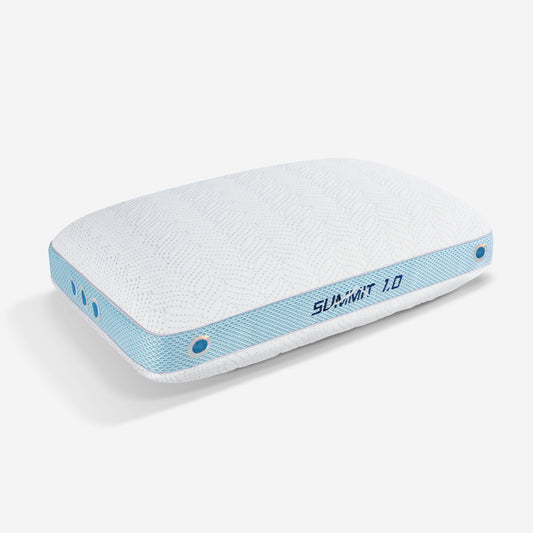
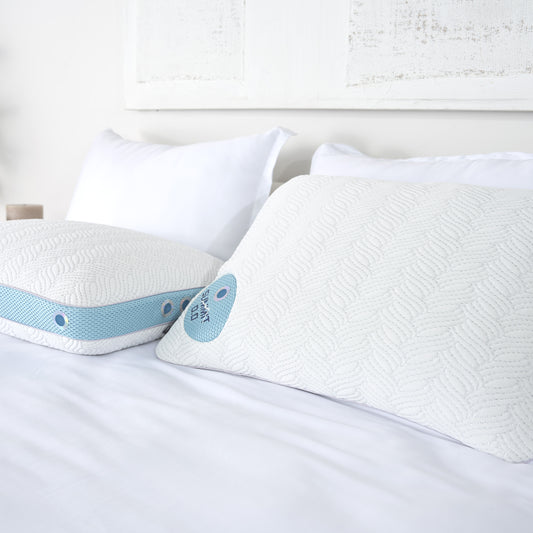
| Side sleeper wanting a premium build | Medium to high | SummitPerformance® Pillow |
| Side sleeper, broad shoulders, larger frame | High | StormPerformance® Pillow |
The Summit is worth a closer look if you want to see how much construction goes into holding a loft. It is a layered build rather than a single block of fill, which is what lets it stay supportive without going stiff.

If you would rather not read a chart, the PillowID Quiz asks a handful of questions and returns the same answer in about a minute flat. What's more, if you're looking for the longer explanation of how height and alignment interact, our guide to pillow loft goes deeper, and the sleep position guide covers the position side in detail.
Not sure which loft you land in?
The PillowID Quiz maps your sleep position and body size to a specific pillow in about a minute. No guessing, no returns.
When Memory Foam Is Still the Right Call
We build performance foam pillows, so it would be easy to write memory foam off entirely; look, we get that. Still, that would not be accurate, and it would not help you buy the right thing, and at the end of the night that's what matters the most.
There are sleepers for whom the molded feel is the whole point. If you run cool, sleep in one position all night without moving much, and specifically want the sensation of the pillow closing around your head, memory foam delivers something a faster-rebounding fill does not try to replicate. Preference is a legitimate reason.
Contoured memory foam shapes also serve a specific niche well. A sculpted cervical pillow that holds a fixed profile can suit a dedicated back sleeper who never rolls, because the shape only works when your head stays in the position it was designed for. If you are a true combination sleeper, that same fixed profile becomes a problem the moment you turn.
The honest summary is this: Memory foam optimizes for the feeling of contact. Performance foam optimizes for what happens over eight hours of contact.
If you have never had a complaint about heat or a flattened pillow by morning, your current setup may already be fine. But if either of those sounds familiar, the material is worth reconsidering, and we have your back every step of the way.
How to Choose Between Memory Foam and Performance Foam Pillows
Three questions get you to an answer faster than any spec sheet. Start with your loft, because that is the decision everything else hangs off. Find your sleep position and body size on the PillowID chart and lock in the height band before you think about fill at all.
Second, ask whether you sleep hot. Not "does the room feel warm," but do you flip the pillow, wake up damp, or push covers off around 3am. If yes, airflow and fabric are doing more for you than contour ever will, and a performance build is the stronger direction.
Third, ask how much you move. Sleepers who settle into one position and stay there can take advantage of slow-rebound contouring. Sleepers who turn several times a night need a fill that is back at full height before they land, which is exactly what performance foam is engineered to do.
Answer those three and the shortlist writes itself. If you want a hand narrowing it further, the pillow buying guide covers the full lineup, and our side sleeper guide and neck comfort guide go position by position.
Whatever you land on, a pillow protector and the right care routine will add years to whichever one you choose!
Frequently Asked Questions About Memory Foam and Performance Pillows
Do you have more questions about the memory foam pillow vs performance pillow debate? We have some answers that further wrap things up below.