Nobody gets excited about a crib protector, and we say that as a bedding company. It is not the crib you spent three weekends researching, and it is not the sheet with the little clouds on it.
Then the first blowout happens. Or the spit-up, or the bottle that gets knocked sideways during a 2am feed. Suddenly the only thing standing between that mess and a mattress you cannot put in the washing machine is a crib protector, and you find out very quickly whether yours was any good.
This guide covers what a crib protector actually is, why waterproofing and breathability are not opposites, how to get the size right, and what to look for before you buy. We will start with the part that confuses almost everyone.

What Is a Crib Protector?
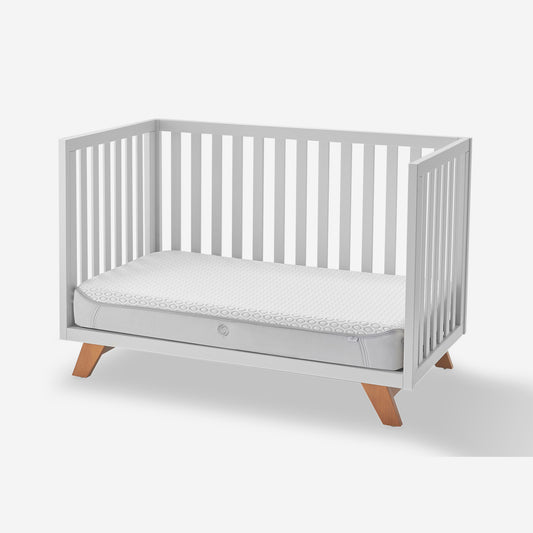
A crib protector is a fitted cover that goes directly over the crib mattress, underneath the fitted sheet. Its job is to create a barrier between your baby and the mattress core so that liquid, sweat, and everyday mess stay on a layer you can strip and wash.
The confusion starts because the phrase gets used for several different products. Some people mean a mattress protector, others mean a rail cover for a teething toddler, and search results mix in bumpers and liners, which are a different category entirely.
Crib Protector vs. Pad vs. Rail Cover vs. Bumper
Four different products get called roughly the same thing, and buying the wrong one is easy to do. Here is the plain version of each.
Crib Mattress Protector
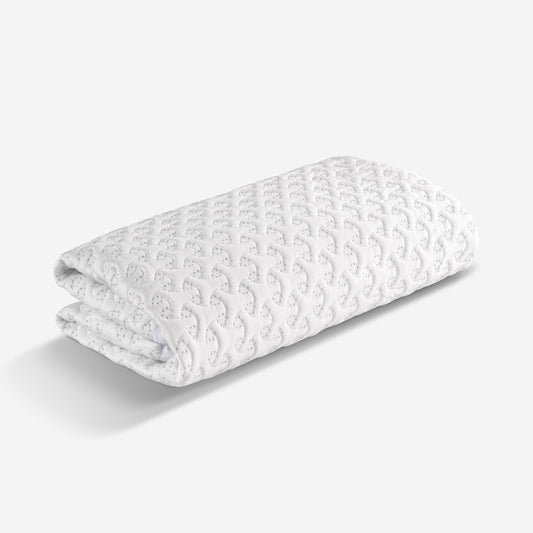
A fitted cover that encases the mattress and provides a waterproof barrier. It goes on like a fitted sheet and stays taut against the mattress surface.
This is what most people actually want when they search for a crib protector. It is the only one of the four that both blocks liquid and stays put under a moving baby.
Crib Mattress Pad
Usually a flat, absorbent layer laid on top of the mattress, sometimes with elastic corner straps. Many crib pads are not waterproof at all; they soak up liquid rather than stopping it.
The bigger issue is that a flat pad can shift and gather during the night. Loose fabric in the crib is exactly what safe sleep guidance tells you to avoid, so a fitted protector is the safer buy.
Crib Rail Cover
A fabric sleeve that wraps the top rail of the crib, aimed at teething toddlers who chew the wood. Some parents search for a crib protector and mean this.
Rail covers protect the crib rather than the crib mattress. If your concern is the finish on the rail rather than what happens under the sheet, this is the product you want; it does nothing for leaks.
Crib Bumper
Padded or mesh liners that attach around the inside of the crib. These are no longer sold in the United States; the Safe Sleep for Babies Act (opens in a new tab) banned the manufacture and sale of padded crib bumpers.
If you came here looking for bumpers, the short answer is that safe sleep guidance calls for a bare crib: a firm flat mattress, a snug fitted sheet, and nothing else in the space with your baby. That distinction is the one worth holding onto. A protector fits safe sleep guidance precisely because it lives under the sheet rather than in the crib alongside your child.
Why a Crib Protector Matters More Than You Think
The obvious reason is mess. The less obvious reasons are the ones that cost you money later.
Crib mattresses are genuinely hard to clean. Once liquid gets past the outer cover and into a foam or fiber core, it does not evaporate on a useful timeline. It sits there instead, and moisture that sits inside a mattress core is how you end up with odor a few months down the line. You cannot wash it out, and you cannot really air it out either.
There is also the warranty. Some crib mattress warranties may be affected by staining, which means a single unprotected accident can quietly reduce the coverage you paid for; check the terms on your own mattress. A protector costs considerably less than the mattress it is guarding.
Then there is the day-to-day math. Newborns can spend well over fourteen hours a day in the crib across naps and overnight sleep, and that surface collects sweat every one of those hours even when nothing dramatic happens. A washable layer on top means you are refreshing the sleep surface regularly rather than hoping for the best.
None of this is unique to cribs. The same argument applies to your own bed, which we made at length in our bed protector buying guide; the crib version just has a shorter fuse.
- 01Diaper LeaksThe overnight failure that soaks straight through a sheet in seconds.
- 02Spit-Up and FeedsMilk and formula that turn into odor fast once they reach a mattress core.
- 03Night SweatBabies run warm; moisture builds at the surface even on quiet nights.
- 04Dust and DanderA washable barrier keeps everyday buildup off the mattress itself.
Those four are the everyday cases. What determines whether a protector handles them well is how the waterproofing is built.

Waterproof Crib Protectors Explained
Every waterproof crib protector has two parts: a face fabric your baby's sheet sits on, and a barrier layer underneath that stops liquid. How those two are built is the whole ballgame.
The cheapest approach is a thick vinyl or PVC sheet. It absolutely stops liquid, but it also stops air, holds heat against the mattress surface, and makes that unmistakable crinkling sound every time your baby rolls over. If you have ever heard a crib protector announce itself at 4am, that was vinyl.
The better approach is a thin laminated membrane bonded to a knit face fabric. The membrane blocks liquid, and because it is thin and bonded rather than layered loose, it moves with the fabric instead of fighting it. No crinkle, and far less heat trapped at the surface.
Where Cheap Waterproofing Fails
Failures almost always happen in the same three places. Seams go first, because a protector can be waterproof across the panel and still leak where the panels are joined. Corners come next, where repeated stretching over the mattress breaks down the barrier at the spot that takes the most stress.
The third is the wash cycle. Bleach and fabric softener both degrade laminated barriers over time, and a protector that survived six months of use can fail after a handful of hot washes with the wrong products. That one is preventable, and we cover it below.
Breathability and Waterproofing Are Not Opposites
This is the part most crib protector guides get wrong. There is a common assumption that waterproof means hot, or that it has to feel like plastic, and that you have to pick one or the other.
You do not, because the two functions come from different layers doing different jobs. The barrier layer handles liquid, while the face fabric above it handles air and moisture vapor. When a protector is built with a thin barrier and a genuinely breathable knit face, air keeps moving at the surface where your baby is, and liquid still gets stopped below. Breathability only disappears when a manufacturer uses one thick plastic layer to do both jobs.
Why Surface Airflow Matters for Babies and Toddlers
Babies regulate temperature less efficiently than adults do, and they cannot kick off a blanket or move to a cooler spot the way you can. That makes the surface they sleep on more consequential than it is for an adult.
A surface that traps heat and holds moisture creates the kind of low-level discomfort that shows up as more frequent waking, and more frequent waking is the last thing any household with a newborn needs. Breathable, moisture-moving fabric is not a luxury feature here; it is the difference between a protector that helps and one that quietly works against you.

We build crib protectors around exactly that split. The Dri-Tec face fabric moves moisture away from the surface and keeps airflow going, while the barrier underneath handles the liquid. The two do complementary jobs rather than interchangeable ones; one manages air and moisture at the surface, the other stops liquid from getting through. You can see the same thinking in our performance crib sheets, which sit directly on top.
Crib Protector Sizes: Getting the Fit Right
Fit is a safety issue, not just a convenience one. A protector that bunches, slides, or leaves slack creates loose fabric in the sleep space, and loose fabric in a crib is what safe sleep guidance tells you to avoid.
The good news is that crib mattress sizing is unusually standardized in the United States. Federal requirements set the dimensions for full-size crib mattresses, so a standard crib protector should fit a standard crib mattress without drama. Mini cribs are the exception and need their own size. Here is how the common sizes compare.
| Mattress Type | Typical Dimensions | Protector to Buy |
|---|---|---|
| Full-Size Crib | 27¼" × 51⅝" minimum, 6" max thickness | Standard crib protector |
| Mini Crib | Commonly 24" × 38", thinner core | Mini crib mattress protector |
| Toddler Bed | Usually the same crib mattress, reused | Standard crib protector |
| Playard or Pack-Style | Varies by brand; measure before buying | Brand-specific size |
One habit worth building: measure the mattress, not the crib frame. Frames vary more than mattresses do, and the protector has to fit the thing it is actually wrapping. Our crib mattress size guide goes deeper on the dimensions.
The Snugness Test
Once the protector is on, grab a corner and pull. It should stay put. If it slides off, or if you can gather a fistful of slack anywhere on the surface, the fit is too loose and you want a different size.
Do the same check with the fitted sheet on top. Both layers should be taut, with no ridges or bunching under your hand.
What to Look For in a Crib Protector
Once you know the size, the rest comes down to construction. These are the eight things worth checking before you buy a crib mattress protector.
- 01Snug Fitted DesignFitted skirt that grips the mattress; no flat pads that shift.
- 02Thin Waterproof BarrierBonded membrane rather than a thick vinyl sheet.
- 03Breathable Face FabricKnit performance fabric that keeps airflow moving at the surface.
- 04Machine WashableHome washer and dryer safe; you will use this constantly.
- 05Quiet Under MovementNo crinkle when your baby rolls; noise wakes light sleepers.
- 06Reinforced SeamsSeams are where leaks start; look for finished, sealed edges.
- 07Tested MaterialsThird-party testing for the materials in your baby's sleep space.
- 08Buy TwoOne on the mattress, one clean and folded; essential at 3am.
Number eight is the one parents skip and later regret. A single protector means any accident at an inconvenient hour turns into a laundry emergency; two means it turns into a two-minute swap.
Fitted vs. Zippered Crib Protectors
You will see two formats, and they solve slightly different problems. A fitted protector covers the top and sides like a fitted sheet. A zippered encasement wraps the mattress completely and seals shut.
For most families, fitted is the right call for daily use, because it comes off and goes back on in seconds. Encasements make more sense when you want full six-sided coverage, though they are slower to change. Here is the trade-off side by side.
| Factor | Fitted Protector | Zippered Encasement |
|---|---|---|
| Coverage | Top and sides | All six sides, fully sealed |
| Change Speed | Fast; seconds at 3am | Slower; full removal needed |
| Best Use | Everyday leaks and washing | Long-term mattress sealing |
| Typical Setup | Rotate two, wash often | One on, fitted layer above |
Plenty of families run both: an encasement stays on year-round, with a fitted protector above it doing the daily work. If you want the longer version of that logic, our guide on what a mattress encasement is breaks it down for adult beds, and the principle carries straight over.
How to Wash and Care for a Crib Mattress Protector
Care is where most protectors get killed off early, and it is all avoidable. The barrier layer is durable but not indestructible, and a few common laundry habits will shorten its life considerably.
Wash immediately after any leak. Beyond that, every two to four weeks is a reasonable rhythm as part of your normal bedding rotation, since sweat builds up whether or not anything obvious happened.
- Machine wash warm and tumble dry low unless the care label says otherwise.
- Skip fabric softener; it coats the face fabric and reduces how well it moves moisture.
- Skip bleach; it degrades laminated waterproof barriers over time.
- Avoid high-heat drying, which is the fastest way to break down a bonded membrane.
- Wash the protector and sheets together to keep the whole rotation on one schedule.
Follow that and a good protector will comfortably outlast the crib stage. The number of sheets you keep on hand feeds directly into how smoothly this works, which we covered in our guide to how many crib sheets you really need.

Our Crib Mattress Protectors
We build crib protectors on the same performance principles as the adult lineup, scaled down and simplified for the crib. The differences between them come down to what you want the face fabric doing.
| Protector | Best For | Key Feature |
|---|---|---|
| Dri-Tec Crib Mattress ProtectorEveryday pick | Most families, most nights | Moisture-wicking face fabric over a waterproof barrier |
| Ver-Tex Crib Mattress ProtectorWarm nurseries | Babies who sleep warm | Cool-to-the-touch surface fabric |
| Air-X Crib Mattress ProtectorAirflow focus | Surface breathability | Open-structure fabric that keeps air moving |
| Ver-Tex Crib Protector 2-PackThe 3am solution | Anyone who took our advice above | Two protectors so one is always ready |
All four are built to fit standard full-size crib mattresses and work with any performance crib sheet layered on top. You can browse the full range in crib protectors, or see how they pair with our crib mattresses.
When Your Child Moves to a Bigger Bed
The crib stage ends faster than it feels like it will. When it does, the same logic applies at the next size up, just with a kid who now has opinions about bedtime.
The Dri-Tec Performance® Kids Mattress Protector carries the same construction into twin and full sizes, and the full range lives in kids mattress protectors. If you are rethinking the whole setup, our baby and kids bedding collection covers it, and how much sleep your child needs each night is a good companion read.
Not Sure Which Crib Protector Fits Your Setup?
Measure your crib mattress, then match it to the protector built for how your baby sleeps. Our team can walk you through the difference between the Dri-Tec, Ver-Tex, and Air-X face fabrics.
Frequently Asked Questions About Crib Mattress Protectors
Still deciding on a crib protector? These are the questions parents ask most.
Do You Need a Crib Mattress Protector?
What Is the Difference Between a Crib Protector and a Crib Pad?
Are Waterproof Crib Protectors Breathable?
What Size Is a Standard Crib Mattress Protector?
How Often Should You Wash a Crib Mattress Protector?
Choosing the Right Crib Protector for Your Baby
A crib protector is a small purchase that quietly decides whether your crib mattress survives the next two years. Get the size right, check that the barrier is thin rather than plastic-thick, and make sure the face fabric actually breathes.
Then buy two. That single decision is the one parents come back and thank us for, usually at an hour when nobody wants to be doing laundry.
We build every crib protector around the same idea as the rest of the lineup: the sleep surface should work with the body rather than against it. For a baby who cannot adjust their own environment, that matters even more. Browse the full crib protector range and start with the fit.