

Bed Sheet Dimension Guide: Every Size in Inches
Quick Summary
Every bed sheet size in one place, from a 39" x 75" twin to a 72" x 84" California king, plus the split and adjustable base configurations most size charts leave out entirely.
The measurement no chart can give you is your mattress depth. That's the number that decides whether a correctly sized sheet actually stays on the bed, and it's the one nobody prints on the package.

Recommended Sheet Set
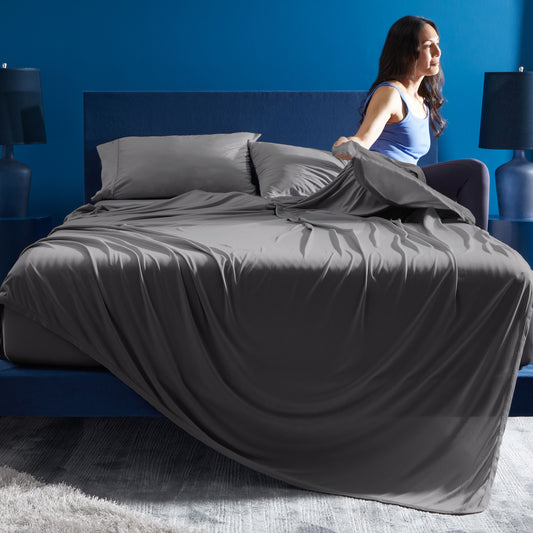
Dri-Tec Performance® Sheet Set
Moisture-wicking fabric and a secure Powerband fit make Dri-Tec a versatile choice across standard and adjustable mattress sizes.
Shop Dri-Tec SheetsBed Sheet Size Chart
Here's the whole lineup in one table. The first six are the standard sizes most people are shopping for. Below those are the split configurations for adjustable bases, and the combined stretch-fit sets that cover two sizes at once.
Every measurement is in inches, and every one is tied to the mattress rather than to a particular brand.
Bed Sheet Sizes: All 14 Configurations
| Configuration | Fitted sheet | Flat sheet | Pillowcase |
|---|---|---|---|
| Standard Sizes | |||
| Twin | 39" x 75" | 71" x 96" | 20" x 30" |
| Twin XL | 39" x 80" | 71" x 102" | 20" x 30" |
| Full | 54" x 75" | 86" x 96" | 20" x 30" |
| Queen | 60" x 80" | 96" x 102" | 20" x 30" |
| King | 76" x 80" | 110" x 102" | 20" x 40" |
| California King | 72" x 84" | 105" x 106" | 20" x 40" |
| Split Configurations | |||
| Split King | 39" x 80" per side | 110" x 102" | 20" x 40" |
| Split California King | 36" x 84" per side | 105" x 106" | 20" x 40" |
| Split Head Queen | 60" x 80" | 96" x 102" | 20" x 30" |
| Split Head King | 76" x 80" | 110" x 102" | 20" x 40" |
| Split Head California King | 72" x 84" | 105" x 106" | 20" x 40" |
| Combined Stretch-Fit Sets | |||
| Twin/Twin XL | Covers both lengths | 71" x 101" | 20" x 30" |
| King/Cal King | Covers both footprints | 110" x 106" | 20" x 40" |
| Split King/Split Cal King | Covers both, per side | 110" x 106" | 20" x 40" |
Split fitted sheet measurements are per side. Combined sets are single stretch-fit sheets built to cover two sizes; see the split and combined sections below.
How to Read a Bed Sheet Size Chart
The fitted sheet column is the one that has to match your bed. Those numbers are the mattress footprint, which means a 60" x 80" queen fitted sheet is describing a 60" x 80" queen mattress. If that column doesn't match, nothing else about the sheet matters.
The flat sheet and pillowcase columns work differently. They aren't matching anything; they're sized to be big enough, which is why a queen flat sheet is 96" x 102" on a bed that's only 60" x 80".
Those two pieces are far more forgiving, and they carry between sizes more often than people expect.
What Are the Standard Bed Sheet Sizes in the United States?
The standard bed sheet sizes are twin at 39" x 75", twin XL at 39" x 80", full at 54" x 75", queen at 60" x 80", king at 76" x 80", and California king at 72" x 84". Those six cover the large majority of beds in the United States.
Everything beyond that list is a variation on the same six footprints. Split configurations divide one of them for an adjustable base, and combined sets stretch to cover two of them.
There's no seventh secret size hiding out there.
Standard Bed Sheet Dimensions by Size
Each size has one thing about it that catches people out. The good news? We make the sheet type that you need abundantly clear.
so, here's the short version of all six, with a link to the full breakdown if you want the in-depth version of each bed sheet dimension size.
Twin Sheet Dimensions
A twin fitted sheet is 39" x 75", with a 71" x 96" flat sheet and a 20" x 30" pillowcase. It's the smallest standard footprint and the bed most likely to be stripped and remade every week.
The oddity here is the flat sheet, though, which is not like the others. At 71 inches wide it's nearly double the width of the mattress, which looks like a mistake until you understand that drape is a fixed requirement while the bed isn't.
Our twin sheet dimensions guide has the full math.
Twin XL Sheet Dimensions
A twin XL fitted sheet is 39" x 80", with a 71" x 102" flat sheet and the same 20" x 30" pillowcase as a twin. Same width as a twin, five inches longer.
This is the standard dorm bed at most colleges, which is how most people meet the size. Those five inches are also why twin sheets from home won't work, and why the swap question dominates this size.
Our twin XL sheet dimensions guide covers the dorm angle and the mix-up in detail.
Full Sheet Dimensions
A full fitted sheet is 54" x 75", with an 86" x 96" flat sheet and a 20" x 30" pillowcase. It's the same length as a twin and fifteen inches wider.
If you've seen a package labeled double and wondered whether it's something else, it isn't; full and double are the same bed with two names, one American and one British.
Our full size bed sheet dimensions guide unpacks the naming and the twin comparison.
Queen Sheet Dimensions
A queen fitted sheet is 60" x 80", with a 96" x 102" flat sheet and a 20" x 30" pillowcase. It's the most common bed size in the country, so it's the most searched sheet size by a wide margin.
The recurring question is whether a full sheet will stretch to cover one. It won't; a full is six inches narrower and five inches shorter.
Our queen size bed sheet dimensions guide has every measurement plus the centimeter conversions.
King Sheet Dimensions
A king fitted sheet is 76" x 80", with a 110" x 102" flat sheet and a 20" x 40" pillowcase. Note that last number, because king is the only size in the entire lineup that breaks from the 20" x 30" standard.
It's also the same length as a queen; the whole difference between the two is sixteen inches of width.
Our king size bed sheet dimensions guide covers the pillowcase catch, the Eastern King naming, and how to fold the thing.
California King Sheet Dimensions
A California king fitted sheet is 72" x 84", with a 105" x 106" flat sheet and a 20" x 40" king pillowcase. It's the longest standard mattress made, which is the entire reason it exists.
It is not, however, the biggest. A king is 6,080 square inches against a California king's 6,048, so the bed with the grander name is fractionally smaller.
Our California king sheet dimensions guide covers that and the king swap that trips up almost everyone.
Split and Adjustable Base Bed Sheet Configurations Explained
This is where most size charts stop and where a lot of real beds actually live. Adjustable bases need mattresses that move, and that changes what the sheets have to do, so you can't just be throwing random regular sheets on your adjustable base mattress.
There are two different things going on under the word "split," and they need completely different sheets; we help you learn a little more about this below.
Split King and Split California King
A split king is two separate mattresses side by side, each one a twin XL at 39" x 80". That means it takes two fitted sheets rather than one, while the flat sheet and pillowcases stay king sized at 110" x 102" and 20" x 40". A split California king works the same way, with each side measuring 36" x 84".
The point of the arrangement is that each side moves independently, which a single fitted sheet stretched across both would prevent. Our split king sheets guide covers the setup, and split head versus split king explains how the two configurations differ.
Split Head Bed Sheet Configurations
A split head bed is one mattress with a division running through the head only, so each side can incline while the foot stays joined. Because the mattress is a single piece, the fitted sheet is too. A split head queen is still 60" x 80", a split head king is still 76" x 80", and a split head California king is still 72" x 84".
That's the detail worth carrying away: split head means one sheet, split king means two. The sheet accommodates the split rather than being cut in half at it, and the flat sheet and pillowcases match the standard size in every case.
One Sheet, Two Sizes
We also build combined stretch-fit sets: Twin/Twin XL, King/Cal King, and Split King/Split Cal King. A single fitted sheet covers either bed in the pair, which takes the guesswork out of the two most confused size pairings there are.
That only works because of the Powerband. A sheet holding tension around the perimeter can stretch into a longer or wider footprint and still grip the smaller one, rather than being locked to one exact set of numbers. Explore our sheet collection to see the range.
Flat Sheet and Pillowcase Sheet Dimensions
Look down the flat sheet column and something strange shows up. A twin flat sheet is 32 inches wider than its mattress. A king flat sheet is 34 inches wider than its mattress. Two beds that differ by 37 inches of width have flat sheets that differ by only 39.
That near-constant is the key to the whole column, and it explains the sizes that look wrong.
Why Flat Sheets Are So Much Bigger Than the Mattress
A flat sheet has three jobs: cover your body, drape down both sides, and leave enough length to tuck at the foot; you don't want your feet poking out, right? The drape is the part that doesn't scale.
That said, you need roughly the same sixteen inches hanging down each side of the bed whether that bed is 39 inches wide or 76.
On a king, adding a fixed amount of drape to an already wide sheet is barely noticeable. On a twin, it nearly doubles the thing. That's why the twin flat sheet looks absurd and the king one doesn't, even though they're built on identical logic.
California king is the strangest case of all; because the bed is narrow and long, the width and length requirements converge and the flat sheet comes out nearly square at 105" x 106". This makes shopping for flat sheets a little more complicated, but the good news is we always have your back at BEDGEAR.
Pillowcases: 20" x 30" Everywhere Except King
Twin, twin XL, full, and queen sets all ship queen or standard pillowcases at 20" x 30". King and California king sets ship king cases at 20" x 40". That's the whole rule, and it's worth knowing because it's the piece people get wrong most often when buying sets separately.
It also explains a persistent mix-up: king and California king use the same pillowcase, which makes it feel like the fitted sheets should swap too.
They don't. If you're unsure which pillows are actually on your bed, our pillow size guide sorts all that out for you.
Why Size Isn't the Same as Fit
Everything above this point is about matching a number on a package to a number on your bed. That's necessary, and it isn't enough, because the chart is missing a dimension.
Every measurement here is two-dimensional. Your mattress is not, though, is not.
Depth is the third number, it's the one nobody prints, and it's the reason two sheets with identical labels can behave completely differently on the same bed.
Depth Is the Number the Chart Can't Give You
A fitted sheet has to reach the underside of the mattress and hold tension there. When your mattress is deeper than the sheet was cut for, the fabric runs out before it clears the bottom edge and the sheet ends up gripping by an inch of corner. That's the corner that lets go at 3am.
Mattress profiles have climbed steadily, and every layer you add climbs them further: a pillow top, a topper, a mattress protector. Meanwhile plenty of sheets are still cut for a mattress height that fewer and fewer people own. Measure the total height of your bed, including everything on it, before you buy anything.
What a Powerband Does Differently

The standard approach gathers a strip of elastic into the four corners. It grips when it's new, then it wears down, and the fabric between the corners has nothing supporting after a while. However, the bigger the sheet, the more weight those four points are carrying and the faster they give up.
To get around this issue, our sheets use a Powerband instead. It's a stretch band engineered to hold tension around the perimeter rather than concentrating the work at the corners, so the grip stays even and accommodates a range of mattress depths rather than one fixed profile.
It's also what makes the combined sets possible; a band that holds across a range can cover two sizes instead of one. If you've ever seen athletic clothing, well, that's what we're working with here at BEDGEAR.
Size Gets You Close; Fit Gets You There
A chart can tell you that your bed takes a 60" x 80" sheet. It can't tell you whether that sheet will still be on the mattress in the morning. That part comes down to how the sheet holds, not what it measures.
Every size we make uses a Powerband, from twin through split California king. Our bed sheet buyer's guide covers what else is worth paying attention to, and what isn't.
Frequently Asked Questions About Bed Sheet Sizes
Here are the questions that come up most across every single bed sheet sizes. We have answers to the most common ones down below.
What Size Sheets Fit a Hospital Bed?
Is a Single Bed Sheet the Same as a Twin?
Are Bed Sheet Sizes the Same in Every Country?
What Is the Difference Between a Flat Sheet and a Fitted Sheet?
How Do I Know What Size Sheets to Buy?
Why Doesn't My Fitted Sheet Stay On?
Finding the Appropriate Bed Sheet Dimensions with BEDGEAR
Bed sheet dimensions are simpler than the packaging makes them look, so there's no need to worry. Six standard footprints, a flat sheet that's always bigger than you'd expect, and a pillowcase that's 20" x 30" on everything except a king. Match the fitted sheet to the mattress and the rest of the set follows.
Then measure the one number this chart can't give you. Add up your mattress, your topper, and your protector, and choose a sheet built to stretch across that range rather than one cut to a single fixed profile.
Size gets you close; fit, now that is what keeps the bed made and your toys toasty deep into the night.
Sheets That Stay Where You Put Them
Powerband fit, performance fabrics, and every size from twin to split cal king. Built for how you actually sleep.
You May Also Like
-

 Moisture-WickingRegular price $199.99Sale price $199.99 Regular priceUnit price per
 -

 Instant-CoolingRegular price $249.99Sale price $249.99 Regular priceUnit price per


