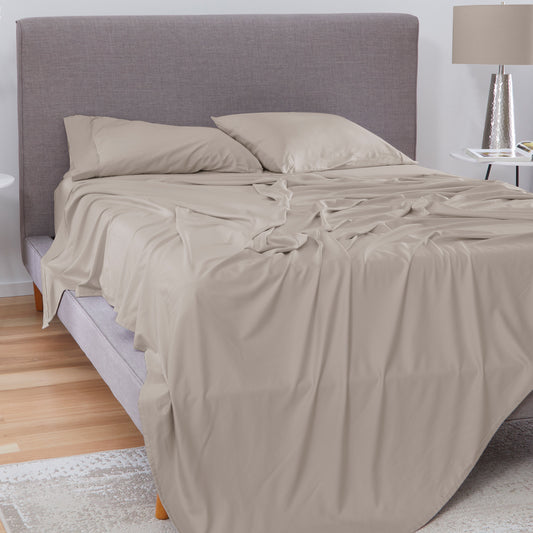
What Size Is a Queen Bed Sheet?
Sound like a simple question, right? Well, that's not exactly the case. A queen bed sheet is sized to a queen mattress, which measures 60 inches wide by 80 inches long. The fitted sheet matches that footprint exactly. The flat sheet and pillowcases are built around it, which is why they carry different numbers entirely.
Those three pieces are what most sets include, and each one has a job. The fitted sheet grips the mattress. The flat sheet covers you. The pillowcases finish the bed. Here's how the measurements line up across the whole set.
Queen Sheet Set Dimensions
| Piece | Inches | Centimeters |
|---|---|---|
| Fitted sheet | 60" x 80" | 152 x 203 cm |
| Flat sheet | 96" x 102" | 244 x 259 cm |
| Pillowcase (queen/standard) | 20" x 30" | 51 x 76 cm |
Centimeter figures are converted from inches and rounded to the nearest whole number. As you can see, it's not just the sheet that you have to account for, but the entire sheet set.
Queen Fitted Sheet Measurements Explained
The queen fitted sheet is cut to 60 inches by 80 inches across the top panel. That panel is the part you actually sleep on, and it sits flat against the mattress surface. Everything else on the sheet exists to wrap the sides and hold the whole thing in place, which is where a lot of that extra fluff comes into play.
The sides are where fitted sheets differ from one another, though. Two sheets can both say 60" x 80" and still behave nothing alike, because that number describes the top of the mattress and says nothing about how far the sheet travels down the sides. That gap between what's printed and what you need is the single biggest reason people end up with a sheet that pops off.
What Are the Measurements of a Queen Size Bed Sheet Set?
A queen size bed sheet set includes a 60" x 80" fitted sheet, a 96" x 102" flat sheet, and two queen or standard pillowcases at 20" x 30". Some sets ship with a single pillowcase instead of two, so it's worth checking the listing before you assume. The three pieces are sized to work together on the same bed, so if you're getting a sheet set, you don't have to worry too much.
You'll notice the flat sheet is dramatically larger than the mattress in both directions. That's intentional and it's covered further down. For now, the short version is that a flat sheet has to cover a person, tuck under a mattress, and still have fabric left over.
Queen Flat Sheet Size

A queen flat sheet measures 96 inches wide by 102 inches long. Set that against a 60" x 80" mattress and the flat sheet is 36 inches wider and 22 inches longer than the bed it's going on. That surplus is the entire point, though, because it needs to stay in place while you're wiggling around under them.
Flat sheets are one of the most searched pieces of the set, and the confusion usually comes from that size gap. People check the number, compare it to their mattress, and assume they've grabbed the wrong size. The good news? They haven't, so there's no need to panic if you find yourself in this situation.
Why a Flat Sheet Is Bigger Than the Mattress
A flat sheet has three jobs happening at once. It has to cover your body, drape over both sides of the bed, and leave enough length at the foot to tuck underneath the mattress. Cut it to the size of the mattress and it would do exactly none of those things.
The extra width gives you roughly 18 inches of drape on each side of a queen. The extra length covers the tuck at the foot and the fold-back at the head, which is the part you turn down over your blanket.
If you sleep with a deeper mattress or you like a generous tuck, that surplus disappears faster than you'd expect; it's the reason some people size up on the flat sheet even when the fitted sheet fits perfectly.
What Size Is a Queen Flat Sheet?
The queen flat sheet is 96" x 102", which converts to roughly 244 x 259 cm. Unlike the fitted sheet, though, it has no elastic, no corners, and no depth to account for; it's a rectangle of fabric and the only measurements that matter are the two on the package.
Because there's no fitted element, flat sheets are far more forgiving across sizes, so you don't really have to go too crazy with them (size-wise at least).
After all, a king flat sheet on a queen bed just means more fabric hanging down the sides. That flexibility is why flat sheets are the one piece of the set where sizing up is a legitimate choice rather than a mistake.
Queen Sheet Dimensions in Centimeters
Sheets sold in the United States are cut to inches, so every centimeter measurement you'll find is a conversion rather than the original spec. That's worth knowing, because it explains why the cm figures you see vary slightly from one site to the next. They're all rounding the same inch measurement in slightly different ways.
Here's the full queen set converted, including how each piece compares to the mattress itself.
Queen Sheet Dimensions in Centimeters
| Piece | Centimeters | Inches |
|---|---|---|
| Queen mattress footprint | 152 x 203 cm | 60" x 80" |
| Fitted sheet | 152 x 203 cm | 60" x 80" |
| Flat sheet | 244 x 259 cm | 96" x 102" |
| Pillowcase (queen/standard) | 51 x 76 cm | 20" x 30" |
Conversions rounded to the nearest centimeter. Expect a variance of a centimeter or two between brands, and make sure you keep this in mind, even if you're not searching for BEDGEAR sheets.
Why Two Queen Sheets Can Fit Differently
Here's the thing nobody prints on the front of the package: mattress depth. Two queen fitted sheets can carry identical 60" x 80" labels and perform completely differently on your bed, because the label describes the top surface and ignores the sides entirely.
Mattress profiles have gotten taller over the last two decades. Add a pillow top, a topper, or a mattress protector and the number climbs again. Meanwhile, plenty of sheets are still cut for a mattress profile that most people no longer own.
How Mattress Depth Changes Sheet Fit
A fitted sheet needs enough material to reach the underside of the mattress and enough tension to stay there. When the mattress is deeper than the sheet was built for, the sheet runs out of fabric before it clears the bottom edge. It hangs on by the last inch or two of corner, which is exactly as reliable as it sounds.
That's the 3am corner pop, and it isn't a defect. Instead, it's a math problem between your mattress height and a sheet that was cut for a shallower bed. It's also why the same sheet can work perfectly in a guest room and fail every night on the primary bed.
What a Powerband on Sheets Does Differently

Most fitted sheets rely on a strip of elastic gathered into the corners. It works at first, then it relaxes; the fabric between the corners has nothing holding it, so the sheet slowly works its way loose over months of use and washing. You end up tugging corners back into place instead of sleeping.
Our sheets use a Powerband instead. It's a stretch band engineered to hold tension around the perimeter rather than bunching the work into four corners, so the sheet grips the mattress evenly and accommodates a range of mattress depths instead of one fixed profile.
That's the practical difference between a sheet that's the right size and a sheet that actually fits. If you've ever seen the elastic fabric around gym clothing, you'll recognize this technology, and it translates really well to bedding.
BEDGEAR Focus
Size Gets You Close; Fit Gets You There
Corner elastic asks four small points to hold an entire sheet in place. A Powerband distributes that tension around the whole perimeter, which is why our fitted sheets stay put on deeper profiles, pillow tops, and mattresses running a topper.
It also means you're not guessing at pocket depth. Explore our sheet collection to see how the band works across every size.
Queen vs. Full and King Sheets
Queen sits in the middle of the lineup, which makes it the size people are most likely to get wrong in both directions. Some try to stretch a full sheet up to a queen; others assume a king will cover it fine.
Neither works the way people hope, so make sure you get sheets that are the right size, or like what we like to call: "Personally fit to your bed."
Here's how the three fitted sheets compare against each other.
Full vs. Queen vs. King Fitted Sheets
The king comparison is the most interesting one for sure. A king is the same 80 inches long as a queen; the entire difference is width.
Overall, that's why a king sheet on a queen bed doesn't look absurd at first glance and still fails in practice.
Will Full Sheets Fit a Queen Bed?
No. A full fitted sheet is 54" x 75" against a queen mattress at 60" x 80", so you're short 6 inches of width and 5 inches of length. Even with a generous stretch, the sheet cannot reach the corners of a queen; it will either refuse to go on or snap off the moment you move.
This is far and away the most common queen sheet question, and it deserves more room than a paragraph. We broke down the full comparison, the near-misses people try, and what actually works in our guide to whether full sheets fit a queen bed.
How to Choose Queen Sheets
Once you know the size, the rest of the decision is about how the sheet behaves on your bed and against your body. These four things matter more than anything printed in large type on the package.
Start With Fit, Not Thread Count
Thread count is the most advertised spec on a sheet and one of the least useful. It counts threads per square inch, which tells you almost nothing about how a sheet feels, how it breathes, or whether it stays on your mattress. Manufacturers learned long ago that a bigger number sells, and the number has been inflated accordingly.
Fit is what you'll actually notice every night. A sheet that grips the mattress and holds through the night beats a high thread count sheet that's loose by Wednesday.
If you want the full breakdown of what the number really measures, we dug into it in our piece on thread count myths.
Match the Material to How You Sleep
Temperature is the variable most people get wrong. If you sleep hot, you want a material that moves heat away from the surface rather than holding it against you. Our Ver-Tex® sheets are cool to the touch on contact, and Dri-Tec sheets promote airflow and move moisture instead of trapping it.
If your temperature swings, or you share a bed with someone whose does, natural performance fibers handle the range better. Hyper-Wool and Hyper-Linen both breathe well across shifting conditions. For a straightforward everyday feel, Hyper-Cotton is the reliable pick.
Measure Your Mattress Depth/Height Before You Buy
Okay, this is the biggest factor to consider.
Take a tape measure to the side of your mattress and record the total height. Include the pillow top if you have one. Include the topper and the protector too, because the fitted sheet has to travel around all of it, not just the mattress.
That single number saves you from the most common sheet mistake there is. It's also why a Powerband matters: a band that holds tension across a range of depths means you're not trying to match a fixed pocket measurement to a bed that changed the moment you added a topper.
If you're also sorting out your mattress size, our queen mattress dimensions guide has the full footprint breakdown.
Don't Forget the Flat Sheet and Pillowcases
The 96" x 102" flat sheet and the 20" x 30" pillowcases are part of the same decision, not an afterthought. If you buy a set, they're matched for you. If you're piecing things together, those are the numbers to hold onto.
Pillowcases are where mismatches sneak in, especially if you're not careful. Queen sets ship with 20" x 30" cases that fit standard and queen pillows; king pillows need a 20" x 40" case and won't work in a queen set.
The good news? Our pillow size guide covers which pillow belongs on which bed if you're not sure what you're sleeping on.
Split Head Queen Is Still a Queen
If you're on an adjustable base with a split head queen, the fitted sheet still covers the full 60" x 80" footprint. The split runs through the head of the mattress only, so one sheet handles the whole bed; you don't need two.
That's different from a split king, which is genuinely two mattresses and takes two fitted sheets. We covered that setup in our split king sheets guide.
Frequently Asked Questions About Queen Mattress Sizes
Still working through queen sheet sizing? Here are the questions that come up most.
What Are Queen Sheet Dimensions in Centimeters?
Will King Size Sheets Fit a Queen Bed?
What Size Sheets Fit a Pillow Top Queen Mattress?
What Size Are Deep Pocket Queen Sheets?
What Size Pillowcases Come With a Queen Sheet Set?
Is a Split Head Queen Sheet the Same Size as a Queen Sheet?
Get the Right Queen Size Bed Sheets Today!
Queen size bed sheet dimensions come down to three numbers you can stop looking up: 60" x 80" fitted, 96" x 102" flat, and 20" x 30" pillowcases. Those figures are tied to the queen mattress itself, so they hold no matter whose sheets you're buying.
The number worth measuring is your mattress depth, because that's the one the package leaves out. Add up the mattress, the topper, and the protector, then choose a sheet built to stretch across that range rather than one cut to a single fixed profile.
Get the size right and the fit right, and the bed stays made; that's the whole job.