Is Beauty Sleep Actually Real?
So, is beauty sleep real? Or is it just something that people say? Well, the truth is that it's 100% real. In fact, your morning face tells a story about the night before. Everyone knows what it looks like after a bad one; you know, the puffiness, the dull skin, the eyes that give it all away. What most people don't think about is the biology behind it. For this reason, beauty sleep isn't marketing language. Instead, it's a measurable physiological process that happens every night whether you optimize for it or not.
In fact, a 2017 study confirmed what most people already suspected: sleep-deprived individuals were consistently rated as less healthy, less attractive, and more tired-looking by outside observers. The effect wasn't subtle. It was visible, and it was driven by real changes in skin appearance, not just perception.
What the Research Actually Says
Okay, so we mentioned a study, but what does that study actually say? And does it confirm anything important? Well, what if we told you that there were two studies. That's right, two peer-reviewed studies make the case cleanly. The first, published in Royal Society Open Science in 2017, found that even a single period of restricted sleep produced visible changes in facial appearance that strangers could identify. The second, published in Clinical and Experimental Dermatology, found that poor sleepers showed increased signs of skin aging and slower skin recovery after UV exposure compared to good sleepers. Neither study was looking at extreme sleep deprivation. Both found measurable effects from the kind of sleep disruption most people experience regularly.
The takeaway isn't that you need a perfect eight hours every night. It's that sleep quality has a direct, documented effect on how your skin looks and how well it recovers. That's not a wellness claim. It's physiology.
Why Eight Hours Isn't Enough on Its Own
Hours matter; so does what's happening during those hours. Deep sleep — specifically slow-wave sleep — is when human growth hormone is released and skin repair accelerates. If you're hitting eight hours but spending most of it in light sleep stages because you're overheating, waking from friction or discomfort, or getting pulled out of deep sleep by light, you're not getting the recovery those hours should be delivering.
This is where your sleep environment becomes a direct variable in your skin and hair health. The pillow you're pressing your face against for eight hours, the fabric creating friction across your hair, the light interrupting your melatonin production — each one affects sleep quality. And sleep quality affects everything else.
What Sleep Does to Your Skin Overnight
Most people think about skincare as something that happens in the bathroom. The cleanser, the serum, the moisturizer. What happens in bed gets less attention — which is backwards, given that your skin spends more time in contact with your pillowcase than it does with any product in your routine.
Sleep is the body's primary repair window. Overnight, skin cell turnover accelerates, inflammation settles, and the processes that keep skin looking healthy run at full capacity. Interrupt those processes — through poor sleep quality, heat, or friction — and the effects show up on your face.
Collagen Production and the Overnight Repair Window
Collagen is the structural protein that keeps skin firm and elastic. Production peaks during deep sleep, when human growth hormone triggers tissue repair across the body. It's not a passive process. It's an active biological function that requires you to actually reach and sustain deep sleep stages to run properly.
Chronic sleep disruption — even mild, ongoing disruption — reduces the time spent in those deep stages. Less deep sleep means less collagen synthesis. Over time, that deficit shows up as fine lines, reduced elasticity, and skin that looks older than it should. You can apply all the collagen-boosting serums you want; if you're not sleeping well, you're working against your own biology.
How Cortisol Affects Your Skin While You Sleep
Cortisol is your primary stress hormone. It's supposed to drop overnight as your body shifts into recovery mode. When sleep is disrupted, whether that's by heat, light, noise, or discomfort, your cortisol stays elevated. Unfortunately, elevated cortisol breaks down collagen, increases inflammation, and triggers oil production. The worse news? All three show up on your skin.
The connection between stress and breakouts is well documented. Less understood is how much of that stress response is driven by poor sleep rather than daytime stress alone. A sleep environment that keeps you in deep, uninterrupted sleep is one of the most direct ways to keep cortisol in check overnight.
Sleep Lines and Morning Puffiness
Sleep lines form when your face is pressed against a surface with enough friction and resistance to crease the skin. On a standard cotton pillowcase, that happens every night. Cotton doesn't move with your skin; it grips it. Press your face into that surface for hours and the lines it creates become increasingly slow to fade, especially as skin loses elasticity with age.
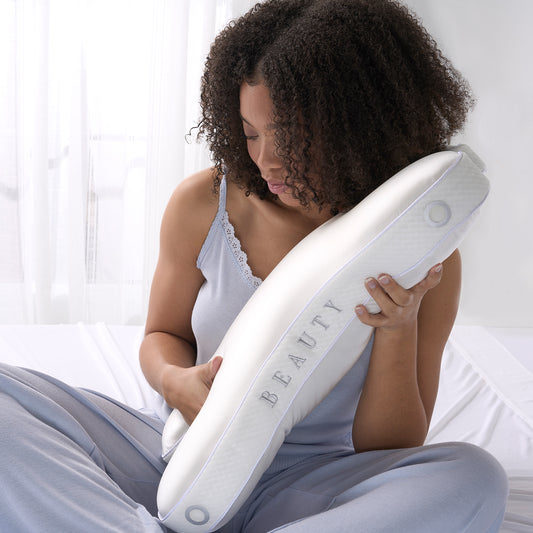
That said, morning puffiness is actually a fluid issue. When you lie still for hours, fluid pools in the face. A cool, breathable sleep surface helps regulate temperature and reduce the kind of heat buildup that makes puffiness worse. The BEDGEAR Beauty Performance® Pillow addresses both variables directly. Its ergonomic shape is designed to reduce direct facial contact, while the Hyper-Silk® cover and Air-X® mesh keep airflow moving so heat doesn't accumulate against your skin through the night.

What Sleep Does to Your Hair Overnight
Skin gets most of the beauty sleep attention, and for good reason. Still, hair deserves equal billing. Every night, your hair is pressed against a surface, pulled by friction, and losing moisture to the fabric it's resting on. The damage is slow and cumulative; most people don't connect their split ends or frizz to what's happening while they sleep.
The good news is that hair protection overnight is one of the easiest swaps in the routine. In fact, the right fabric and the right accessories remove most of the damage before it starts.
How Friction Causes Breakage and Frizz
Hair is covered in a cuticle layer; overlapping scales that lie flat when hair is healthy and lift when it's damaged or dry. Friction roughens that cuticle. It causes the scales to catch on each other and on the fabric they're moving against. The result? Frizz, tangles, and over time, breakage at the points of most contact.
Furthermore, you move in your sleep more than you realize. Every shift in position drags hair across the sleep surface. On a rough or high-friction fabric, those movements are working against the cuticle layer hundreds of times a night. The solution isn't to stop moving; it's to remove the friction from the equation.
Why Cotton Pillowcases Are the Problem
Cotton is breathable and durable. Sure, that's awesome, but cotton is genuinely terrible for your hair. The fiber structure is absorbent and grippy; it draws moisture out of hair and creates the kind of surface resistance that lifts the cuticle with every movement. If you've ever woken up with a tangle or a frizzy root situation that wasn't there when you went to bed, a cotton pillowcase is almost certainly involved.
The Hyper-Silk® Performance® Pillowcase is engineered specifically to eliminate that problem. This is due to the fact that the vegan Hyper-Silk® fabric is friction-free and cool-to-the-touch; hair glides across it rather than catching. The high-stretch design moves with you through the night so the surface stays smooth regardless of how much you shift position. It fits securely over any standard pillow and zips into place so it doesn't bunch or shift overnight.
Moisture Loss and Hair Health
Absorbent fabrics pull moisture from hair while you sleep. For anyone with dry, color-treated, curly, or coily hair, that overnight moisture loss compounds the dryness that already makes those hair types more prone to breakage. You can apply the best leave-in conditioner on the market before bed; if you're sleeping on cotton, you're losing a meaningful portion of that moisture to the fabric by morning.
Hyper-Silk® doesn't absorb moisture the way cotton does. It lets your hair retain what you've put into it overnight. Now, when you pair that with a protective style — a loose braid, a scrunchie, a turban — and you've addressed both friction and moisture in a single routine change.
Silk Pillowcase Benefits for Skin and Hair
The pillowcase is the highest-contact surface in your entire sleep environment. Think about it. Your face and hair are pressed against it for hours every night, shifting position repeatedly, generating friction with every movement. Most people have never thought twice about what that fabric is made of. They should.
Switching to a silk or silk-alternative pillowcase is consistently one of the first recommendations from dermatologists and hair care specialists for reducing overnight skin and hair damage. The science behind it is straightforward; the difference in the morning is real.
Less Friction, Fewer Sleep Lines
A standard cotton pillowcase has a relatively rough surface at the fiber level. When skin moves against it — which it does every time you shift position — the friction drags and creases. Those creases become sleep lines. In younger skin with strong elasticity, they fade quickly. As skin ages and elasticity decreases, they take longer to go and eventually stop fading entirely.
A friction-free surface removes that mechanism. Skin glides rather than drags; the creasing that creates sleep lines simply doesn't happen at the same rate. For anyone already using anti-aging skincare, this is the overnight component that most routines are missing.
Hyper-Silk® vs. Traditional Silk
Okay, so you've seen silk and now we're telling you all about our special silk. So, what's the difference? Well, natural silk has genuine benefits for skin and hair. It's smooth, low-friction, and protein-based — qualities that make it gentler than cotton on both surfaces. It also comes with real drawbacks: it's expensive, delicate, requires careful washing, and isn't vegan.
BEDGEAR's Hyper-Silk® fabric, on the other hand, is engineered to outperform traditional silk on the variables that matter for sleep. It's friction-free and cool-to-the-touch; natural silk can actually retain heat, which works against the temperature drop your body needs for deep sleep. Hyper-Silk® is also knitted with an advanced construction that allows air to circulate freely, preventing heat and moisture buildup through the night. Overall. the result is a fabric that delivers the skin and hair benefits of silk without the thermal penalty or the care requirements.
Why Vegan Silk Is Worth Considering
Traditional silk is produced from silkworm cocoons — a process that raises animal welfare concerns for a growing number of consumers. Vegan silk alternatives like Hyper-Silk® deliver the same smooth, low-friction surface without any animal byproducts. For consumers who are already intentional about vegan beauty products, extending that standard to their sleep surface is a natural next step.
The performance case for vegan silk stands entirely on its own. Hyper-Silk® is cooler, more breathable, and easier to care for than traditional silk. The vegan credential is an added benefit, not a compromise.
Silk vs. Satin Pillowcase: What's the Difference?
Silk and satin get used interchangeably in beauty content. They're not the same thing — and the distinction matters when you're making a buying decision based on skin and hair benefits.
Understanding the difference takes about sixty seconds. Once you know it, the choice becomes a lot clearer.
How They're Made
Silk is a natural fiber. It's produced by silkworms and has a protein structure that gives it its characteristic smoothness. Satin, on the other hand, is not a material — it's a weave pattern. Satin can be made from silk, but it's far more commonly made from polyester or other synthetics. When you see a "satin pillowcase" at a low price point, it's almost certainly polyester woven in a satin pattern, not actual silk.
That distinction changes the performance profile significantly. Polyester satin is smoother than cotton but still synthetic; it can trap heat and doesn't breathe well. Silk satin is smoother and more breathable but expensive and animal-derived. Hyper-Silk®, however, sits outside both categories — engineered fabric with a friction-free surface, active breathability, and a cool-to-the-touch feel that neither natural silk nor polyester satin consistently delivers.
Silk or Satin: Which Is Better for Skin?
For skin, the key variables are friction and temperature. Both silk and satin reduce friction compared to cotton. Where they diverge is thermal performance. Polyester satin traps heat; natural silk is better but still not as breathable as a purpose-built performance fabric. Heat disrupts sleep, elevates cortisol, and works against the overnight skin repair process.
Hyper-Silk® addresses friction and temperature simultaneously. The knitted construction promotes airflow; the smooth surface eliminates the dragging and creasing that cotton creates. For skin health specifically, that combination is more effective than either traditional silk or polyester satin alone.
Silk or Satin: Which Is Better for Hair?
Now, let's talk about hair for a second here. For hair, friction is the primary variable. Both silk and satin outperform cotton here. Polyester satin creates less friction than cotton but generates static, which contributes to frizz — especially for fine or color-treated hair. Natural silk is better on static but comes with the moisture-retention and care issues already covered.
Hyper-Silk® is friction-free and doesn't generate the static that polyester satin does. It also doesn't absorb moisture from hair the way cotton does. For curly, coily, or chemically treated hair where moisture retention is a priority, that non-absorbent quality is as important as the friction reduction.
How to Protect Your Hair While Sleeping
A good nighttime hair routine doesn't have to be complicated. It has to be consistent, and sleep plays a big factor here. The goal is simple: reduce friction, retain moisture, and keep hair in a position that minimizes stress on the shaft overnight. There are a few ways to do that; the right one depends on your hair type and how you sleep.
What all of them have in common is that they work better on a friction-free sleep surface. The pillowcase and the protective style work together. Neither one does the full job alone.
The Case for an Overnight Hair Wrap
An overnight hair wrap — whether a turban, bonnet, or sleep cap — keeps hair contained and protected from the sleep surface entirely. Instead of your hair moving against the pillowcase all night, it stays wrapped in a smooth, friction-free fabric. For anyone with curly, coily, natural, or chemically treated hair, this is the most complete overnight protection available.
The BEDGEAR Hyper-Silk® Turban is built for exactly this purpose. The Hyper-Silk® fabric is friction-free and non-absorbent; hair retains its moisture and style rather than losing both to the sleep surface. The fit is secure enough to stay in place through the night without being tight enough to create pressure or tension at the hairline — which is its own source of breakage if a wrap isn't designed correctly.
Scrunchies vs. Regular Hair Ties
If you sleep with your hair up, what you're tying it with matters as much as how you tie it. Standard elastic hair ties create a concentrated point of tension and friction right where the tie sits. That's where breakage happens — not gradually across the whole hair shaft, but at one specific point, repeatedly, every night.
A fabric scrunchie distributes the hold across a wider surface area and reduces that concentrated tension. A Hyper-Silk® scrunchie goes further; the smooth fabric creates virtually no friction at the contact point. The BEDGEAR Hyper-Silk® Plush Scrunchie is oversized and cushioned for an extra-gentle hold that won't crease or snap hair. The Hyper-Silk® Skinny Scrunchies (available in a 6 pack) are the everyday option — still friction-free, lighter hold, better for finer hair or looser styles.
Which Method Works for Your Hair Type
Straight or wavy hair responds well to a loose braid or a low bun secured with a Hyper-Silk® scrunchie. The goal is to keep hair from spreading across the pillow and generating friction; a contained style does that without requiring a full wrap.
Curly and coily hair benefits most from a full wrap — turban or sleep cap — because the curl pattern is more vulnerable to disruption from friction and moisture loss. Sleeping on a Hyper-Silk® pillowcase adds a second layer of protection for any hair that escapes the wrap overnight.
Color-treated and chemically processed hair is more fragile at the cuticle level regardless of texture. A friction-free pillowcase is non-negotiable; add a scrunchie or turban based on your texture and you've covered the main variables.
Silk Hair Scrunchie vs. Regular Scrunchie
The scrunchie had its moment in the nineties, came back as a trend, and never really left. What changed is the conversation around what scrunchies are actually made of — and why that matters more than most people realize.
Not all scrunchies are created equal. The fabric is the whole game.
What a Regular Scrunchie Actually Does to Your Hair
A standard fabric scrunchie is better than an elastic hair tie. That's a low bar. The fabric cover reduces some of the direct elastic tension on the hair, but most scrunchies are made from polyester or cotton — both of which create friction at the contact point. That friction roughens the cuticle, and the combination of friction and repeated tension is what causes the creasing and snapping that shows up as breakage over time.
The other issue is absorbency. Cotton scrunchies pull moisture from hair at the contact point, which contributes to dryness and brittleness right where the hair is already under the most mechanical stress. It's a compounding problem: friction plus moisture loss at the same location, every night.
How a Silk Scrunchie Is Different
A silk or Hyper-Silk® scrunchie changes both variables. The smooth fabric dramatically reduces friction at the contact point; hair slides against it rather than catching. And unlike cotton, Hyper-Silk® doesn't absorb moisture from the hair shaft. Your hair retains what you've put into it overnight rather than losing it to the fabric holding it in place.
The hold is also different. A well-made silk scrunchie distributes tension more evenly across the hair than a standard elastic-based scrunchie does. Less concentrated pressure means less creasing at the tie point — which is where a lot of breakage originates, especially for fine or fragile hair.
Plush vs. Skinny: Which One Do You Need
BEDGEAR makes two Hyper-Silk® scrunchie options; they solve slightly different problems.
The Hyper-Silk® Plush Scrunchie is oversized and cushioned. It's designed for anyone whose hair needs extra-gentle handling — thick hair, curly hair, color-treated hair, or anyone who's been dealing with breakage at the tie point. The cushioned construction distributes hold across a larger surface area and minimizes pressure on the hair shaft. It's the overnight option for anyone who sleeps with hair up and wants maximum protection.
The Hyper-Silk® Skinny Scrunchies are the everyday carry. Six per pack, lighter profile, still fully friction-free. They work for daytime wear, lighter holds, and finer hair types that don't need the volume of the plush version. For most people, the answer is both, so plush for overnight, skinny for the rest of the day.
What Is a Silk Sleep Cap?
The silk sleep cap has been a staple in hair care routines for decades — particularly for natural, curly, and coily hair types where overnight protection isn't optional, it's essential. It's gained mainstream attention recently, but the logic behind it hasn't changed: keep your hair away from the pillowcase, and you keep the friction, moisture loss, and style disruption that the pillowcase causes away from your hair.
The terminology gets a little loose in this category. Sleep cap, hair turban, bonnet — they're often used interchangeably. There are some real differences worth understanding.
Sleep Cap vs. Hair Turban: Is There a Difference?
A sleep cap is typically a fitted, dome-shaped covering that sits close to the head. It works well for shorter hair or tightly coiled styles that don't need a lot of interior volume. A hair turban is generally larger, with a twist or knot at the front and more room inside for longer hair or styles that benefit from staying loose overnight. Both serve the same core function: creating a barrier between your hair and the sleep surface.
The BEDGEAR Hyper-Silk® Turban falls into the turban category — secure enough to stay on through the night, with enough interior space to accommodate most hair lengths and styles. The Hyper-Silk® fabric inside means that even if hair shifts within the turban during sleep, it's moving against a friction-free surface rather than a rough one.
Who Benefits Most from a Silk Sleep Cap
The benefits are real across hair types, but some people see a more immediate difference than others.
Curly and coily hair types benefit most visibly. The curl pattern is fragile; friction disrupts it, moisture loss dries it out, and both happen simultaneously on a standard pillowcase. A silk sleep cap eliminates both variables in one step. Waking up with a preserved curl pattern rather than a frizzy, flattened version of it is a noticeable difference from night one.
Natural hair that's been stretched, blown out, or styled benefits from the protection a turban provides. Keeping the style intact overnight extends the life of the blowout and reduces the heat styling needed to refresh it the next day. Less heat means less cumulative damage over time.
Fine or thinning hair benefits from the reduction in mechanical stress. Fine hair breaks easily; a silk turban removes one of the most consistent sources of that stress.
How to Wear a Silk Hair Turban Overnight
The goal is a secure fit that stays on without creating tension at the hairline. Tension at the hairline causes its own breakage — traction alopecia along the edges is a real and common consequence of headwear that's too tight or positioned incorrectly.
For the BEDGEAR Hyper-Silk® Turban: gather hair loosely at the crown before putting the turban on rather than tucking it in tightly. The turban should sit comfortably across the forehead without pulling. If it feels tight, adjust the position rather than forcing it — a turban that's too snug defeats part of the purpose.
For longer hair, a loose braid or twist before wrapping keeps hair from tangling inside the turban overnight. Secure the braid with a Hyper-Silk® scrunchie before wrapping and you've covered every friction point in a single routine.
Silk Eye Mask Benefits
A sleep mask is easy to dismiss as a travel accessory or a luxury item. It's neither. Light is one of the most direct disruptors of melatonin production; even low-level light exposure through closed eyelids suppresses the hormone that signals your body to stay asleep. If your bedroom isn't fully dark — streetlights, phone notifications, a partner's screen — a sleep mask is one of the most effective and underrated sleep tools available.
The fabric matters more here than most people expect. The skin around the eyes is the thinnest on the face. What's pressing against it for eight hours deserves some thought.
Light Blocking and Sleep Quality
Melatonin production is triggered by darkness and suppressed by light. Your eyes detect light even when closed; the photoreceptors in the retina respond to ambient light and signal the brain to reduce melatonin output. In a room that isn't fully dark, that suppression is continuous and low-grade — enough to reduce sleep depth and duration without fully waking you.
A well-fitted sleep mask eliminates that variable entirely. Research on shift workers and travelers — populations where sleep timing and environment are consistently disrupted — consistently shows that sleep masks improve sleep quality and increase time spent in restorative sleep stages. The mechanism is simple: remove the light, let melatonin do its job.
Why the Material Matters for Skin Around Your Eyes
Did you know that the skin around the eyes is significantly thinner than the rest of the face? And that it's more prone to fine lines, more reactive to pressure, and more vulnerable to friction. A sleep mask that fits well but is made from a rough or grippy fabric presses against that skin for hours every night. The creasing and friction it creates in a sensitive area works directly against the skin repair process happening underneath it.
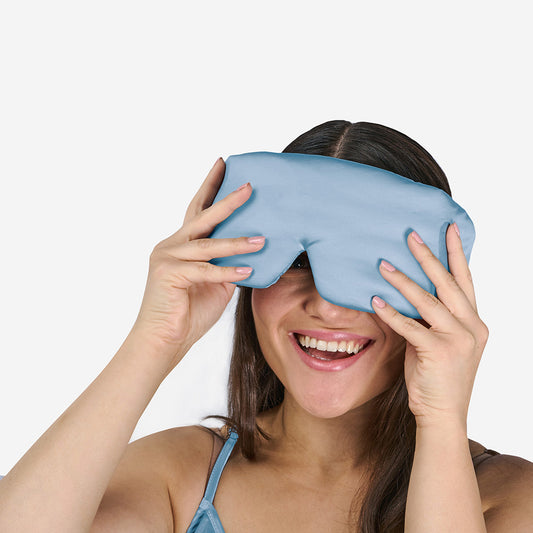
A Hyper-Silk® sleep mask removes that tradeoff. The fabric is smooth and friction-free, so it rests against the skin without dragging or creating the pressure points that a standard fabric mask does. Therefore, for anyone using eye cream or retinol around the eye area, a non-absorbent fabric also means the product stays on the skin rather than transferring to the mask overnight.
What to Look for in a Silk Sleep Mask
Fit and fabric are the two variables that determine whether a sleep mask actually works. A mask that gaps at the edges lets light in and defeats the purpose. A mask that's too tight creates pressure that leaves marks and disrupts circulation. The sweet spot is a contoured fit that blocks light completely without pressing hard against the eyes or creating tension around the head.
The BEDGEAR Hyper-Silk® Sleep Mask is built around both variables. The Hyper-Silk® fabric is smooth against the delicate skin around the eyes; the fit is designed to block light fully without the pressure points that a flat, uncontoured mask creates. For anyone whose sleep quality is affected by light — even ambient, low-level light — it's one of the most direct upgrades available.
Building Your Beauty Sleep Routine
Every section of this guide has pointed at individual variables: friction, moisture, light, temperature, cortisol. This is where they come together. A beauty sleep routine isn't a ten-step process. It's a few deliberate swaps that address each variable systematically, and most of them happen before you even close your eyes.
The products don't need to work in isolation. They're designed to work as a system, and at BEDGEAR, we're here to help you build a personalized sleep system that fits your need.
Start with Your Sleep Surface
The pillowcase is the foundation. Everything else builds on top of it. If your face and hair are pressing against a cotton surface all night, no scrunchie or turban fully compensates for that. The friction-free, breathable sleep surface is the baseline; the rest of the routine layers on top.
The Hyper-Silk® Performance® Pillowcase is that baseline. Friction-free fabric, cool-to-the-touch, non-absorbent, and built to move with you through the night rather than against you. If you make one change from this guide, this is the one.
For anyone who wants to go further, the BEDGEAR Beauty Performance® Pillow takes the surface-level benefits of the pillowcase and builds them into the pillow itself. The ergonomic shape reduces direct facial contact; the Hyper-Silk® cover and Air-X® mesh keep airflow moving so heat doesn't build against your skin. The React™ crown provides conforming support without the pressure that standard pillow construction creates against the face. It's the most complete overnight skin solution in the lineup.

Protect Your Hair Before Bed
Once your sleep surface is sorted, hair protection is the next layer. The approach depends on your hair type; the principle is the same across all of them: reduce friction, retain moisture, minimize mechanical stress.
For most hair types, a Hyper-Silk® scrunchie to secure a loose style is the minimum. It removes the concentrated tension point that standard hair ties create and replaces it with a gentle, friction-free hold. For curly, coily, natural, or longer hair, adding the Hyper-Silk® Turban over the top covers the rest of the surface area that the scrunchie alone doesn't address.
The two-step combination — scrunchie plus turban — is the most complete hair protection routine available without being complicated. It takes about thirty seconds and addresses every friction and moisture variable overnight.
The Full Nighttime Lineup
Put it all together and the routine looks like this: Hyper-Silk® pillowcase on a Beauty Performance® Pillow, hair secured with a Hyper-Silk® scrunchie or wrapped in the Hyper-Silk® Turban, and the Hyper-Silk® Sleep Mask if light is a factor or if protecting the skin around the eyes is a priority.
Each piece does something specific. The pillowcase eliminates surface friction for skin. The pillow reduces facial contact and keeps the surface cool. The scrunchie removes tension and friction from the hair tie point. The turban wraps hair in a friction-free environment for the full night. The sleep mask blocks light and protects the most delicate skin on the face.
None of them require a complicated routine. They replace what you're already doing — sleeping on a pillowcase, tying your hair back, using a sleep mask — with versions that are actually built for the job. That's the whole idea.
Build Your Beauty Sleep Routine with Hyper-Silk®
Friction-free fabric, cooling construction, and every piece of the overnight routine in one collection. Your skin and hair work hard to recover overnight. Give them a surface worth sleeping on.
Frequently Asked Questions About Beauty Sleep
Still have questions about building a beauty sleep routine? Here are the most common ones answered.