Sleep Deprivation and Reaction Time: The Quick Answer
Sleep deprivation slows reaction time, and it does it in two ways; makes sense, right? As your body needs sleep to rest and recover. Your average response gets slower, and you start having lapses, which are moments when you respond way late or miss a signal completely. Both get worse the longer you stay awake and the more short nights you string together.
The good news is that the effect works in reverse too. When researchers have athletes sleep more, reaction times get faster. Therefore, sleep isn't just protecting your reflexes; it's actually one of the few things that can actually sharpen them and give you that competitive edge that you're looking for.
How Researchers Measure Reaction Time
Most sleep studies use a simple tool called the Psychomotor Vigilance Task, or PVT, which is a fancy name for a simple computer test. You stare at a screen for about 10 minutes and hit a button the moment a light or counter appears. It sounds easy, and that's exactly the point. In fact, it purposely strips away skill and strategy, so the only thing being measured is how alert your brain is on game-day.
Typically, researchers count any response slower than 500 milliseconds as a lapse. Simply put, that's half a second, which is a long time when a ball, a car, or a defender is coming at you at full speed. Now, simple as it is, the PVT has become the go-to measure of alertness in sleep research, and that's because it's reliable and measurable.
Why Sleep Lapses Matter More Than Averages
A team at the University of Pennsylvania tested 74 adults through both a full night without sleep and five nights of 4-hour sleep. What they found is very interesting. The team at the University of PA found that lapses and response speed were the most sensitive signs of sleep loss, more than the average reaction time alone (Basner and Dinges, 2011 (opens in a new tab)).
That matches real life pretty well, and this goes beyond athletic ventures. A tired athlete isn't a little slower on every play, and so is a salesman closing a deal. They're mostly fine, but then suddenly a beat late on the one play that matters or hesitant to close a big deal.
What One Bad Night of Sleep Does to Your Reaction Time
At the end of the night, you don't need days of sleep loss to feel it. A long day that runs into the late evening is enough to start dulling your responses, and this applies to even the most stable sleepers beforehand. Below we cover what a few well-known studies found.
In an Australian study of 39 transport workers and army personnel, for example, performance on some tests after 17 to 19 hours awake was equal to or worse than at a 0.05% blood alcohol concentration. What's more, they found that response speeds were up to 50% slower on some tests. After longer stretches awake, performance dropped to the level of a 0.1% blood alcohol concentration (Williamson and Feyer, 2000 (opens in a new tab)).
From there, a driving simulator study found something similar. For lane tracking and speed control, 18.5 and 21 hours awake produced changes about the same size as 0.05% and 0.08% blood alcohol concentrations (Arnedt et al., 2001 (opens in a new tab)). The table below lines up what each study measured.
| Hours Awake | Comparable To | What Was Measured |
|---|---|---|
| 17–19 hours | 0.05% BAC or worse on some tests | Cognitive and motor tests; responses up to 50% slower on some |
| 18.5 hours | 0.05% BAC | Simulated driving: lane tracking and speed variability |
| 21 hours | 0.08% BAC | Simulated driving: lane tracking and speed variability |
| Longer than 19 hours | Up to 0.1% BAC | Cognitive and motor tests |
Sources: Williamson and Feyer, 2000 (n = 39); Arnedt et al., 2001 (n = 18). Alcohol comparisons apply to specific tests, not all measures.
To be fair, sleep loss and alcohol aren't the same thing, and alcohol did more damage on some measures in the driving study, so don't assume your too drunk to drive if you just missed a few hours of sleep. Still, the comparison makes the point clearly, and there really is something to being "punch drunk" after all. In fact, if you've been up since 6 a.m., your reactions at midnight probably aren't what you think they are, and this only gets worse.
Some more bad news: Athletes aren't immune either. In a study of 18 male college athletes, one night without sleep significantly slowed choice reaction time the next morning. Interestingly, their anaerobic power didn't change at all (Taheri and Arabameri, 2012 (opens in a new tab)). In other words, your legs may show up while your reactions stay in bed.
Short Nights Add Up: The Sleep Debt Effect
Most people don't pull all-nighters, and we've found very few people who even want to. Instead, they just sleep 5 or 6 hours a night for weeks at a time. Unfortunately, that pattern turns out to be sneaky bad, because the cost builds quietly in the background.
In a landmark University of Pennsylvania study, 48 healthy adults were limited to 4, 6, or 8 hours in bed for 14 straight days. The 4- and 6-hour groups showed steady, dose-dependent declines on every cognitive test. By the end, sleeping 6 hours or less a night produced deficits equal to up to two full nights without sleep (Van Dongen et al., 2003 (opens in a new tab)).
A Walter Reed Army Institute of Research study looked at the same question from another angle, and it gets much worse. The Walter Reed Army Institute of Research Study gave 66 volunteers 3, 5, 7, or 9 hours in bed for a week, then tracked their PVT speed (Belenky et al., 2003 (opens in a new tab)). In the chat below, we cover how each group fared.
| Time in Bed | During the Week | After 3 Recovery Nights |
|---|---|---|
| 9 hours | Speed and lapses stayed at baseline | Stayed at baseline |
| 7 hours | Speed dipped, then leveled off lower | Still below baseline |
| 5 hours | Speed dropped and lapses increased | Still below baseline |
| 3 hours | Speed fell and lapses rose every day | Improved quickly, but not all the way back |
Source: Belenky et al., 2003 (n = 66). Recovery nights were 8 hours in bed.
Two things jump out right out of the gate. First and foremost, even the 7-hour group slowed down a bit, so "pretty good" sleep may not be enough to keep your sharpest edge. Second, three nights of decent sleep didn't fully undo a week of short ones. If you want a deeper look at why the kind of sleep matters as much as the hours, check out our guide on why sleep quality matters more than sleep quantity.
You Won't Feel It Happening
In most cases, people go about their day without knowing they've been missing out on the quality sleep they need. And here's the part that should make everyone a little nervous: in the Van Dongen study, people's sleepiness ratings jumped at first, then barely moved even as their performance kept falling. Moreover, the researchers noted that subjects were largely unaware of their growing deficits.
For this reason, the whole "I'm used to it" phrase is such a common line from short sleepers. So, at the end of the night, you may get used to feeling tired. However, the data says your reaction time doesn't get used to anything, and that it's probably going to get worse before it gets better if you don't start catching up..
How Much Does Sleep Affect Reaction Time and Thinking?
We went through a lot already, but it gets worse. Reaction time takes the biggest hit when you don't sleep well, but it isn't the only skill on the line. A meta-analysis of 70 studies sorted the effects of short-term sleep deprivation into six thinking skills (Lim and Dinges, 2010 (opens in a new tab)).
Simple attention, the kind the PVT measures, showed the largest effect, especially lapses. Working memory, processing speed, and complex attention also took meaningful hits, so always keep this in mind. Reasoning accuracy showed the smallest effect, which wasn't statistically significant, but that does not mean it does not exist.
Therefore, when you're short on sleep, you can probably still solve a puzzle if you take your time. What suffers is your ability to stay locked in and respond fast, again and again. For an athlete, a driver, or a parent chasing a toddler, that's exactly the skill you need most, and one you can't afford to miss.
Sleep and Reaction Time for Athletes in Sports
When it comes to athletes, reaction time is the gap between seeing the play and making it happen on the field. That's why sports science has taken such a close look at what sleep does to performance, and the most famous example comes from Stanford.
Researchers asked 11 players on Stanford's men's basketball team to aim for at least 10 hours in bed each night for 5 to 7 weeks, just to see what would happen. The players ended up sleeping almost 111 minutes more per night on average. Their PVT reaction times got faster, their sprint time dropped from 16.2 to 15.5 seconds, and both free throw and 3-point percentages improved by about 9% (Mah et al., 2011 (opens in a new tab)). It's a small study, sure, but the results line up with everything else on this list.
And the best part? There's a bigger picture that backs it up. A 2022 review of 69 studies found that sleep loss lowered exercise performance by about 7.6% on average. Performance dropped roughly 0.4% for every hour athletes had been awake before exercising (Craven et al., 2022 (opens in a new tab)).
Slower reactions may carry a physical cost too. A meta-analysis of youth sports found that adolescents who chronically slept poorly had higher odds of injury than those who slept well (Gao et al., 2019 (opens in a new tab)). For more on what happens to your body overnight, read our guide on how sleep affects muscle recovery, or start with the full rundown on how better sleep improves performance. Trust us, the rabbit hole keeps getting deeper the more you look into it.
A.J. Brown: Recovery Is Part of the Job
Pro football receiver A.J. Brown makes his living on split-second reads and explosive cuts. So, it's no surprise that he treats sleep as seriously as his training. Here's how he puts it.
"For me, recovery is part of the job. And having the right mattress and pillows is a big part of my recovery routine. Train Hard. Recover Harder. Sleep better."

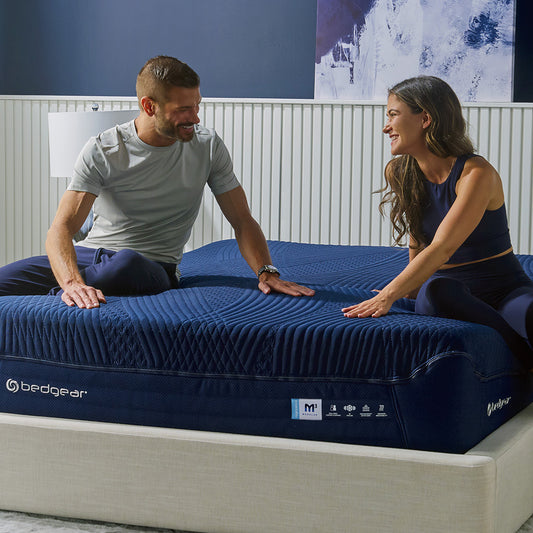
A.J. sleeps on the M3 Night Ice, our cooling, customizable mattress. You can see why we built it for athletes who run hot in our guide to the best mattress for athletes. At the end of the night, we love helping athletes wake up ready to take on the field.
P.J. Washington: Sleep as a Competitive Edge
Dallas Mavericks forward P.J. Washington plays through an 82-game schedule full of late tip-offs and cross-country flights; a real problem for most sleep cycles. For him, consistent recovery is what keeps his game sharp from October to spring.
"As a professional athlete, having a personalized sleep system is crucial to my performance and recovery, and BEDGEAR keeps me at my best. Their Performance® bedding helps me stay cool and sleep deep, so I always wake up feeling recharged and ready to put in the work."

Want to see how he does it? In the video below, P.J. walks through his nightly routine and the setup he sleeps on; this way, you can see if a BEDGEAR sleep system is right for you. Of course, you can also read the full story of how P.J. Washington uses sleep as his secret weapon. We can't touch on this enough.
At the end of the discussion, you can see that both athletes say the same thing in different words. Sleep isn't downtime for them; it's part of the work, recovery, and influences the result on the field and on the court.
Can Extra Sleep Protect Your Reaction Time?
Sometimes short nights are unavoidable, we get it. Whether it's a road trip, a newborn, or a big deadline, things happen out there. That said, you may be wondering, "Is this something I can get ahead of? Well, the research says you can, at least partly, and dive in below. .
In a Walter Reed study, 24 adults spent either 10 hours in bed or their usual amount (about 7 hours) for one week. From there, everyone went through a week of 3-hour nights. Then, the group that had banked extra sleep had fewer PVT lapses during the short nights, and their reaction speed bounced back faster afterward (Rupp et al., 2009 (opens in a new tab)).
That's a useful takeaway before a tournament, a move, or a busy travel week. Front-load your sleep when you can. For a broader look at what actually works, see our breakdown of sleep optimization and what the science actually says. This way, you can make an informed decision.
What About Caffeine?
Caffeine and other stimulants can help you feel more awake when you're short on sleep. That's obvious and well-documented. Still, feeling alert and being alert aren't the same thing, as the Van Dongen study showed. Sure, a stimulant can buy you some time, but it doesn't pay back the sleep debt underneath it all.
For these reasons, if you rely on caffeine, try to keep it earlier in the day so it doesn't cut into tonight's sleep. Also, make sure you just treat it as a bridge, not a plan.
How to Protect Your Reaction Time Tonight
While you may be curious about sleep and reaction time for the love of the game, we bet that you want some actionable insights, right? The good news is that you don't need a pro team's recovery staff to sleep like an athlete. A few consistent habits go a long way. We cover some tips that will help you protect your reaction time starting tonight below.
Aim for 7+ Hours
Treat 7 hours as the floor, not the goal. Athletes in heavy training often need more.
Bank Sleep Early
Sleep longer in the days before a big event, trip, or crunch week.
Keep It Cool and Dark
A cool, dark, quiet room helps your body settle into deeper sleep.
Cut Long Days Short
Reaction time drops the longer you stay awake. Skip the late nights before you need to be sharp.
All that being said, your sleep environment matters too, especially if you run hot after training. Heat and trapped moisture can make it harder to stay asleep. Our guides on the best sleep environment for athletes and your sleep microclimate cover what to look for; this way, you don't wake up all night and ruin everything you try.

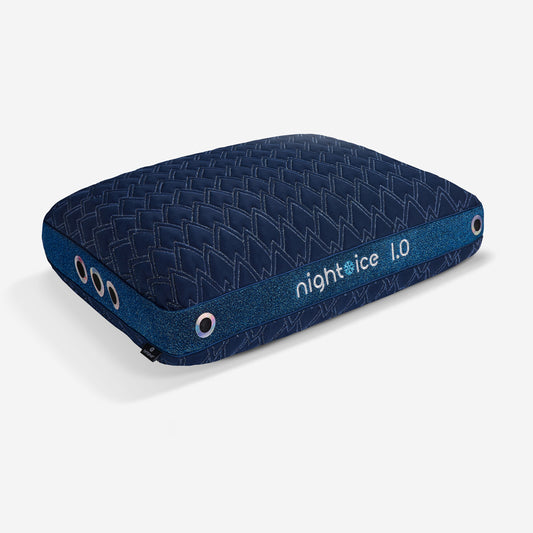
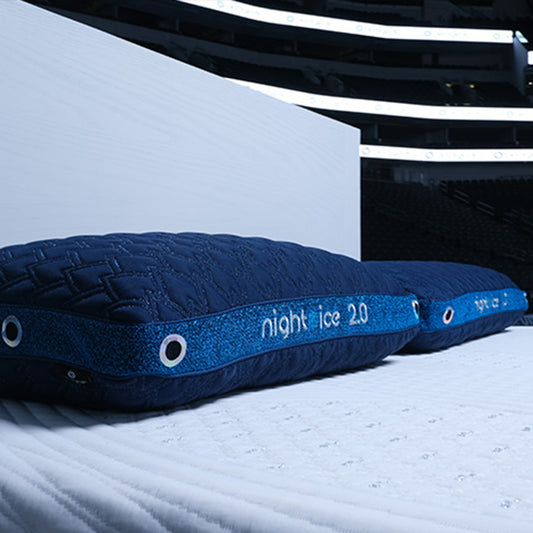
If you want to set up your bed the way A.J. and P.J. do, start with the M3 Night Ice Performance® Mattress and the Night Ice Performance® Pillow. Both are cool to the touch and built to be breathable, so heat doesn't build up around you overnight. Of course, no mattress replaces the hours themselves; the right setup just helps you make the most of them.
Sleep Deprivation and Reaction Time: What You Can Do Today
The research on sleep deprivation and reaction time points the same way every single time. Stay up too long and your responses slow down, sometimes as much as mild alcohol impairment on certain tests. Now, if you string together short nights, the deficit keeps growing and often without you even noticing.
On the flip side, more sleep helps, so no need to panic. Athletes who extended their sleep got faster, and people who banked sleep held up better when the short nights came. At the end of the night, whether you're chasing a starting spot or just a safer drive home, protecting your sleep is one of the simplest ways to protect your reaction time.
Frequently Asked Questions About Sleep and Reaction Time
Sleep and reaction time is a big topic, and we get a lot of questions about this. Below, we offer quick answers to the ones we hear the most.